
Pulp Fiction, 1913 · page 52 of 192
Ainslee's Magazine, February 1913 — page 52: what you’re looking at
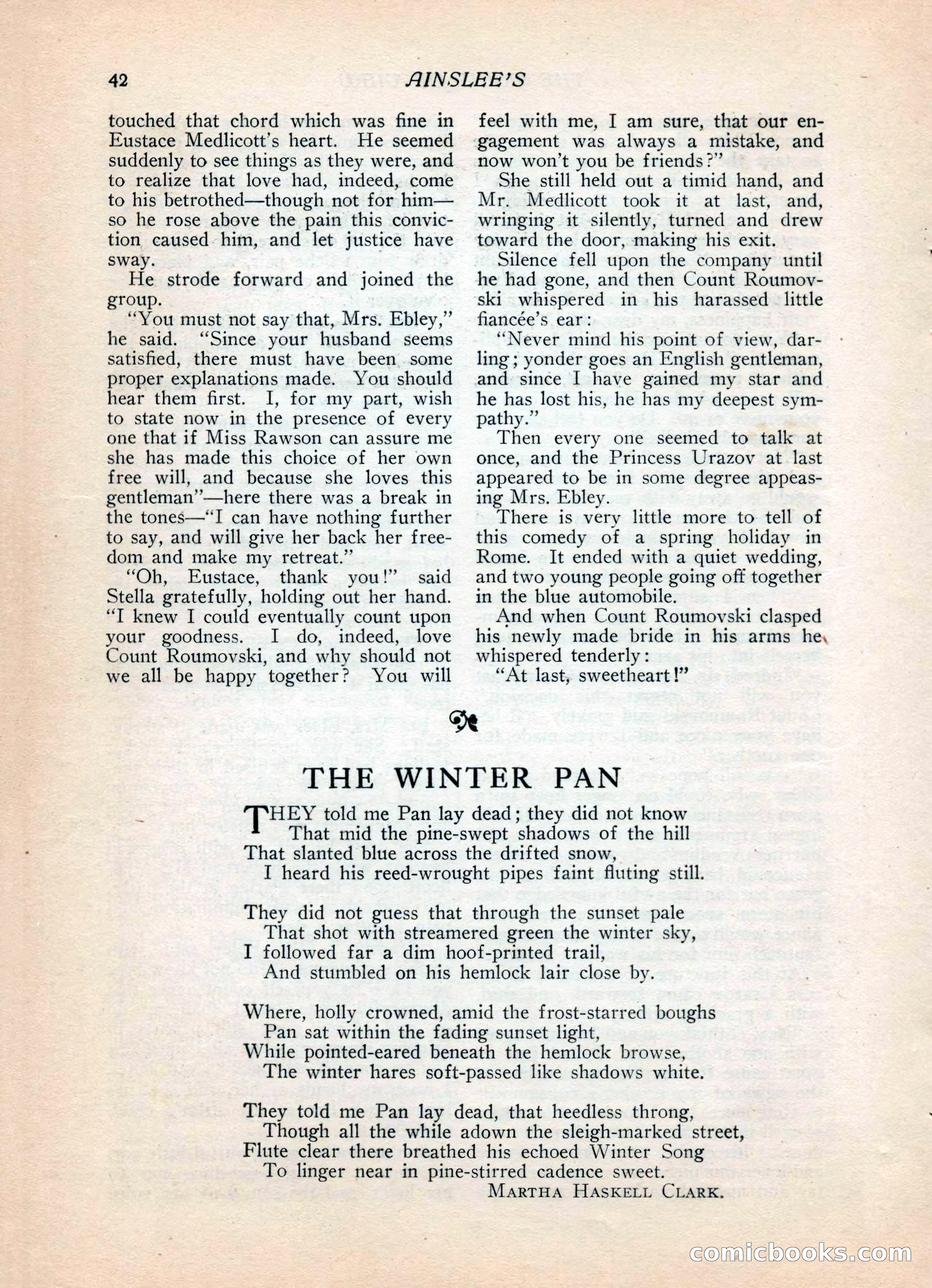
A restored page from Pulp Fiction, 1913. Page through the whole issue in the reader above.
📄 Transcribed text from this page (OCR, searchable)
Machine-transcribed from the original scan — historical spelling and the odd misread are preserved.
42 touched that chord which was fine in Eustace Medlicott’s heart. He seemed suddenly to see things as they were, and to realize that love had, indeed, come to his betrothed—though not for him— so he rose above the pain this convic- tion caused him, and let justice have sway. He strode forward and joined the group. “You must not say that, Mrs. Ebley,” he said. “Since your husband seems satisfied, there must have been some proper explanations made. You should hear them first. I, for my part, wish to state now in the presence of every one that if Miss Rawson can assure me she has made this choice of her own free will, and because she loves this gentleman’’—here there was a break in the tones—‘*I can have nothing further to say, and will give her back her free- dom and make my retreat.” “Oh, Eustace, thank you!” said Stella gratefully, holding out her hand. “T knew I could eventually count upon your goodness. I do, indeed, love Count Roumovski, and why should not we all be happy together? You will AINSLEE’S feel with me, I am sure, that our en- gagement was always a mistake, and now won't you be friends?” She still held out a timid hand, and Mr. Medlicott took it at last, and, wringing it silently, turned and drew toward the door, making his exit. Silence fell upon the company until he had gone, and then Count Roumov- ski whispered in his harassed little flancee’s ear: “Never mind his point of view, dar- ling ; yonder goes an English gentleman, and since [ have gained my star and he has lost his, he has my deepest sym- pathy.” Then every one seemed to talk at once, and the Princess Urazov at last appeared to be in some degree appeas- ing Mrs. Ebley. There is very little more to tell of this comedy of a spring holiday in Rome. It ended with a quiet wedding, and two young people going off together in the blue automobile. And when Count Roumovski clasped his newly made bride in his arms he, whispered tenderly: “At last, sweetheart!” Oe THE WINTER PAN HEY told me Pan lay dead; they did not know That mid the pine-swept shadows of the hill That slanted blue across the drifted snow, I heard his reed-wrought pipes faint fluting still. They did not guess that through the sunset pale That shot with streamered green the winter sky, I followed far a dim hoof-printed trail, And stumbled on his hemlock lair close by. Where, holly crowned, amid the frost-starred boughs Pan sat within the fading sunset light, While pointed-eared beneath the hemlock browse, The winter hares soft-passed like shadows white. They told me Pan lay dead, that heedless throng, Though all the while adown the sleigh-marked street, Flute clear there breathed his echoed Winter Song To linger near in pine-stirred cadence sweet. MartTHA HASKELL CLARK. CONMUCE oO) KK (C@