
Pulp Fiction, 1913 · page 174 of 192
Ainslee's Magazine, February 1913 — page 174: what you’re looking at
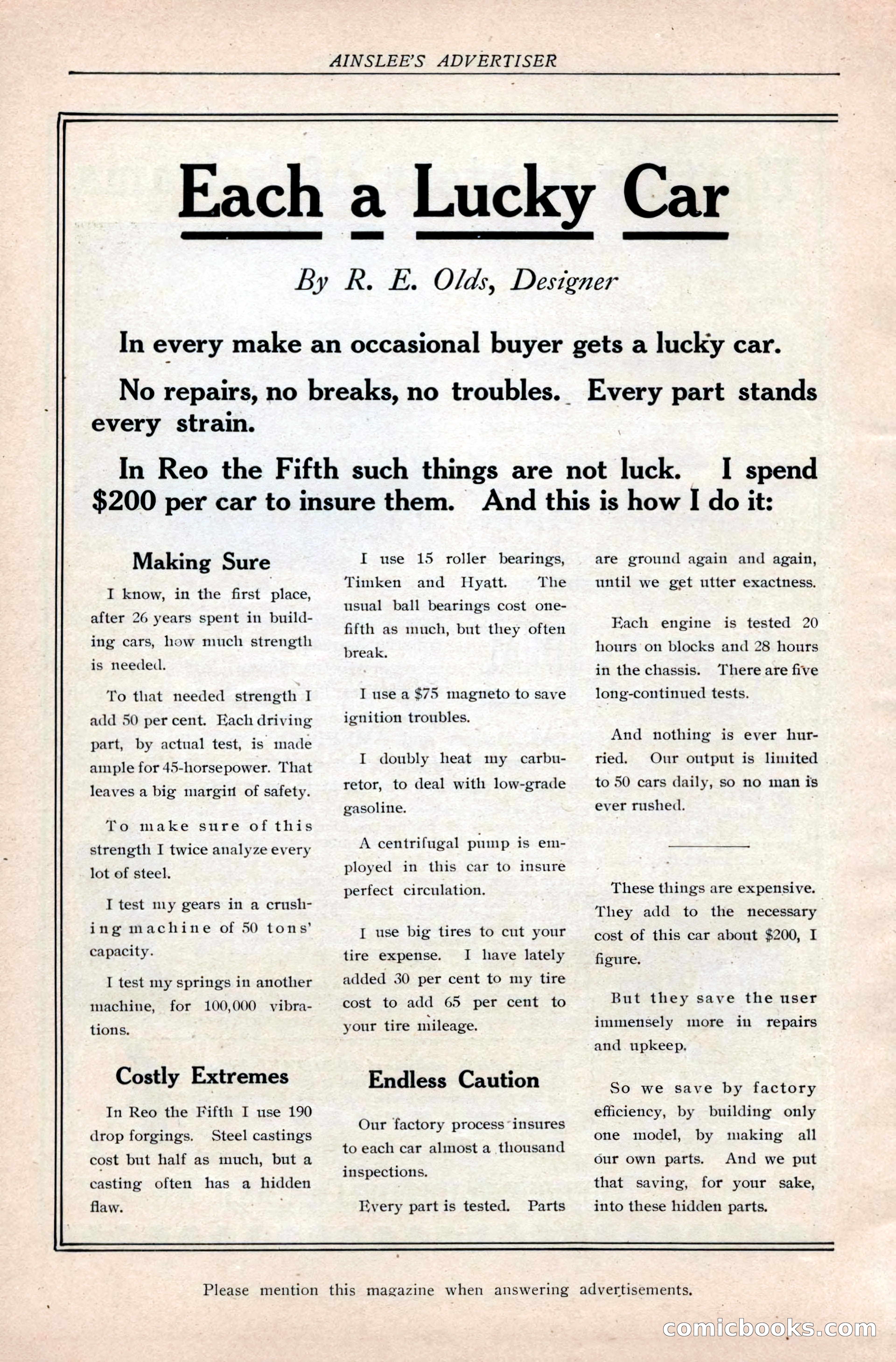
A restored page from Pulp Fiction, 1913. Page through the whole issue in the reader above.
📄 Transcribed text from this page (OCR, searchable)
Machine-transcribed from the original scan — historical spelling and the odd misread are preserved.
Each AINSLEE’S ADVERTISER a Lucky Car By R. E. Olds, Destener In every make an occasional buyer gets a lucky car. No repairs, no breaks, no troubles. every strain. In Reo the Fifth such things are not luck. Every part stands I spend $200 per car to insure them. And this is how I do it: Making Sure I know, in the first place, after 26 years spent in build- ing cars, how much strength is needed. To that needed strength I add 50 percent. Each driving part, by actual test, is made ample for 45-horsepower. That leaves a big margin of safety. To make sure of this strength I twice analyze every lot of steel. I test my gears in a crush- ing machine of 50 tons’ capacity. I test my springs in another machine, for 100,000 vibra- tions. Costly Extremes In Reo the Fifth I use 190 drop forgings. Steel castings cost but half as much, but a casting often has a hidden flaw. I use 15 roller bearings, Timken and Hyatt. The usual ball bearings cost one- fifth as much, but they often break. I use a $75 magneto to save ignition troubles. I doubly heat my carbu- retor, to deal with low-grade gasoline. A centrifugal pump is em- ployed in this car to insure perfect circulation. I use big tires to cut your tire expense. I have lately added 30 per cent to my tire cost to add 65 per cent to your tire mileage. Endless Caution Our factory process “insures to each car almost a thousand inspections. Every partis tested. Parts are ground again and again, until we get utter exactness. Each engine is tested 20 hours on blocks and 28 hours in the chassis. There are five long-continued tests. And nothing is ever hur- ried. Our output is limited to 50 cars daily, so no man is ever rushed. These things are expensive. They add to the necessary cost of this car about $200, I figure. But they save the user immensely more in repairs and upkeep. So we save by factory efficiency, by building only one model, by making all our own parts. And we put that saving, for your sake, into these hidden parts. Please mention this magazine when answering advertisements. (C@) Connicloao|k