
Pulp Fiction, 1913 · page 167 of 192
Ainslee's Magazine, February 1913 — page 167: what you’re looking at
A restored page from Pulp Fiction, 1913. Page through the whole issue in the reader above.
📄 Transcribed text from this page (OCR, searchable)
Machine-transcribed from the original scan — historical spelling and the odd misread are preserved.
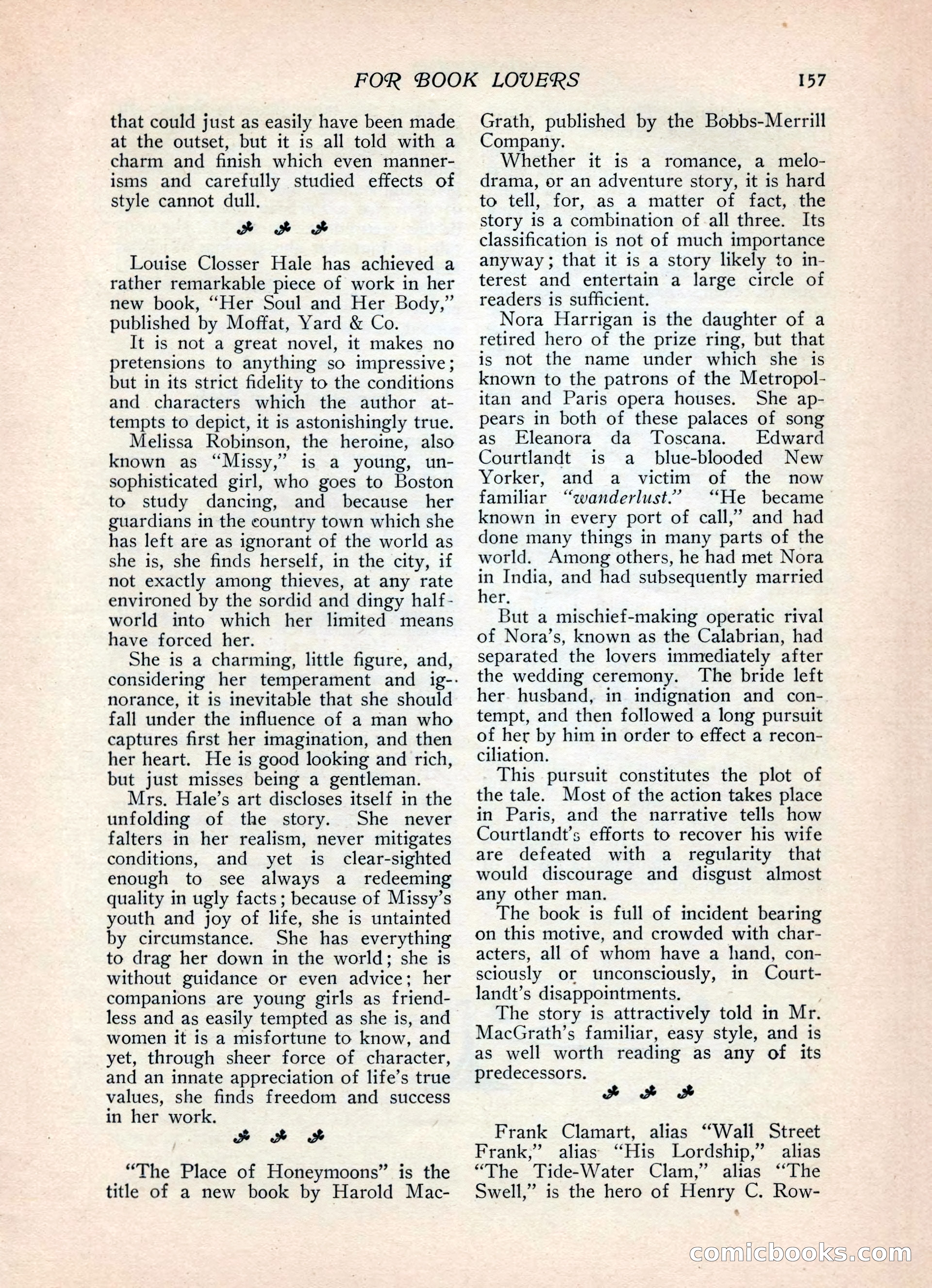
FOR BOOK LOVERS that could just as easily have been made at the outset, but it is all told with a charm and finish which even manner- isms and carefully studied effects of style cannot dull. eH e Louise Closser Hale has achieved a rather remarkable piece of work in her new book, “Her Soul and Her Body,” published by Moffat, Yard & Co. It is not a great novel, it makes no pretensions to anything so impressive; but in its strict fidelity to the conditions and characters which the author at- tempts to depict, it is astonishingly true. Melissa Robinson, the heroine, also known as “Missy,” is a young, un- sophisticated girl, who goes to Boston to study dancing, and because her guardians in the eountry town which she has left are as ignorant of the world as she is, she finds herself, in the city, if not exactly among thieves, at any rate environed by the sordid and dingy half- world into which her limited means have forced her. She is a charming, little figure, and, considering her temperament and ig-. norance, it is inevitable that she should fall under the influence of a man who captures first her imagination, and then her heart. He is good looking and rich, but just misses being a gentleman. Mrs. Hale’s art discloses itself in the unfolding of the story. She never falters in her realism, never mitigates conditions, and yet is_ clear-sighted enough to see always a_ redeeming quality in ugly facts; because of Missy’s youth and joy of life, she is untainted by circumstance. She has everything to drag her down in the world; she is without guidance or even advice; her companions are young girls as friend- less and as easily tempted as she is, and women it is a misfortune to know, and yet, through sheer force of character, and an innate appreciation of life’s true values, she finds freedom and success in her work. oe “The Place of Honeymoons” is the title of a new book by Harold Mac- 157 Grath, published by the Bobbs-Merrill Company. Whether it is a romance, a melo- drama, or an adventure story, it is hard to tell, for, as a matter of fact, the story is a combination of all three. Its classification is not of much importance anyway; that it is a story likely to in- terest and entertain a large circle of readers is sufficient. Nora Harrigan is the daughter of a retired hero of the prize ring, but that is not the name under which she is known to the patrons of the Metropol- itan and Paris opera houses. She ap- pears in both of these palaces of song as Eleanora da Toscana. Edward Courtlandt is a _blue-blooded New Yorker, and a victim of the now familiar “wanderlust.’ “He became known in every port of call,” and had done many things in many parts of the world. Among others, he had met Nora in India, and had subsequently married her. But a mischief-making operatic rival of Nora’s, known as the Calabrian, had separated the lovers immediately after the wedding ceremony. ‘The bride left her. husband, in indignation and con- tempt, and then followed a long pursuit of her by him in order to effect a recon- ciliation. This pursuit constitutes the plot of the tale. Most of the action takes place in Paris, and the narrative tells how Courtlandt’s efforts to recover his wife are defeated with a regularity that would discourage and disgust almost any other man. The book is full of incident bearing on this motive, and crowded with char- acters, all of whom have a hand, con- sciously or unconsciously, in Court- landt’s disappointments. The story is attractively told in Mr. MacGrath’s familiar, easy style, and is as well worth reading as any of its predecessors. ~*~ & & Frank Clamart, alias “Wall Street Frank,” alias “His Lordship,” alias “The Tide-Water Clam,” alas “The Swell,” is the hero of Henry C. Row- EO ANUC NOOK (C@