
Pulp Fiction, 1913 · page 164 of 192
Ainslee's Magazine, February 1913 — page 164: what you’re looking at
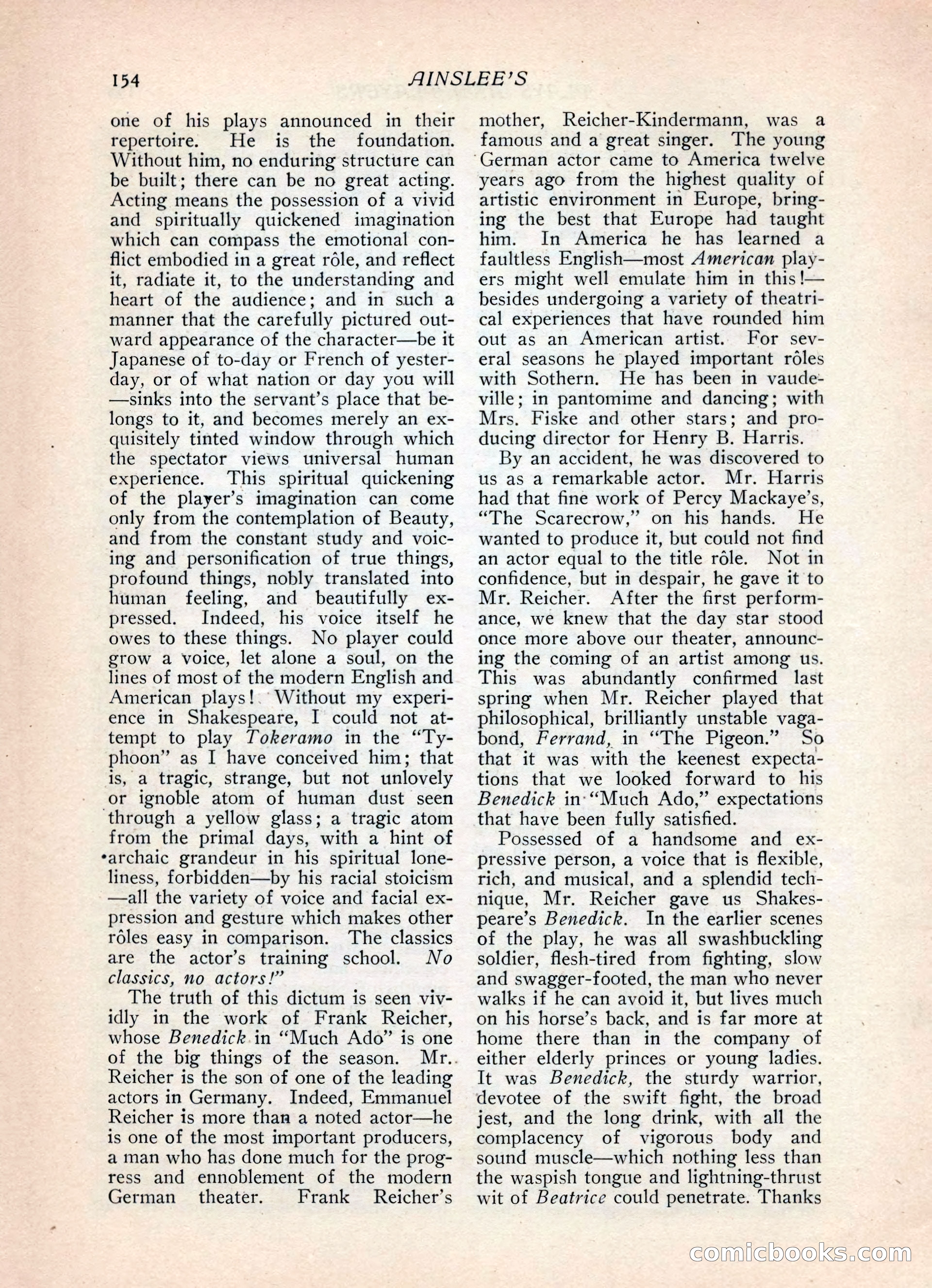
A restored page from Pulp Fiction, 1913. Page through the whole issue in the reader above.
📄 Transcribed text from this page (OCR, searchable)
Machine-transcribed from the original scan — historical spelling and the odd misread are preserved.
154 one of his plays announced in their repertoire. He is the foundation. Without him, no enduring structure can be built; there can be no great acting. Acting means the possession of a vivid and spiritually quickened imagination which can compass the emotional con- flict embodied in a great role, and reflect it, radiate it, to the understanding and heart of the audience; and in such a manner that the carefully pictured out- ward appearance of the character—he it Japanese of to-day or French of yester- day, or of what nation or day you will —sinks into the servant’s place that be- longs to it, and becomes merely an ex- quisitely tinted window through which the spectator views universal human experience. This spiritual quickening of the player’s imagination can come only from the contemplation of Beauty, and from the constant study and voic- ing and personification of true things, profound things, nobly translated into human feeling, and beautifully ex- pressed. Indeed, his voice itself he owes to these things. No player could grow a voice, let alone a soul, on the lines of most of the modern English and American plays!. Without my experi- ence in Shakespeare, I could not at- tempt to play Tokeramo in the “Ty- phoon” as I have conceived him; that is, a tragic, strange, but not unlovely or ignoble atom of human dust seen ‘through a yellow glass; a tragic atom from the primal days, with a hint of earchaic grandeur in his spiritual lone- liness, forbidden—by his racial stoicism —all the variety of voice and facial ex- pression and gesture which makes other roles easy in comparison. The classics are the actor’s training school. No classics, no actors!” The truth of this dictum is seen viv- idly in the work of Frank Reicher, whose Benedick.in “Much Ado” is one of the big things of the season. Reicher is the son of one of the leading actors in Germany. Indeed, Emmanuel Reicher is more than a noted actor—he is one of the most important producers, a man who has done much for the prog- ress and ennoblement of the modern German theater. Frank Reicher’s Mr.. AINSLEE’S mother, Reicher-Kindermann, was a famous and a great singer. The young ‘German actor came to America twelve years ago from the highest quality of artistic environment in Europe, bring- ing the best that Europe had taught him. In America he has learned a faultless English—most American play- ers might well emulate him in this !— besides undergoing a variety of theatri- cal experiences that have rounded him out as an American artist. For sev- eral seasons he played important roles with Sothern. He has been in vaude- ville; in pantomime and dancing; with Mrs. Fiske and other stars; and pro- ducing director for Henry B. Harris. By an accident, he was discovered to us as a remarkable actor. Mr. Harris had that fine work of Percy Mackaye’s, “The Scarecrow,” on his hands. He wanted to produce it, but could not find an actor equal to the title role. Not in confidence, but in despair, he gave it to Mr. Reicher. After the first perform- ance, we knew that the day star stood once more above our theater, announc- ing the coming of an artist among us. This was abundantly confirmed last spring when Mr. Reicher played that philosophical, brilliantly unstable vaga- bond, Ferrand, in “The Pigeon.” So that it was with the keenest expecta- tions that we looked forward to his Benedick in: “Much Ado,” expectations that have been fully satisfied. Possessed of a handsome and ex- pressive person, a voice that is flexible, rich, and musical, and a splendid tech- nique, Mr. Reicher gave us Shakes- peare’s Benedick. In the earlier scenes of the play, he was all swashbuckling soldier, flesh-tired from fighting, slow and swagger-footed, the man who never walks if he can avoid it, but lives much on his horse’s back, and is far more at home there than in the company of either elderly princes or young ladies. It was Benedick, the sturdy warrior, devotee of the swift fight, the broad jest, and the long drink, with all the complacency of vigorous body and sound muscle—which nothing less than the waspish tongue and lightning-thrust wit of Beatrice could penetrate. Thanks COMMICLOO S (C@ im