
Pulp Fiction, 1913 · page 161 of 192
Ainslee's Magazine, February 1913 — page 161: what you’re looking at
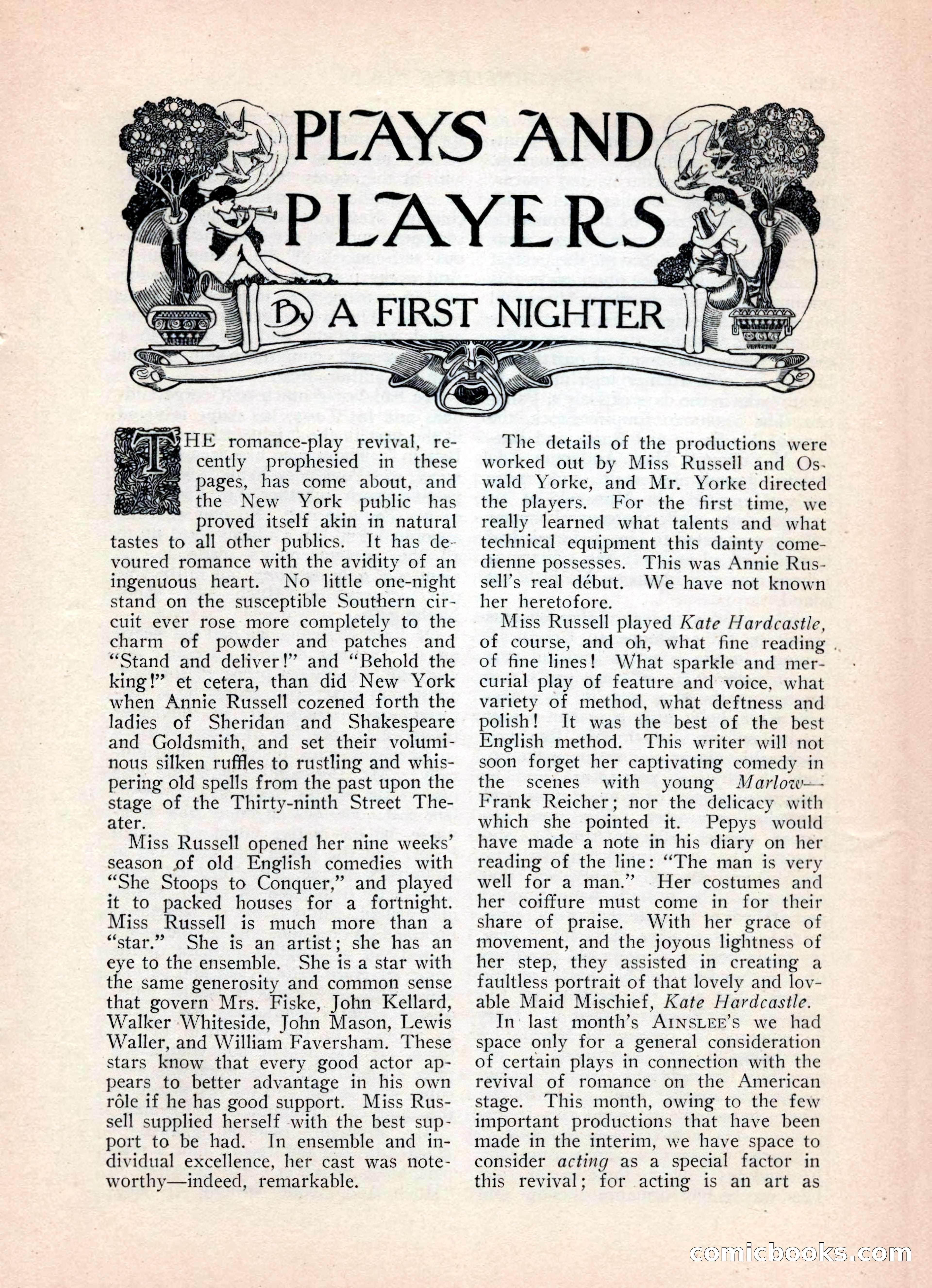
A restored page from Pulp Fiction, 1913. Page through the whole issue in the reader above.
📄 Transcribed text from this page (OCR, searchable)
Machine-transcribed from the original scan — historical spelling and the odd misread are preserved.
MWaloy HE romance-play revival, re- re. cently prophesied in these pages, has come about, and the New York public has proved itself akin in natural tastes to all other publics. It has de- voured romance with the avidity of an ingenuous heart. No little one-night stand on the susceptible Southern cir- cuit ever rose more completely to the charm of powder and patches and “Stand and deliver!” and “Behold the king!” et cetera, than did New York when Annie Russell cozened forth the ladies of Sheridan and Shakespeare and Goldsmith, and set their volumi- nous silken ruffles to rustling and whis- pering old spells from the past upon the stage of the Thirty-ninth Street The- ater. Miss Russell opened her nine weeks’ season of old English comedies with “She Stoops to Conquer,” and played it to packed houses for a fortnight. Miss Russell is much more than a “star.” She is an. artist; she has an eye to the ensemble. She is a star with the same generosity and common sense that govern Mrs. Fiske, John Kellard, Walker Whiteside, John Mason, Lewis Waller, and William Faversham. These stars know that every good actor ap- pears to better advantage in his own role if he has good support. Miss Rus- sell supplied herself with the best sup- port to be had. In ensemble and in- dividual excellence, her cast was note- worthy—indeed, remarkable. The details of the productions were worked out by Miss Russell and Os. wald Yorke, and Mr. Yorke directed the players. For the first time, we really learned what talents and what technical equipment this dainty come- dienne possesses. This was Annie Rus- sell’s real début. We have not known her heretofore. Miss Russell played Kate Hardcastle, of course, and oh, what fine reading . of fine lines!’ What sparkle and mer- curial play of feature and voice, what variety of method, what deftness and polish! It was the best of the best English method. This writer will not soon forget her captivating comedy in the scenes with young Marlow— Frank Reicher; nor the delicacy with which she pointed it. Pepys would have made a note in his diary on her reading of the line: “The man is very well for a man.” -Her costumes and her coiffure must come in for their share of praise. With her grace of movement, and the joyous lightness of her step, they assisted in creating a faultless portrait of that lovely and lov- able Maid Mischief, Kate Hardcastle. In last month’s AINSLEE’s we had space only for a general consideration of certain plays in connection with the revival of romance on the American stage. This month, owing to the few important productions that have been made in the interim, we have space to consider acting as a special factor in this revival; for acting is an art as (C@ DOOLK (C@ im