
Pulp Fiction, 1913 · page 16 of 192
Ainslee's Magazine, February 1913 — page 16: what you’re looking at
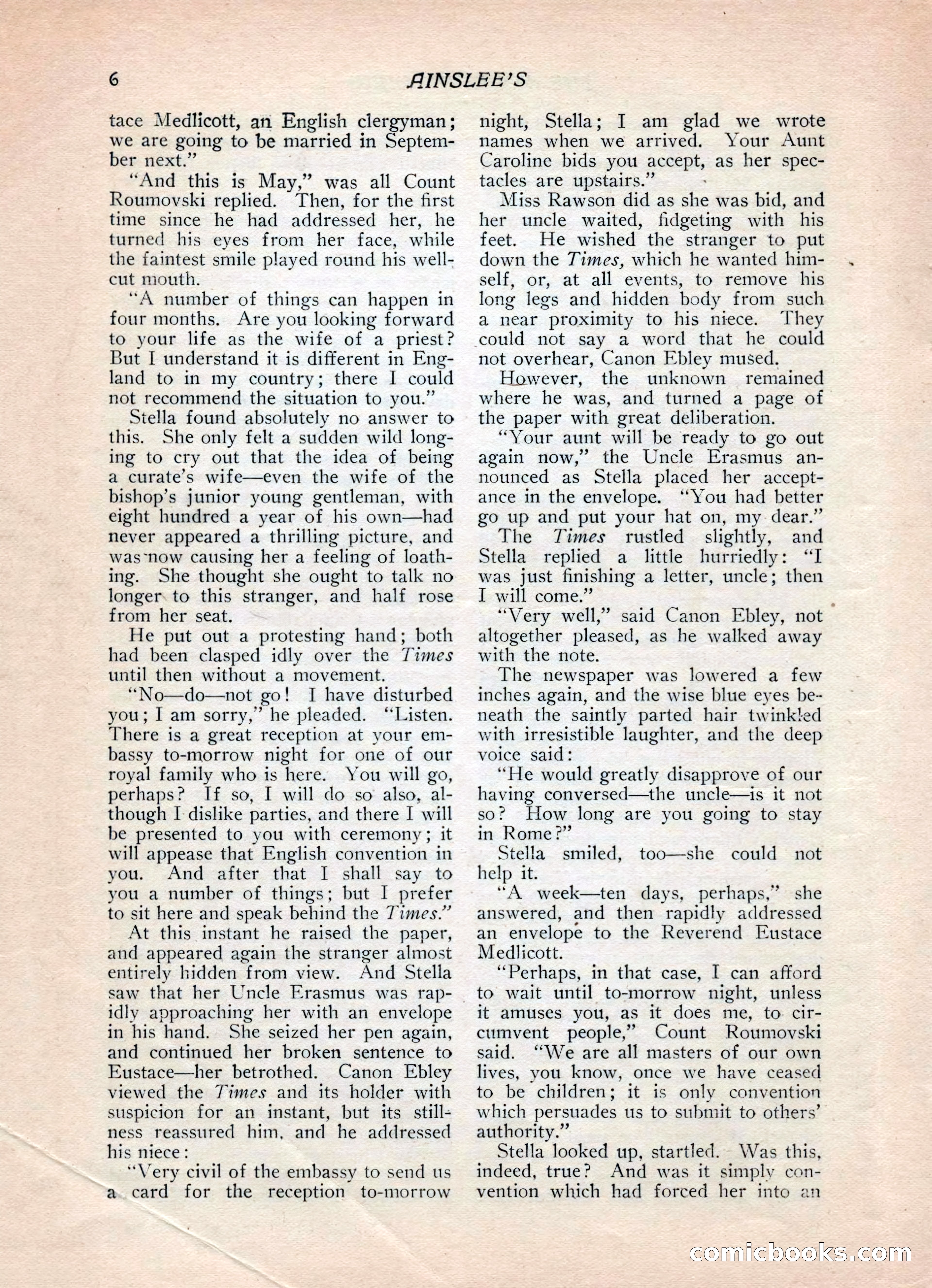
A restored page from Pulp Fiction, 1913. Page through the whole issue in the reader above.
📄 Transcribed text from this page (OCR, searchable)
Machine-transcribed from the original scan — historical spelling and the odd misread are preserved.
6 AINSLEE’S tace Medlicott, an English clergyman; we are going to be married in Septem- ber next.” “And this is May,” was all Count Roumovski replied. Then, for the first time since he had addressed her, he turned his eyes from her face, while the faintest smile played round his well- cut mouth. “A number of things can happen in four months. Are you looking forward to your life as the wife of a priest? But I understand it is different in Eng- land to in my country; there I could not recommend the situation to you.” Stella found absolutely no answer to this. She only felt a sudden wild long- ing to cry out that the idea of being a curate’s wife—even the wife of the bishop’s junior young gentleman, with eight hundred a year of his own—had never appeared a thrilling picture, and was-now causing her a feeling of loath- ing. She thought she ought to talk no longer. to this stranger, and half rose from her seat. He put out a protesting hand; both had been clasped idly over the Times until then without a movement. ‘“‘No—do—not go! I have disturbed you; I am sorry,” he pleaded. “Listen. There is a great reception at your em- bassy to-morrow night for one of our royal family who is here. You will go, perhaps? If so, I will do so also, al- though I dislike parties, and there I will be presented to you with ceremony; it will appease that English convention in you. And after that I shall say to you a number of things; but I prefer to sit here and speak behind the Times.” At this instant he raised the paper, and appeared again the stranger almost entirely hidden from view. And Stella saw that her Uncle Erasmus was rap- | idly approaching her with an envelope in his hand. She seized her pen again, and continued her broken sentence to Eustace—her betrothed. Canon Ebley viewed the 7imes and its holder with suspicion for an instant, but its still- ness reassured him, and he addressed his niece: “Very civil of the embassy to send us a card for the reception to-morrow night, Stella; I am glad we wrote names when we arrived. Your Aunt Caroline bids you accept, as her spec- tacles are upstairs.” Miss Rawson did as she was bid, and her uncle waited, fidgeting with his feet. He wished the stranger to put down the Times, which he wanted him- self, or, at all events, to remove his long legs and hidden body from such a near proximity to his niece. They could not say a word that he could not overhear, Canon Ebley mused. However, the unknown remained where he was, and turned a page of the paper with great deliberation. “Your aunt will be ready to go out again now,’ the Uncle Erasmus an- nounced as Stella placed her accept- ance in the envelope. ‘You had better go up and put your hat on, my dear.” The Times rustled slightly, and Stella replied a little hurriedly: “I was just finishing a letter, uncle; then I will come.” “Very well,” said Canon Ebley, not — altogether pleased, as he walked away with the note. The newspaper was lowered a few inches again, and the wise blue eyes be- neath the saintly parted hair twinkled with irresistible laughter, and the deep voice said: ‘He would greatly disapprove of our having conversed—the uncle—is it not so? How long are you going to stay in Rome?” Stella smiled, help it. “A week—ten days, perhaps,’ she answered, and then rapidly addressed an envelope to the Reverend Eustace Medlicott. “Perhaps, in that case, I can afford to wait until to-morrow night, unless it amuses you, as it does me, to cir- cumvent people,” Count Roumovski said. ‘We are all masters of our own lives, you know, once we have ceased to be children; it is only convention which persuades us to submit to others’ authority.” Stella looked up, startled. Was this, indeed, true? And was it simply con- vention which had forced her into an too—she could not COLMUCE Ook (©)