
Pulp Fiction, 1913 · page 147 of 192
Ainslee's Magazine, February 1913 — page 147: what you’re looking at
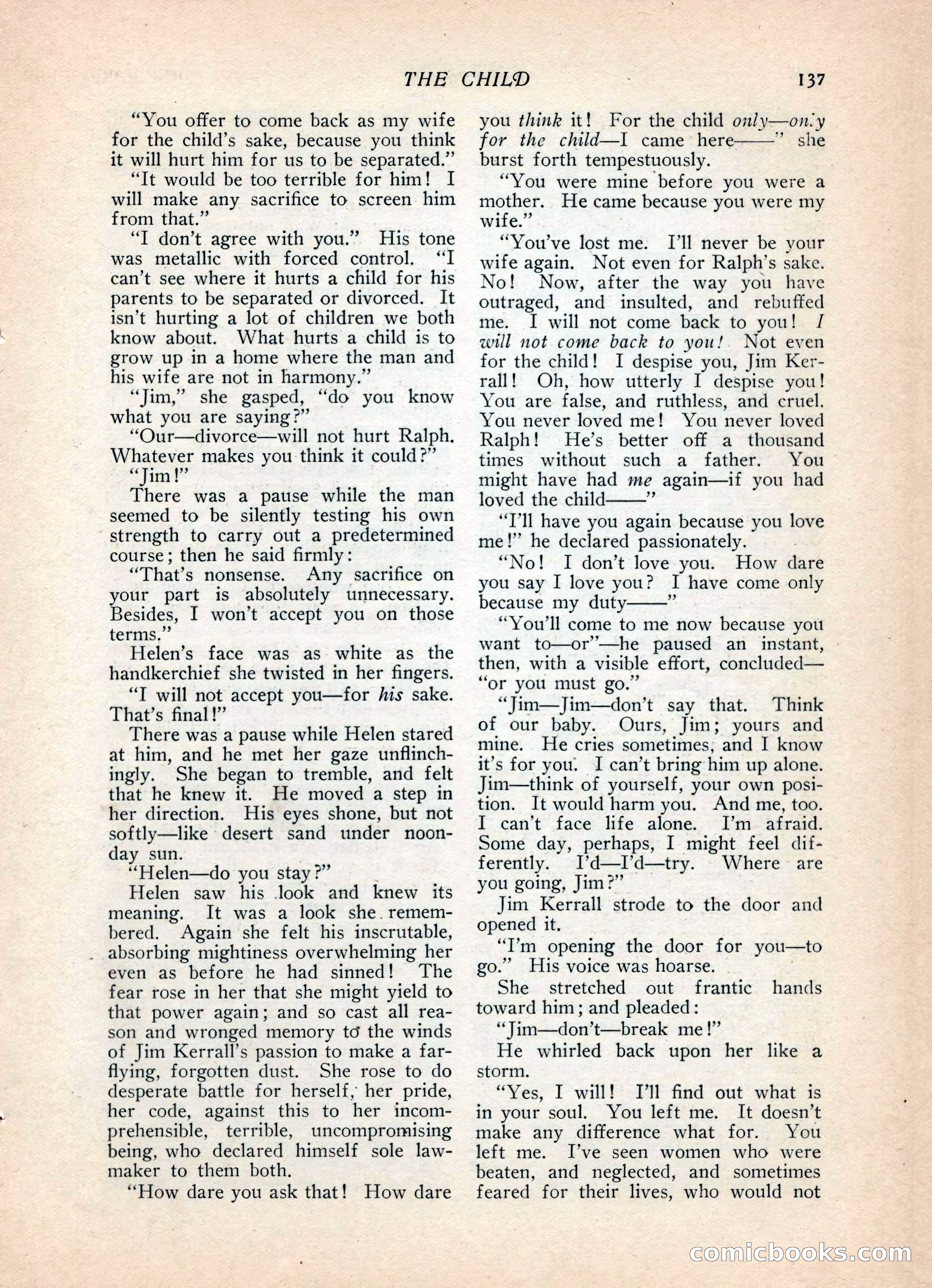
A restored page from Pulp Fiction, 1913. Page through the whole issue in the reader above.
📄 Transcribed text from this page (OCR, searchable)
Machine-transcribed from the original scan — historical spelling and the odd misread are preserved.
THE CHILD “You offer to come back as my wife for the child’s sake, because you think it will hurt him for us to be separated.” “It would be too terrible for him! [I will make any sacrifice to screen him from that.” “I don’t agree with you.” His tone was metallic with forced control. “I can’t see where it hurts a child for his parents to be separated or divorced. It isn’t hurting a lot of children we both know about. What hurts a child is to grow up in a home where the man and his wife are not in harmony.” “Jim,” she gasped, “do you know what you are saying?” “Our—divorce—will not hurt Ralph. Whatever makes you think it could?” “Jim v? There was a pause while the man seemed to be silently testing his own strength to carry out a predetermined course; then he said firmly: “That’s nonsense. Any sacrifice on your part is absolutely unnecessary. Besides, I won’t accept you on those terms.” Helen’s face was as white as the handkerchief she twisted in her fingers. “T will not accept you—for his sake. That’s final!” There was a pause while Helen stared at him, and he met her gaze unflinch- ingly. She began to tremble, and felt that he knew it. He moved a step in her direction. His eyes shone, but not softly—like desert sand under noon- day sun. ‘““Helen—do you stay ?” Helen saw his look and knew its meaning. It was a look she. remem- bered. Again she felt his inscrutable, _ absorbing mightiness overwhelming her even as before he had sinned! The fear rose in her that she might yield to that power again; and so cast all rea- son and wronged memory tod the winds of Jim Kerrall’s passion to make a far- flying, forgotten dust. She rose to do desperate battle for herself, her pride, her code, against this to her incom- prehensible, terrible, uncompromising being, who declared himself sole law- maker to them both. “How dare you ask that! How dare 137 you think it! For the child only—on-y for the child—I came here ” she burst forth tempestuously. “You were mine before you were a mother. He came because you were my wite.” “You've lost me. I'll never be your wife again. Not even for Ralph's sake. No! Now, after the way you have outraged, and insulted, and rebuffed me. I will not come back to you! J will not come back to you!. Not even for the child! I despise you, Jim Ker- rall! Oh, how utterly I despise you! You are false, and ruthless, and cruel. You never loved me! You never loved Ralph! He’s better off a thousand times without such a father. You might have had me again—if you had loved the child “T’ll have you again because you love me!” he declared passionately. “No! I don’t love you. How dare you say I love you? I have come only because my duty ¥s “You'll come to me now because you want to—or’’—he paused an instant, then, with a visible effort, concluded— “or you must go.” “Jim—Jim—don’t say that. Think of our baby. Ours, Jim; yours and mine. He cries sometimes; and I know it’s for you. I can’t bring him up alone. Jim—think of yourself, your own posi- tion. It would harm you. And me, too. I can't .face life alone. I’m- afraid. Some day, perhaps, I might feel dif- ferently. [’d—I’d—try. Where are you going, Jim?” Jim Kerrall strode to the door and opened it. “I’m opening the door for you—to go.” His voice was hoarse. stretched out frantic She hands toward him; and pleaded: ‘“‘Jim—don’t—break me!” He whirled back upon her like a storm. “Ves, I will! Il find out what is in your soul. You left me. It doesn’t make any difference what for. You left me. I’ve seen women who were beaten, and neglected, and sometimes feared for their lives, who would not (C@ ANUC NOOK (C@