
Pulp Fiction, 1913 · page 129 of 192
Ainslee's Magazine, February 1913 — page 129: what you’re looking at
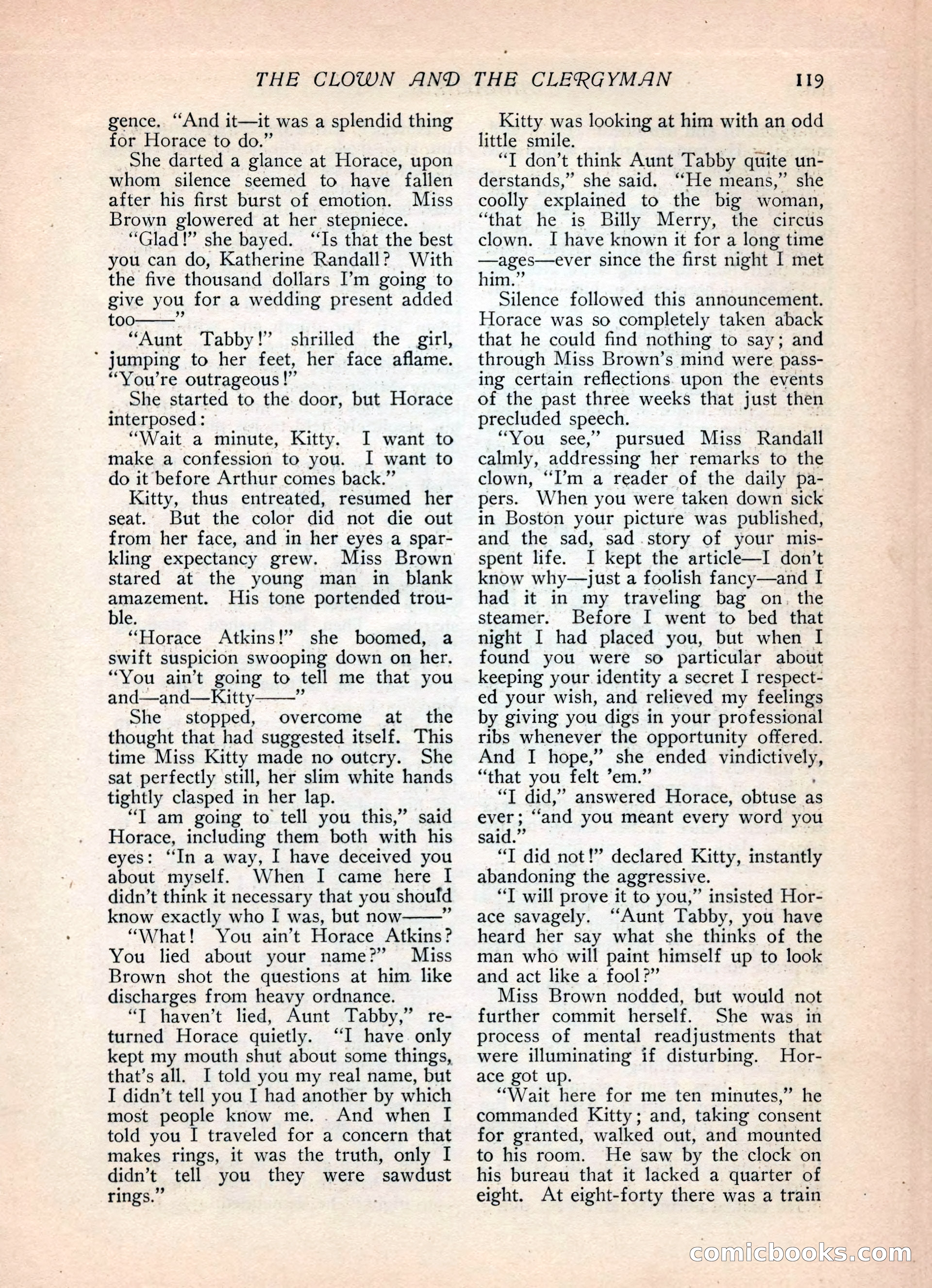
A restored page from Pulp Fiction, 1913. Page through the whole issue in the reader above.
📄 Transcribed text from this page (OCR, searchable)
Machine-transcribed from the original scan — historical spelling and the odd misread are preserved.
THE CLOWN AND gence. “And it—it was a splendid thing for Horace to do.” She darted a glance at Horace, upon whom silence seemed to have fallen after his first burst of emotion. Miss Brown glowered at her stepniece. “Glad!” she bayed. “Is that the best you can do, Katherine Randall? With the five thousand dollars I’m going to give you for a wedding present added too “Aunt Tabby!’ shrilled the girl, * jumping to her feet, her face aflame. “You’re outrageous !” She started to the door, but Horace interposed: “Wait a minute, Kitty. I want to make a confession to you. I want to do it before Arthur comes back.” Kitty, thus entreated, resumed her seat. But the color did not die out from her face, and in her eyes a spar- kling expectancy grew. Miss Brown stared at the young man in blank amazement. His tone portended trou- ble. “Horace Atkins!’ she boomed, a swift suspicion swooping down on her. “You ain’t going to tell me that you and—and—Kitty She stopped, overcome at the thought that had suggested itself. This time Miss Kitty made no outcry. She sat perfectly still, her slim white hands tightly clasped in her lap. “T am going to tell you this,” said Horace, including them both with his eyes: “In a way, I have deceived you about myself. When I came here | didn’t think it necessary that you should know exactly who I was, but now % “What! You ain’t Horace Atkins? You lied about your name?” Miss Brown shot the questions at him like discharges from heavy ordnance. “T haven’t lied, Aunt Tabby,” re- turned Horace quietly. “I have. only kept my mouth shut about some things, that’s all. I told you my real name, but I didn’t tell you I had another by which most people know me. . And when I told you I traveled for a concern that makes rings, it was the truth, only I didn’t tell you they were sawdust rings.” THE CLERGYMAN 119 Kitty was looking at him with an odd little smile. | “T don’t think Aunt Tabby quite un- derstands,” she said. “He means,” she coolly explained to the big woman, “that he is Billy Merry, the circus clown. I have known it for a long time —ages—ever since the first night | met him.” Silence followed this announcement. Horace was so completely taken aback that he could find nothing to say; and through Miss Brown’s mind were pass- ing certain reflections. upon the events of the past three weeks that just then precluded speech. “You see,” pursued Miss Randall calmly, addressing her remarks to the clown, “I’m a reader of the daily pa- pers. When you were taken down sick in Boston your picture was published, and the sad, sad story of your mis- spent life. I kept the article—I don’t know why—just a foolish fancy—and I had it in my traveling bag on. the steamer. Before I went to bed that night I had placed you, but when I found you were so particular about keeping your identity a secret I respect- ed your wish, and relieved my feelings by giving you digs in your professional ribs whenever the opportunity offered. And I hope,” she | ended vindigeeye “that you felt ’em.’ ak did,” . Horace, obtuse as “and you meant every word you “T did not!” declared Kitty, instantly abandoning the aggressive. “T will prove it to you,” insisted Hor- ace savagely. “Aunt Tabby, you have heard her say what she thinks of the man who will paint himself up to look and act like a fool?” Miss Brown nodded, but would not further commit herself. She was in process of mental readjustments that were illuminating if disturbing. Hor- ace got up. “Wait here for me ten minutes,” he commanded Kitty; and, taking consent for granted, walked out, and mounted to his room. He saw by the clock on his bureau that it lacked a quarter of eight. At eight-forty there was a train Com G VOOLK (C@