
Pulp Fiction, 1913 · page 126 of 192
Ainslee's Magazine, February 1913 — page 126: what you’re looking at
A restored page from Pulp Fiction, 1913. Page through the whole issue in the reader above.
📄 Transcribed text from this page (OCR, searchable)
Machine-transcribed from the original scan — historical spelling and the odd misread are preserved.
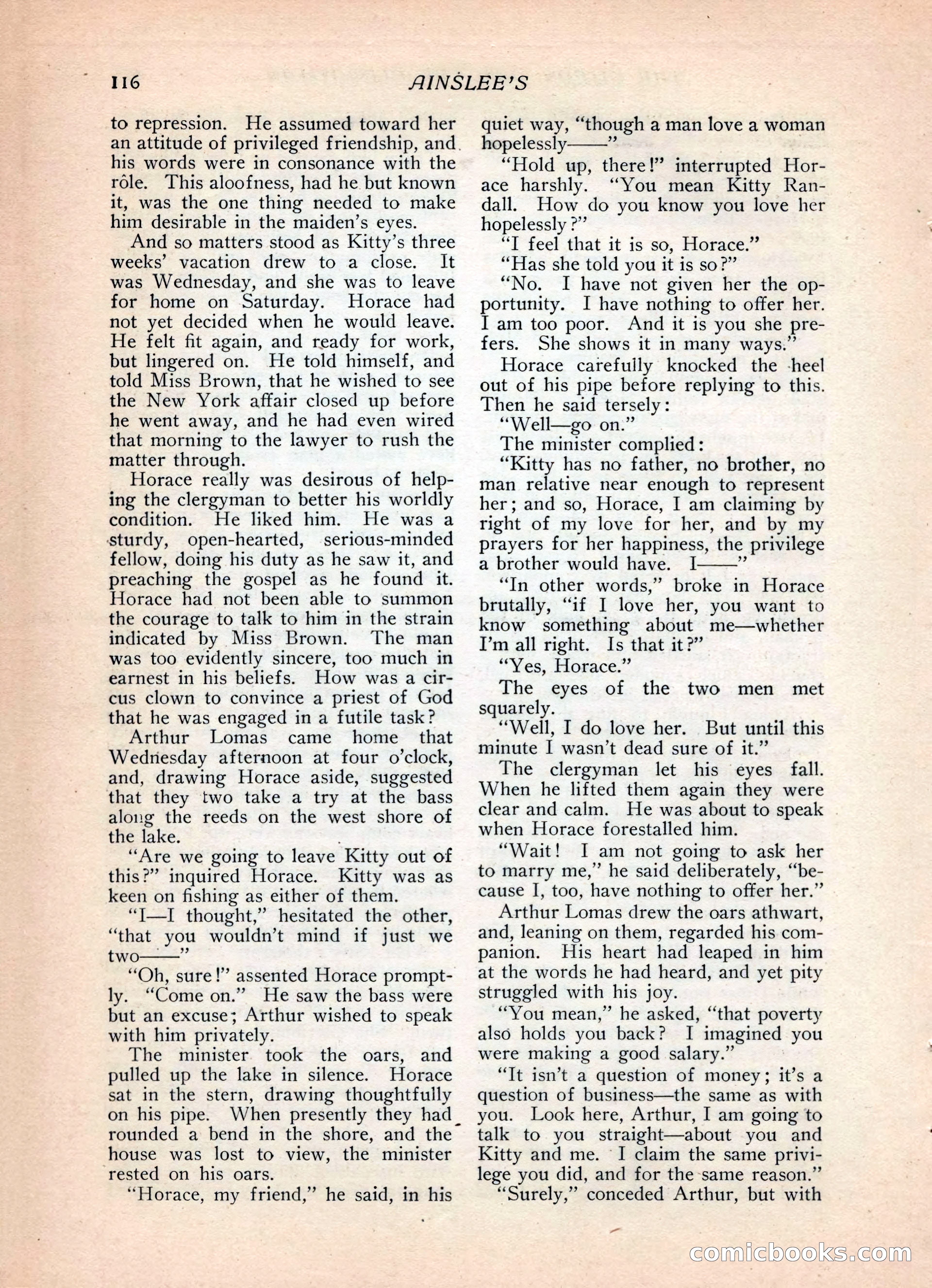
116 to repression. He assumed toward her an attitude of privileged friendship, and. his words were in consonance with the role. This aloofness, had he but known it, was the one thing needed to make him desirable in the maiden’s eyes. And so matters stood as Kitty’s three weeks’ vacation drew to a close. It was Wednesday, and she was to leave for home on Saturday. Horace had not yet decided when he would leave. He felt fit again, and ready for work, but lingered on. He told himself, and told Miss Brown, that he wished to see the New York affair closed up before he went away, and he had even wired that morning to the lawyer to rush the matter through. Horace really was desirous of help- ing the clergyman to better his worldly condition. He liked him. He was a sturdy, open-hearted, serious-minded fellow, doing his duty as he saw it, and preaching the gospel as he found it. Horace had not been able to summon the courage to talk to him in the strain indicated by Miss Brown. The man was too evidently sincere, too much in earnest in his beliefs. How was a cir- cus clown to convince a priest of God that he was engaged in a futile task? Arthur Lomas came home _ that Wedriesday afternoon at four o'clock, and, drawing Horace aside, suggested that they two take a try at the bass along the reeds on the west shore of the lake. “Are we going to leave Kitty out of this?” inquired Horace. Kitty was as keen on fishing as either of them. “I—I thought,” hesitated the other, “that you wouldn’t mind if just we two——” “Oh, sure!” assented Horace prompt- ly. “Come on.” He saw the bass were but an excuse; Arthur wished to speak with him privately. The minister took the oars, and pulled up the lake in silence. Horace sat in the stern, drawing thoughtfully on his pipe. rounded a bend in the shore, and the house was lost to view, the minister rested on his oars. “Horace, my friend,” he said, in his When presently they had_ AINSLEE’S quiet way, “though a man love a woman hopelessly “Hold up, there!” interrupted Hor- ace harshly. “You mean Kitty Ran- dall. How do you know you love her hopelessly ?” “T feel that it is so, Horace.” “Has she told you it is so?” “No. I have not given her the op- portunity. I have nothing to offer her. I am too poor. And it is you she pre- fers. She shows it in many ways.” Horace carefully knocked the -heel out of his pipe before replying to this. Then he said tersely: “Well—go on.” The minister complied: “Kitty has no father, no brother, no man relative near enough to represent her; and so, Horace, I am claiming by right of my love for her, and by my prayers for her happiness, the privilege a brother would have. I “In other words,” broke in Horace brutally, “if I love her, you want to know something about me—whether I’m all right. Is that it?” “Yes, Horace.” The eyes of the two men met squarely. “Well, I do love her. But until this minute I wasn’t dead sure of it.” The clergyman let his eyes fall. When he lifted them again they were clear and calm. He was about to speak when Horace forestalled him. “Wait! I am not going to ask her to marry me,” he said deliberately, “be- cause I, too, have nothing to offer her.” Arthur Lomas drew the oars athwart, and, leaning on them, regarded his com- panion. His heart had leaped in him at the words he had heard, and yet pity struggled with his joy. “You mean,” he asked, “that poverty also holds you back? I imagined you were making a good salary.” “Tt isn’t a question of money; it’s a question of business—the same as with you. Look here, Arthur, I am going to talk to you straight—about you and Kitty and me. I claim the same privi- lege you did, and for the same reason.” “Surely,” conceded Arthur, but with an COMMUC OO) KK (C@)