
Pulp Fiction, 1913 · page 123 of 192
Ainslee's Magazine, February 1913 — page 123: what you’re looking at
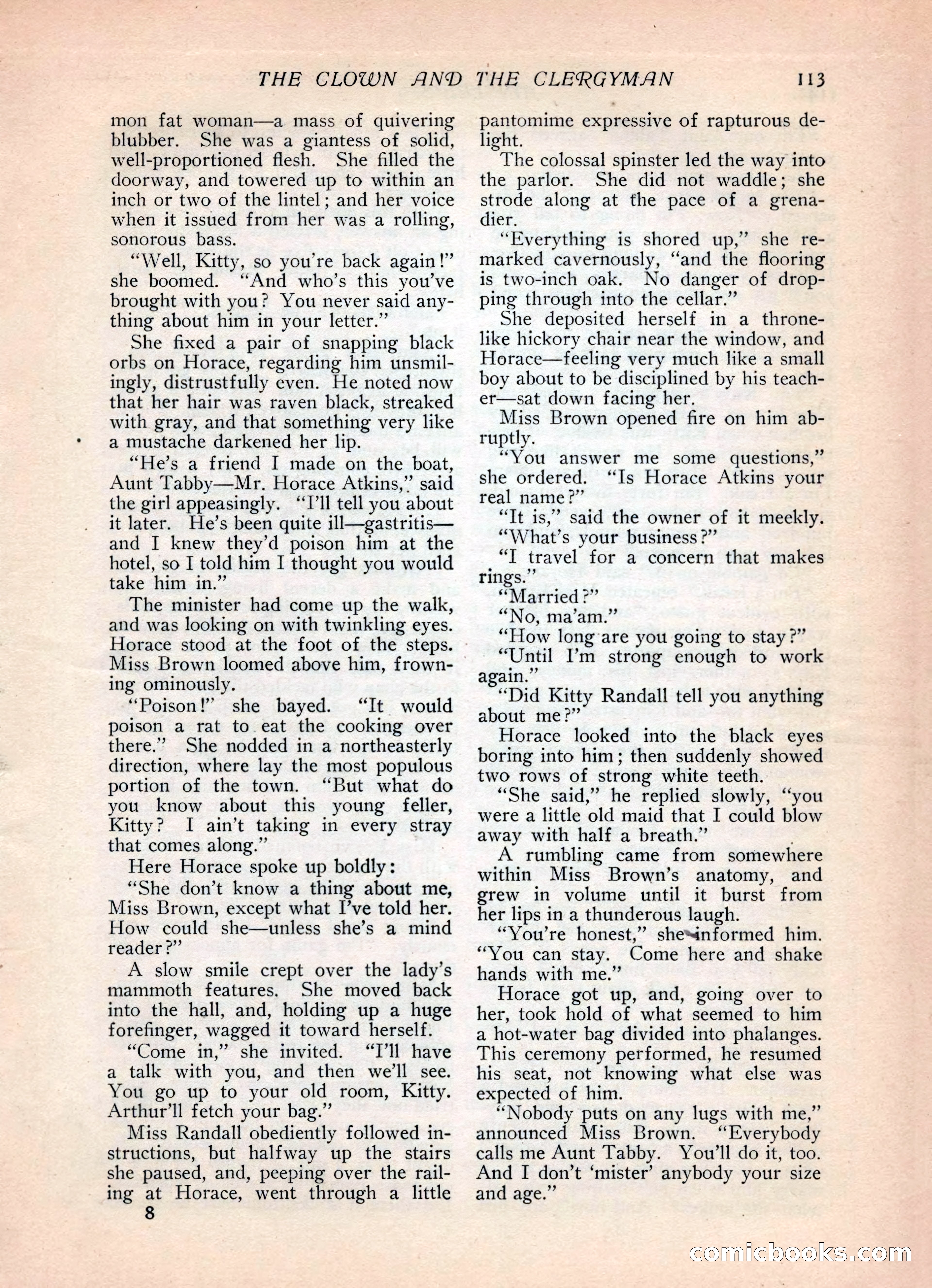
A restored page from Pulp Fiction, 1913. Page through the whole issue in the reader above.
📄 Transcribed text from this page (OCR, searchable)
Machine-transcribed from the original scan — historical spelling and the odd misread are preserved.
THE CLOWN AND THE CLERGYMAN mon fat woman—a mass of quivering blubber. She was a giantess of solid, well-proportioned flesh. She filled the doorway, and towered up to within an inch or two of the lintel; and her voice when it issued from her was a rolling, sonorous bass. “Well, Kitty, so you’re back again!” she boomed. “And who’s this you’ve brought with you? You never said any- thing about him in your letter.” She fixed a pair of snapping black orbs on Horace, regarding him unsmil- ingly, distrustfully even. He noted now that her hair was raven black, streaked with gray, and that something very like a mustache darkened her lip. ‘“‘He’s a friend I made on the boat, Aunt Tabby—Mr. Horace Atkins,” said the girl appeasingly. “I'll tell you about it later. He’s been quite ill—gastritis— and I knew they’d poison him at the hotel, so I told him I thought you would take him in.” The minister had come up the walk, and was looking on with twinkling eyes. Horace stood at the foot of the steps. Miss Brown loomed above him, frown- ing ominously. ‘Poison!’ she bayed. “It would poison a rat to eat the cooking over there.” She nodded in a northeasterly direction, where lay the most populous portion of the town. “But what do you know about this young feller, Kitty? I ain’t taking in every stray that comes along.” Here Horace spoke up boldly: “She don’t know a thing about me, Miss Brown, except what I’ve told her. How could she—unless she’s a mind reader ?” A slow smile crept over the lady’s mammoth features. She moved back into the hall, and, holding up a huge forefinger, wagged it toward herself. “Come in,” she invited. “I’ll have a talk with you, and then we'll see. You go up to your old room, Kitty. Arthur’ll fetch your bag.” Miss Randall obediently followed in- structions, but halfway up the stairs she paused, and, peeping over the rail- ing at Horace, went through a little 8 113 pantomime expressive of rapturous de- light. The colossal spinster led the way into the parlor. She did not waddle; she strode along at the pace of a grena- dier. “Everything is shored up,” she re- marked cavernously, “and the flooring is two-inch oak. No danger of drop- ping through into the cellar.” She deposited herself in a throne- like hickory chair near the window, and Horace—feeling very much like a small boy about to be disciplined by his teach- er—sat down facing her. Miss Brown opened fire on him ab- ruptly. “You answer me some questions,” she ordered. “Is Horace Atkins your real name?” “Tt is,” said the owner of it meekly. “What’s your business ?” “I travel for a concern that makes rings.” “Married ?” “No, ma’am.” “How long are you going to stay?” “Until ’'m strong enough to work again.” “Did Kitty Randall tell you anything about me?” Horace looked into the black eyes boring into him; then suddenly showed two rows of strong white teeth. “She said,” he replied slowly, “you were a little old maid that I could blow away with half a breath.” : A rumbling came from somewhere within Miss Brown’s anatomy, and grew in volume until it burst from her lips in a thunderous laugh. “You’re honest,” shesinformed him. “You can stay. Come here and shake hands with me.” Horace got up, and, going over to her, took hold of what seemed to him a hot-water bag divided into phalanges. This ceremony performed, he resumed his seat, not knowing what else was expected of him. “Nobody puts on any lugs with me,” announced Miss Brown. ‘Everybody calls me Aunt Tabby. You'll do it, too. And I don’t ‘mister’ anybody your size and age.” (C@ VOLK (C@