
Pulp Fiction, 1913 · page 105 of 192
Ainslee's Magazine, February 1913 — page 105: what you’re looking at
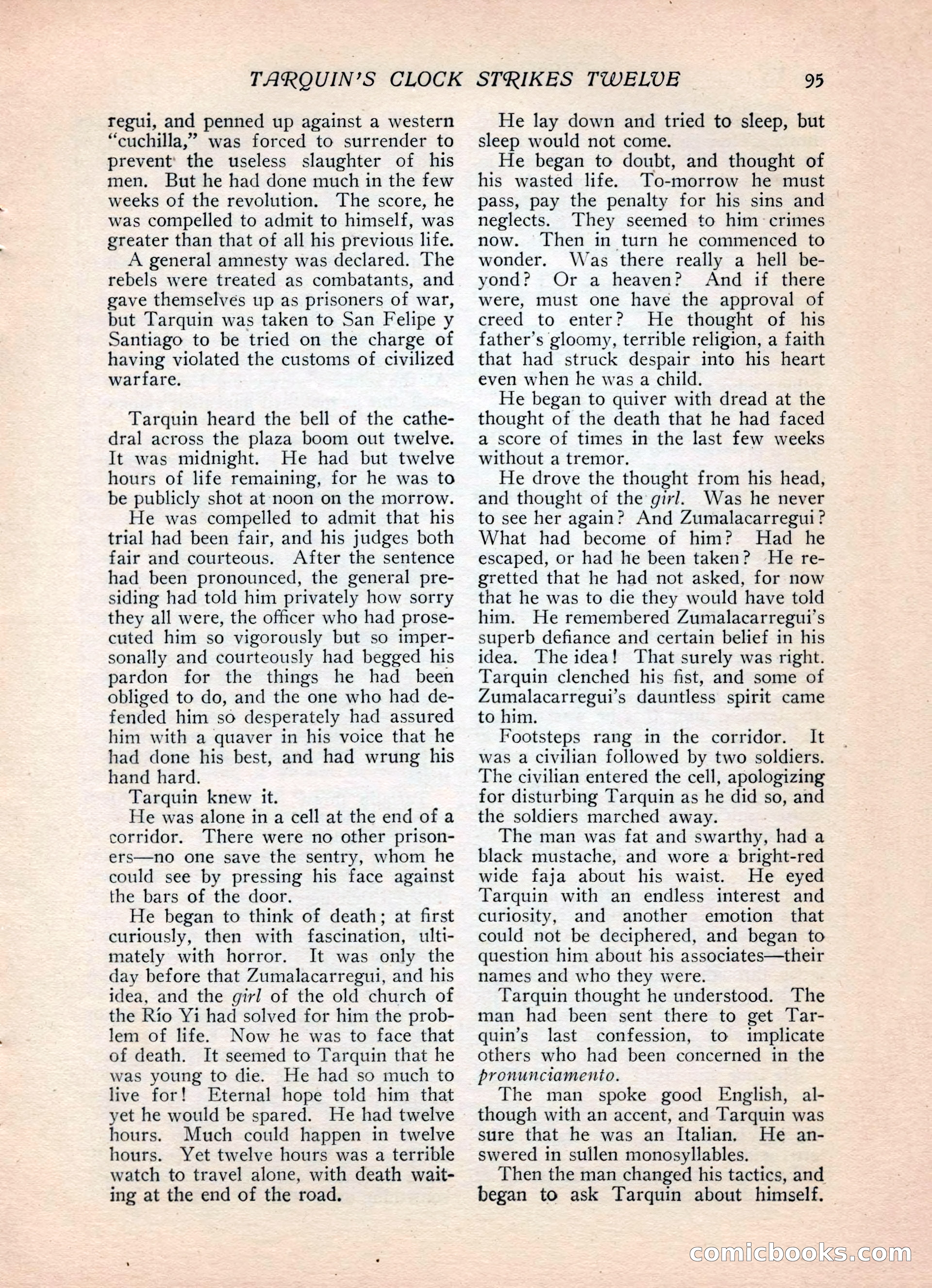
A restored page from Pulp Fiction, 1913. Page through the whole issue in the reader above.
📄 Transcribed text from this page (OCR, searchable)
Machine-transcribed from the original scan — historical spelling and the odd misread are preserved.
TARQUIN’S CLOCK regui, and penned up against a western “cuchilla,’” was forced to surrender to prevent’ the useless slaughter of his men. But he had done much in the few weeks of the revolution. The score, he was compelled to admit to himself, was greater than that of all his previous life. A general amnesty was declared. The rebels were treated as combatants, and gave themselves up as prisoners of war, but Tarquin was taken to San Felipe y Santiago to be tried on the charge of having violated the customs of civilized warfare. Tarquin heard the bell of the cathe- dral across the plaza boom out twelve. It was midnight. He had but twelve hours of life remaining, for he was to be publicly shot at noon on the morrow. He was compelled to admit that his trial had been fair, and his judges both fair and courteous. After the sentence had been pronounced, the general pre- siding had told him privately how sorry they all were, the officer who had prose- cuted him so vigorously but so imper- sonally and courteously had begged his pardon for the things he had been obliged to do, and the one who had de- fended him so desperately had assured him with a quaver in his voice that he had done his best, and had wrung his hand hard. Tarquin knew it. He was alone in a cell at the end of a corridor. There were no other prison- ers—no one save the sentry, whom he could see by pressing his face against the bars of the door. He began to think of death; at first curiously, then with fascination, ulti- mately with horror. It was only the day before that Zumalacarregui, and his idea, and the girl of the old church of the Rio Yi had solved for him the prob- lem of life. Now he was to face that of death. It seemed to Tarquin that he was young to die. He had so much to live for! Eternal hope told him that yet he would be spared. He had twelve hours. Much could happen in twelve hours. Yet twelve hours was a terrible watch to travel alone, with death wait- ing at the end of the road. STRIKES TWELVE 95 He lay down and tried to sleep, but sleep would not come. He began to doubt, and thought of his wasted life. To-morrow he must pass, pay the penalty for his sins and neglects. They seemed to him crimes now. Then in turn he commenced to wonder. Was there really a hell be- yond? Or a heaven? And if there were, must one have the approval of creed to enter? He thought of his father’s gloomy, terrible religion, a faith that had struck despair into his heart even when he was a child. He began to quiver with dread at the thought of the death that he had faced a score of times in the last few weeks without a tremor. He drove the thought from his head, and thought of the girl. Was he never to see her again? And Zumalacarregui ? What had become of him? Had he escaped, or had he been taken? He re- gretted that he had not asked, for now that he was to die they would have told him. He remembered Zumalacarregui’s superb defiance and certain belief in his idea. Theidea! That surely was right. Tarquin clenched his fist, and some of Zumalacarregui’s dauntless spirit came to him. Footsteps rang in the corridor. It was a civilian followed by two soldiers. The civilian entered the cell, apologizing for disturbing Tarquin as he did so, and the soldiers marched away. The man was fat and swarthy, had a black mustache, and wore a bright-red wide faja about his waist. He eyed Tarquin with an endless interest and curiosity, and another emotion that could not be deciphered, and began to question him about his associates—their names and who they were. Tarquin thought he understood. The man had been sent there to get Tar- quin’s last confession, to implicate others who had been concerned in the pronunctiamento. The man spoke good English, al- though with an accent, and Tarquin was sure that he was an Italian, He an- swered in sullen monosyllables. Then the man changed his tactics, and began to ask Tarquin about himself. CORMICGLOOO© G S (E@)