
Pulp Fiction, 1913 · page 101 of 192
Ainslee's Magazine, February 1913 — page 101: what you’re looking at
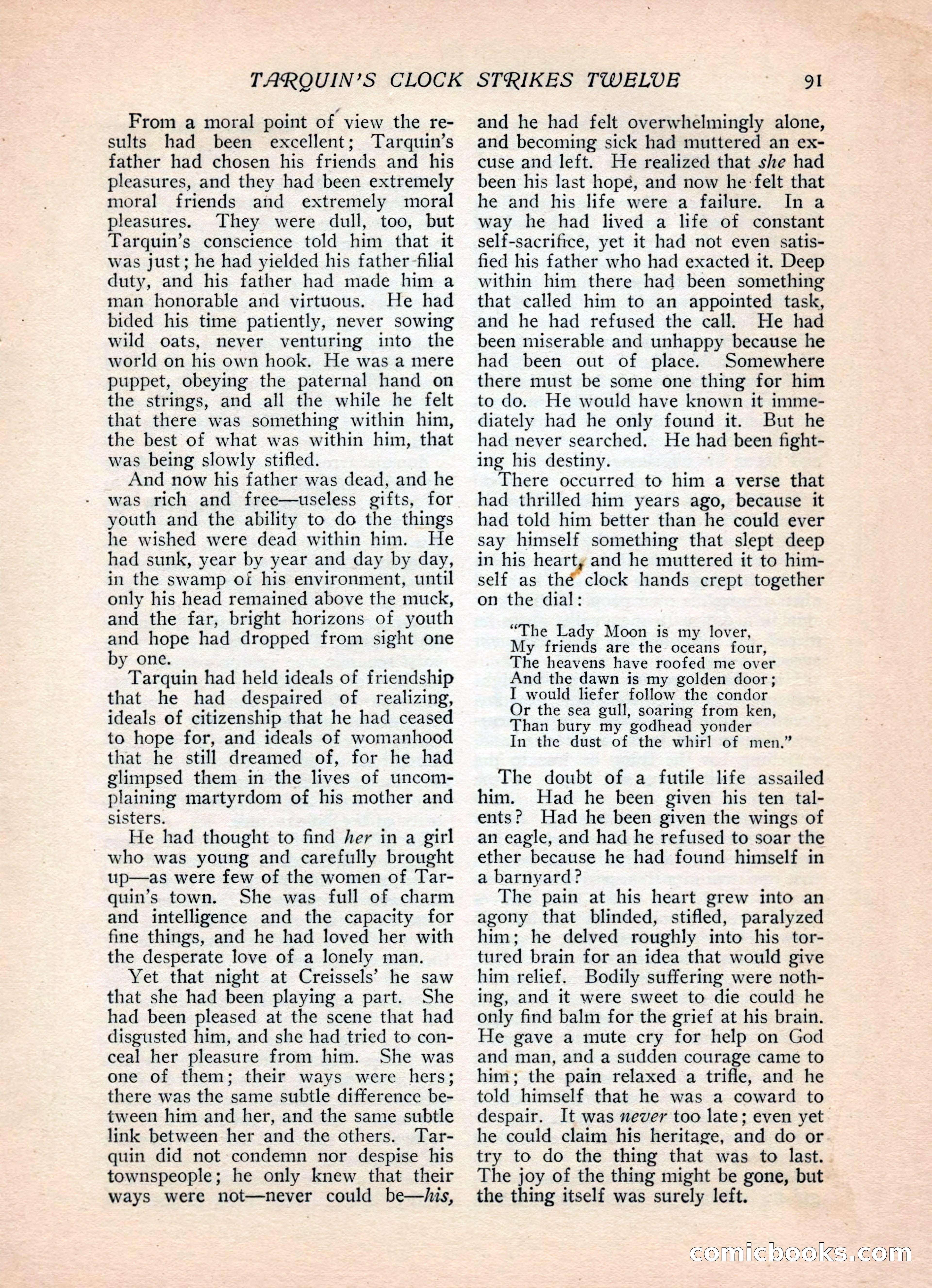
A restored page from Pulp Fiction, 1913. Page through the whole issue in the reader above.
📄 Transcribed text from this page (OCR, searchable)
Machine-transcribed from the original scan — historical spelling and the odd misread are preserved.
TARQUIN’S CLOCK From a moral point of view the re- sults had been excellent; Tarquin’s father had chosen his friends and his pleasures, and they had been extremely moral friends and extremely moral pleasures. They were dull, too, but Tarquin’s conscience told him that it was just; he had yielded his father filial duty, and his father had made him a man honorable and virtuous. He had bided his time patiently, never sowing wild oats, never venturing into the world on his own hook. He was a mere puppet, obeying the paternal hand on the strings, and all the while he felt that there was something within him, the best of what was within him, that was being slowly stifled. And now his father was dead, and he was rich and free—useless gifts, for youth and the ability to do the things he wished were dead within him. He had sunk, year by year and day by day, in the swamp oi his environment, until only his head remained above the muck, and the far, bright horizons of youth and hope had dropped from sight one by one. Tarquin had held ideals of friendship that he had despaired of realizing, ideals of citizenship that he had ceased to hope for, and ideals of womanhood that he still dreamed of, for he had glimpsed them in the lives of uncom- plaining martyrdom of his mother and sisters. He had thought to find her in a girl who was young and carefully brought up—as were few of the women of Tar- quin’s town. She was full of charm and intelligence and the capacity for fine things, and he had loved her with the desperate love of a lonely man. Yet that night at Creissels’ he saw that she had been playing a part. She had been pleased at the scene that had disgusted him, and she had tried to con- ceal her pleasure from him. She was one of them; their ways were hers; there was the same subtle difference be- tween him and her, and the same subtle link between her and the others. Tar- quin did not condemn nor despise his townspeople; he only knew that their ways were not—never could be—his, STRIKES TWELVE 91 and he had felt overwhelmingly alone, and becoming sick had muttered an ex- cuse and left. He realized that she had been his last hopé, and now he felt that he and his life were a failure. In a way he had lived a life of constant self-sacrifice, yet it had not even satis- fied his father who had exacted it. Deep within him there had been something that called him to an appointed task, and he had refused the call. He had been miserable and unhappy because he had been out of place. Somewhere there must be some one thing for him to do. He would have known it imme- diately had he only found it. But he had never searched. He had been fight- ing his destiny. "There occurred to him a verse that had thrilled him years ago, because it had told him better than he could ever say himself something that slept deep in his hearty and he muttered it to him- self as thé? clock hands crept together on the dial: “The Lady Moon is my lover, My friends are the oceans four, The heavens have roofed me over And the dawn is my golden door; I would liefer follow the condor. Or the sea gull, soaring from ken, Than bury my godhead yonder In the dust of the whirl of men.’ The doubt of a futile life assailed him. Had he been given his ten tal- ents? Had he been given the wings of an eagle, and had he refused to soar the ether because he had found himself in a barnyard? The pain at his heart grew into an agony that blinded, stifled, paralyzed him; he delved roughly into his tor- tured brain for an idea that would give him relief. Bodily suffering were noth- ing, and it were sweet to die could he only find balm for the grief at his brain. He gave a mute cry for help on God and man, and a sudden courage came to him; the pain relaxed a trifle, and he told himself that he was a coward to despair. It was never too late; even yet he could claim his heritage, and do or try to do the thing that was to last. The joy of the thing might be gone, but the thing itself was surely left. COL OOYKO)|K< (E@)