
Pulp Fiction, 1926 · page 8 of 212
Adventure Magazine Cover — page 8: what you’re looking at
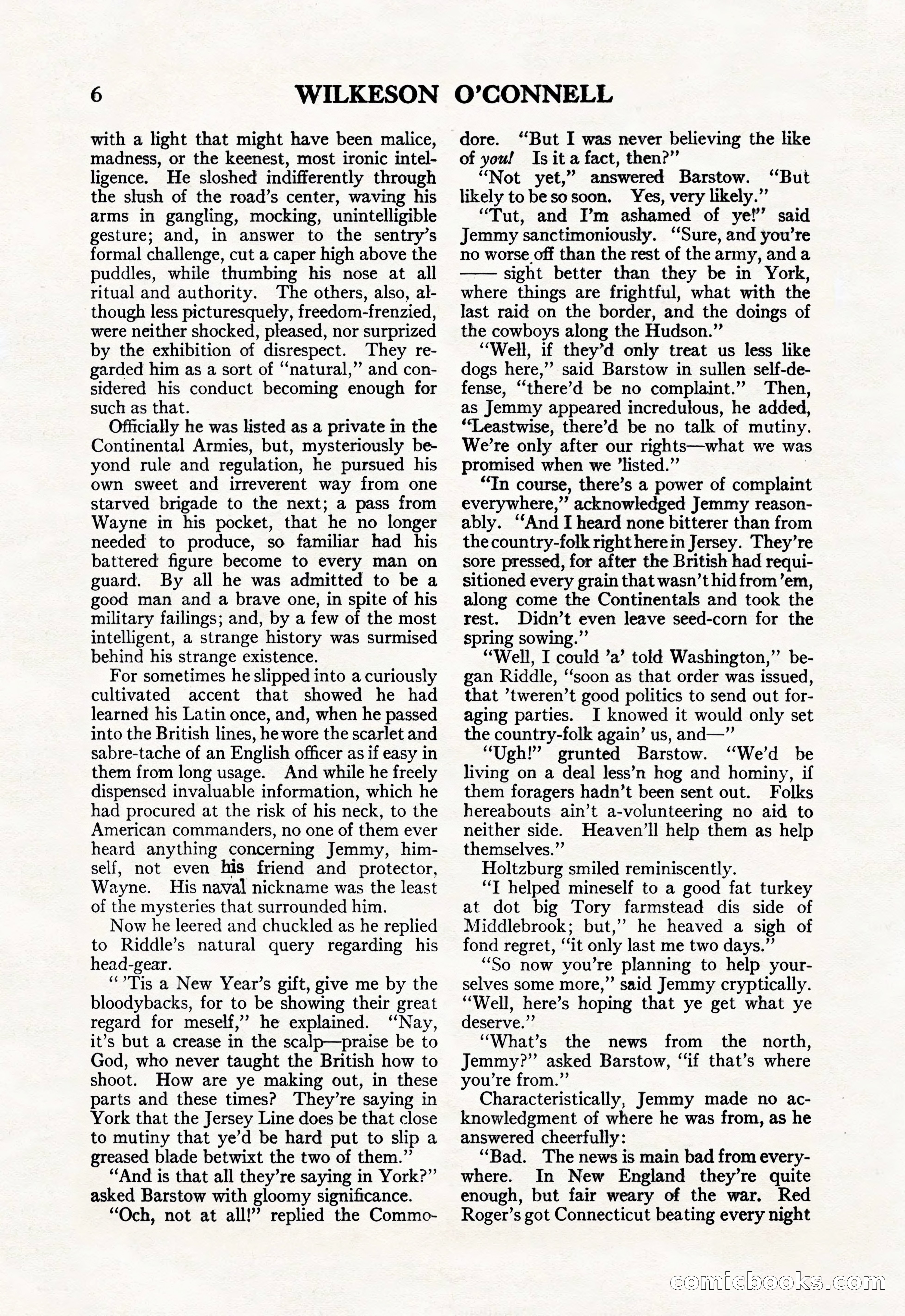
A restored page from Pulp Fiction, 1926. Page through the whole issue in the reader above.
📄 Transcribed text from this page (OCR, searchable)
Machine-transcribed from the original scan — historical spelling and the odd misread are preserved.
6 WILKESON with a light that might have been malice, madness, or the keenest, most ironic intel- ligence. He sloshed indifferently through the slush of the road’s center, waving his arms in gangling, mocking, unintelligible gesture; and, in answer to the sentry’s formal challenge, cut a caper high above the puddles, while thumbing his nose at all ritual and authority. The others, also, al- though less picturesquely, freedom-frenzied, were neither shocked, pleased, nor surprized by the exhibition of disrespect. They re- garded him as a sort of “natural,” and con- sidered his conduct becoming enough for such as that. Officially he was listed as a private in the Continental Armies, but, mysteriously be- yond rule and regulation, he pursued his own sweet and irreverent way from one starved brigade to the next; a pass from Wayne in his pocket, that he no longer needed to produce, so familiar had his battered figure become to every man on guard. By all he was admitted to be a good man and a brave one, in spite of his military failings; and, by a few of the most intelligent, a strange history was surmised behind his strange existence. For sometimes he slipped into a curiously cultivated accent that showed he had learned his Latin once, and, when he passed into the British lines, he wore the scarlet and sabre-tache of an English officer as if easy in them from long usage. And while he freely dispensed invaluable information, which he had procured at the risk of his neck, to the American commanders, no one of them ever heard anything concerning Jemmy, him- self, not even his friend and protector, Wayne. His naval nickname was the least of the mysteries that surrounded him. Now he leered and chuckled as he replied to Riddle’s natural query regarding his head-gear. “Tis a New Year’s gift, give me by the bloodybacks, for to be showing their great regard for meself,” he explained. ‘Nay, it’s but a crease in the scalp—praise be to God, who never taught the British how to shoot. How are ye making out, in these parts and these times? They’re saying in York that the Jersey Line does be that close to mutiny that ye’d be hard put to slip a greased blade betwixt the two of them.” ‘And is that all they’re saying in York?” asked Barstow with gloomy significance. “Och, not at all!’ replied the Commo- -dore. O’CONNELL “But I was never believing the like of you! Isita fact, then?” “Not yet,” answered Barstow. likely tobesosoon. Yes, very likely.”’ “Tut, and I’m ashamed of ye!’ said Jemmy sanctimoniously. ‘Sure, and you’re no worse off than the rest of the army, anda sight better than they be in York, where things are frightful, what with the last raid on the border, and the doings of the cowboys along the Hudson.” ‘Well, if they’d only treat us less like dogs here,’’ said Barstow in sullen self-de- fense, “there’d be no complaint.” Then, as Jemmy appeared incredulous, he added, “‘Leastwise, there’d be no talk of mutiny. We're only after our rights—what we was promised when we ’listed.” “In course, there’s a power of complaint everywhere,” acknowledged Jemmy reason- ably. “And I heard none bitterer than from the country-folk right herein Jersey. They’re sore pressed, for after the British had requi- sitioned every grain that wasn’t hid from’em, along come the Continentals and took the rest. Didn’t even leave seed-corn for the spring sowing.”’ ‘Well, I could ’a’ told Washington,”’ be- gan Riddle, ‘‘soon as that order was issued, that ’tweren’t good politics to send out for- aging parties. I knowed it would only set the country-folk again’ us, and—”’ “Ugh!” grunted Barstow. ‘‘We’d be living on a deal less’n hog and hominy, if them foragers hadn’t been sent out. Folks hereabouts ain’t a-volunteering no aid to neither side. Heaven’ll help them as help themselves.” Holtzburg smiled reminiscently. “T helped mineself to a good fat turkey at dot big Tory farmstead dis side of Middlebrook; but,” he heaved a sigh of fond regret, “it only last me two days.” ‘So now vou’re planning to help your- selves some more,” said Jemmy cryptically. “Well, here’s hoping that ye get what ye deserve.” ‘“‘What’s the news from the north, Jemmy?”’ asked Barstow, “if that’s where you’re from.” Characteristically, Jemmy made no ac- knowledgment of where he was from, as he answered cheerfully: “Bad. The news is main bad from every- where. In New England they’re quite enough, but fair weary of the war. Red Roger’s got Connecticut beating every night “But COMICLOOO S CO