
Pulp Fiction, 1926 · page 44 of 212
Adventure Magazine Cover — page 44: what you’re looking at
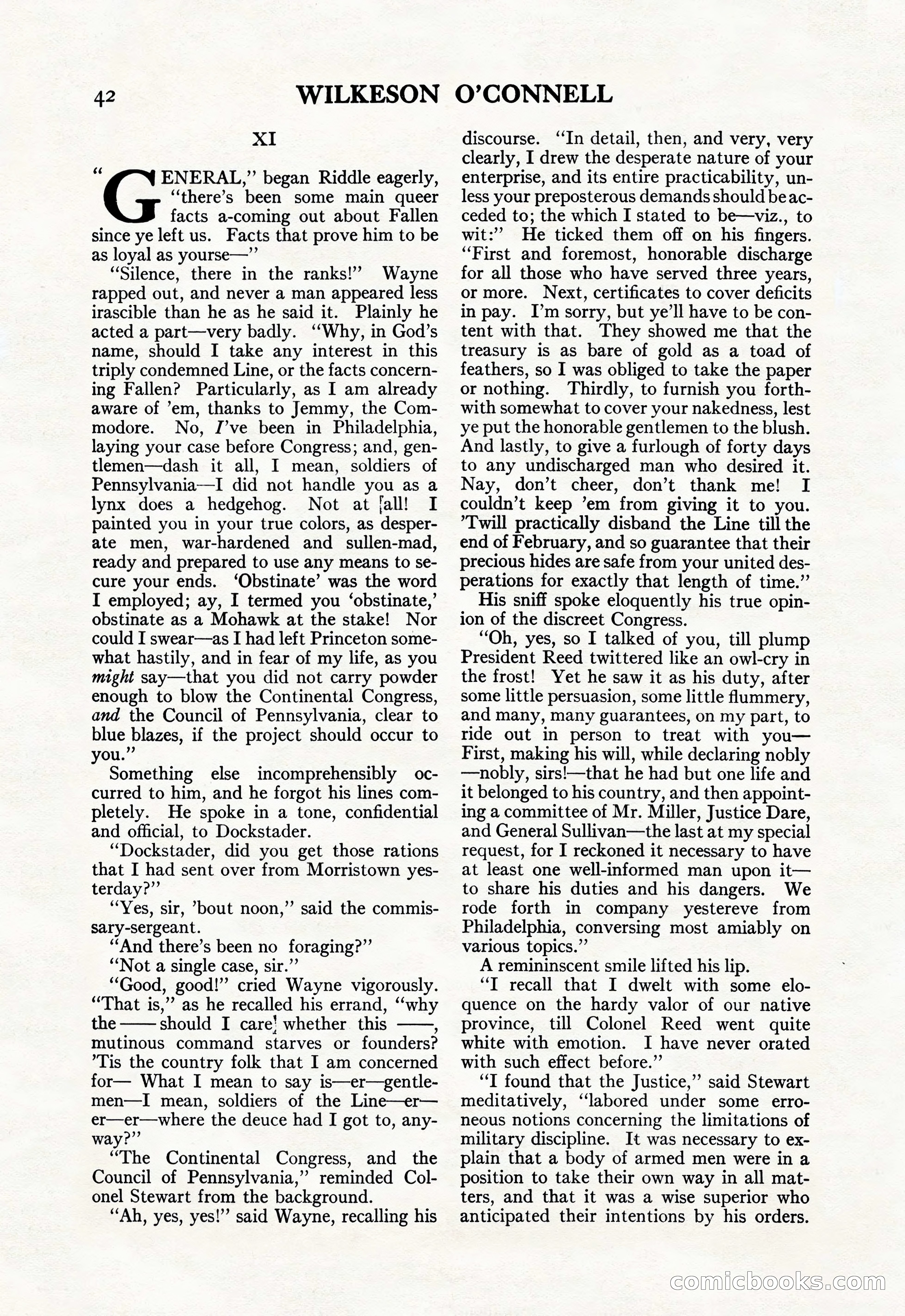
A restored page from Pulp Fiction, 1926. Page through the whole issue in the reader above.
📄 Transcribed text from this page (OCR, searchable)
Machine-transcribed from the original scan — historical spelling and the odd misread are preserved.
42 XI . 5 vtess’> began Riddle eagerly, “‘there’s been some main queer facts a-coming out about Fallen since ye left us. Facts that prove him to be as loyal as yourse—”’ “Silence, there in the ranks!’’ Wayne rapped out, and never a man appeared less irascible than he as he said it. Plainly he acted a part—very badly. ‘‘Why, in God’s name, should I take any interest in this triply condemned Line, or the facts concern- ing Fallen? Particularly, as I am already aware of ’em, thanks to Jemmy, the Com- modore. No, I’ve been in Philadelphia, laying your case before Congress; and, gen- tlemen—dash it all, I mean, soldiers of Pennsylvania—I did not handle you as a lynx does a hedgehog. Not at fall! I painted you in your true colors, as desper- ate men, war-hardened and _ sullen-mad, ready and prepared to use any means to se- cure your ends. ‘Obstinate’ was the word I employed; ay, I termed you ‘obstinate,’ obstinate as a Mohawk at the stake! Nor could I swear—as I had left Princeton some- what hastily, and in fear of my life, as you might say—that you did not carry powder enough to blow the Continental Congress, and the Council of Pennsylvania, clear to blue blazes, if the project should occur to you.” Something else incomprehensibly oc- curred to him, and he forgot his lines com- pletely. He spoke in a tone, confidential and official, to Dockstader. “Dockstader, did you get those rations that I had sent over from Morristown yes- terday?”’ “Yes, sir, bout noon,” said the commis- Sary-sergeant. ‘‘And there’s been no foraging?”’ “Not a single case, sir.” “Good, good!” cried Wayne vigorously. “That is,” as he recalled his errand, “why the should I care! whether this mutinous command starves or founders? Tis the country folk that I am concerned for— What I mean to say is—er—gentle- men—I mean, soldiers of the Line—er— er—er—where the deuce had I got to, any- way?” ‘The Continental Congress, and the Council of Pennsylvania,” reminded Col- onel Stewart from the background. “Ah, yes, yes!’ said Wayne, recalling his WILKESON O’CONNELL discourse. “In detail, then, and very, very clearly, I drew the desperate nature of your enterprise, and its entire practicability, un- less your preposterous demands should beac- ceded to; the which I stated to be—viz., to wit:” He ticked them off on his fingers. “First and foremost, honorable discharge for all those who have served three years, or more. Next, certificates to cover deficits in pay. I’m sorry, but ye’ll have to be con- tent with that. They showed me that the treasury is as bare of gold as a toad of feathers, so I was obliged to take the paper or nothing. Thirdly, to furnish you forth- with somewhat to cover your nakedness, lest ye put the honorable gentlemen to the blush. And lastly, to give a furlough of forty days to any undischarged man who desired it. Nay, don’t cheer, don’t thank me! I couldn’t keep ’em from giving it to you. *Twill practically disband the Line till the end of February, and so guarantee that their precious hides are safe from your united des- perations for exactly that length of time.” His sniff spoke eloquently his true opin- ion of the discreet Congress. “Oh, yes, so I talked of you, till plump President Reed twittered like an owl-cry in the frost! Yet he saw it as his duty, after some little persuasion, some little flummery, and many, many guarantees, on my part, to ride out in person to treat with you— First, making his will, while declaring nobly —nobly, sirs!—that he had but one life and it belonged to his country, and then appoint- ing a committee of Mr. Miller, Justice Dare, and General Sullivan—the last at my special request, for I reckoned it necessary to have at least one well-informed man upon it— to share his duties and his dangers. We rode forth in company yestereve from Philadelphia, conversing most amiably on various topics.”’ A remininscent smile lifted his lip. “T recall that I dwelt with some elo- quence on the hardy valor of our native province, till Colonel Reed went quite white with emotion. I have never orated with such effect before.”’ “T found that the Justice,” said Stewart meditatively, “labored under some erro- neous notions concerning the limitations of military discipline. It was necessary to ex- plain that a body of armed men were in a position to take their own way in all mat- ters, and that it was a wise superior who anticipated their intentions by his orders. CORICOOO S CO