
Pulp Fiction, 1926 · page 41 of 212
Adventure Magazine Cover — page 41: what you’re looking at
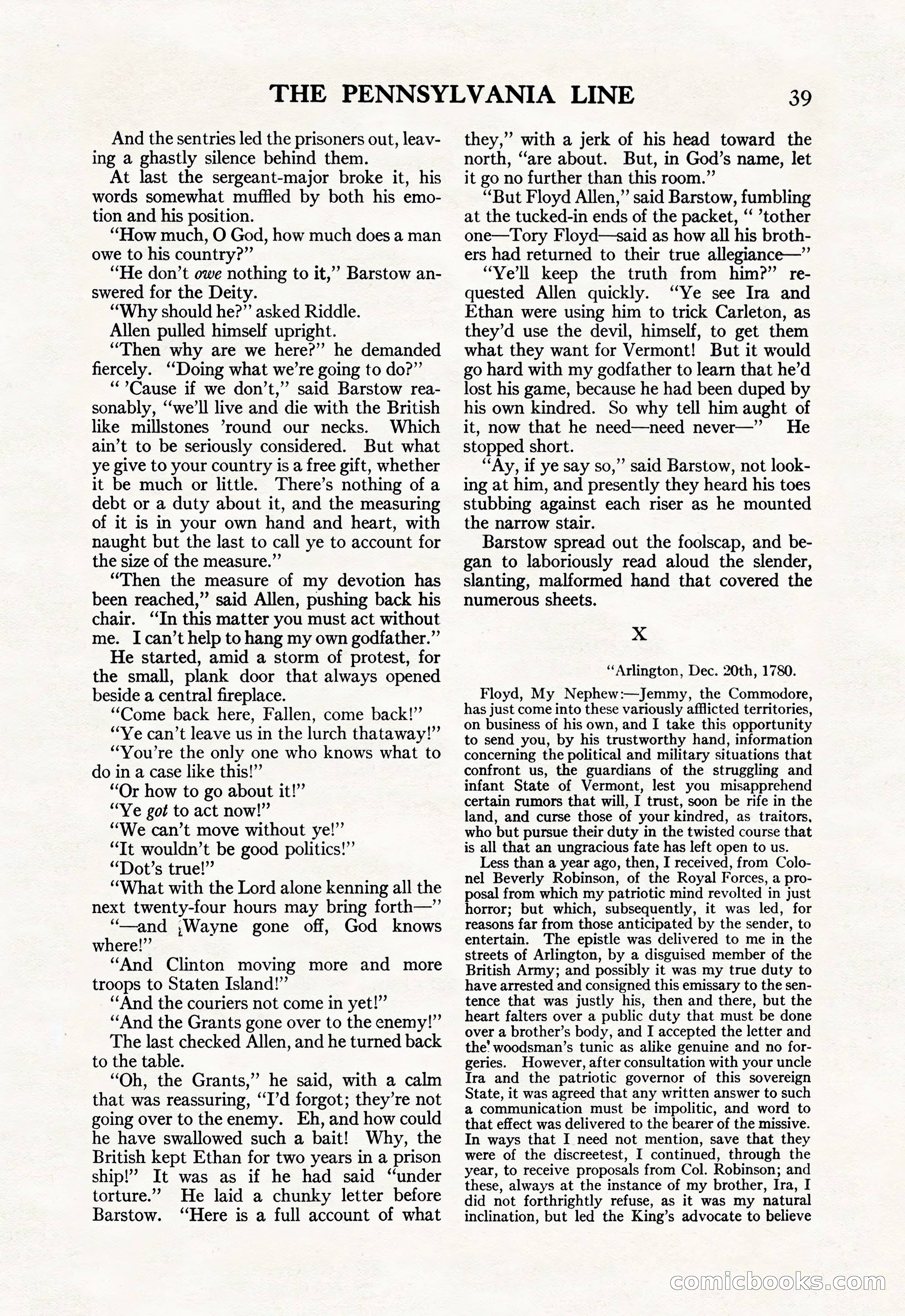
A restored page from Pulp Fiction, 1926. Page through the whole issue in the reader above.
📄 Transcribed text from this page (OCR, searchable)
Machine-transcribed from the original scan — historical spelling and the odd misread are preserved.
THE PENNSYLVANIA LINE And the sentries led the prisoners out, leav- ing a ghastly silence behind them. At last the sergeant-major broke it, his words somewhat muffled by both his emo- tion and his position. “How much, O God, how much does a man owe to his country?” “He don’t owe nothing to it,” Barstow an- swered for the Deity. “Why should he?” asked Riddle. Allen pulled himself upright. “Then why are we here?” he demanded fiercely. ‘Doing what we’re going to do?”’ ‘“‘°’Cause if we don’t,” said Barstow rea- sonably, “we'll live and die with the British like millstones ’round our necks. Which ain’t to be seriously considered. But what ye give to your country is a free gift, whether it be much or little. There’s nothing of a debt or a duty about it, and the measuring of it is in your own hand and heart, with naught but the last to call ye to account for the size of the measure.” “Then the measure of my devotion has been reached,” said Allen, pushing back his chair. “In this matter you must act without me. I can’t help to hang my own godfather.” He started, amid a storm of protest, for the small, plank door that always opened beside a central fireplace. “Come back here, Fallen, come back!” “Ye can’t leave us in the lurch thataway!”’ ‘“You’re the only one who knows what to do in a case like this!” “Or how to go about it!”’ “Ye got to act now!” “We can’t move without ye!”’ “Tt wouldn’t be good politics!’ “Dot’s true!” “What with the Lord alone kenning all the next twenty-four hours may bring forth—’”’ “and ,;,Wayne gone off, God knows where!” “And Clinton moving more and more troops to Staten Island!” ‘“‘And the couriers not come in yet!” “And the Grants gone over to the enemy!” The last checked Allen, and he turned back to the table. “Oh, the Grants,” he said, with a calm that was reassuring, “I’d forgot; they’re not going over to the enemy. Eh, and how could he have swallowed such a bait! Why, the British kept Ethan for two years in a prison ship!” It was as if he had said “under torture.” He laid a chunky letter before Barstow. ‘Here is a full account of what 39 they,”’ with a jerk of his head toward the north, ‘‘are about. But, in God’s name, let it go no further than this room.” “But Floyd Allen,” said Barstow, fumbling at the tucked-in ends of the packet, “‘ ’tother one—Tory Floyd—-said as how all his broth- ers had returned to their true allegiance—” “Ye'll keep the truth from him?” re- quested Allen quickly. “Ye see Ira and Ethan were using him to trick Carleton, as they’d use the devil, himself, to get them what they want for Vermont! But it would go hard with my godfather to learn that he’d lost his game, because he had been duped by his own kindred. So why tell him aught of it, now that he need—need never—” He stopped short. ‘Ay, if ye say so,” said Barstow, not look- ing at him, and presently they heard his toes stubbing against each riser as he mounted the narrow stair. Barstow spread out the foolscap, and be- gan to laboriously read aloud the slender, slanting, malformed hand that covered the numerous sheets. x “Arlington, Dec. 20th, 1780. Floyd, My Nephew:—Jemmy, the Commodore, has just come into these variously afflicted territories, on business of his own, and I take this opportunity to send you, by his trustworthy hand, information concerning the political and military situations that confront us, the guardians of the struggling and infant State of Vermont, lest you misapprehend certain rumors that will, I trust, soon be rife in the land, and curse those of your kindred, as traitors, who but pursue their duty in the twisted course that is all that an ungracious fate has left open to us. Less than a year ago, then, I received, from Colo- nel Beverly Robinson, of the Royal Forces, a pro- posal from which my patriotic mind revolted in just horror; but which, subsequently, it was led, for reasons far from those anticipated by the sender, to entertain. The epistle was delivered to me in the streets of Arlington, by a disguised member of the British Army; and possibly it was my true duty to have arrested and consigned this emissary to the sen- tence that was justly his, then and there, but the heart falters over a public duty that must be done over a brother’s body, and I accepted the letter and the’ woodsman’s tunic as alike genuine and no for- geries. However, after consultation with your uncle Ira and the patriotic governor of this sovereign State, it was agreed that any written answer to such a communication must be impolitic, and word to that effect was delivered to the bearer of the missive. In ways that I need not mention, save that they were of the discreetest, I continued, through the year, to receive proposals from Col. Robinson; and these, always at the instance of my brother, Ira, I did not forthrightly refuse, as it was my natural inclination, but led the King’s advocate to believe CORCLOO <S) CO