
Pulp Fiction, 1926 · page 38 of 212
Adventure Magazine Cover — page 38: what you’re looking at
A restored page from Pulp Fiction, 1926. Page through the whole issue in the reader above.
📄 Transcribed text from this page (OCR, searchable)
Machine-transcribed from the original scan — historical spelling and the odd misread are preserved.
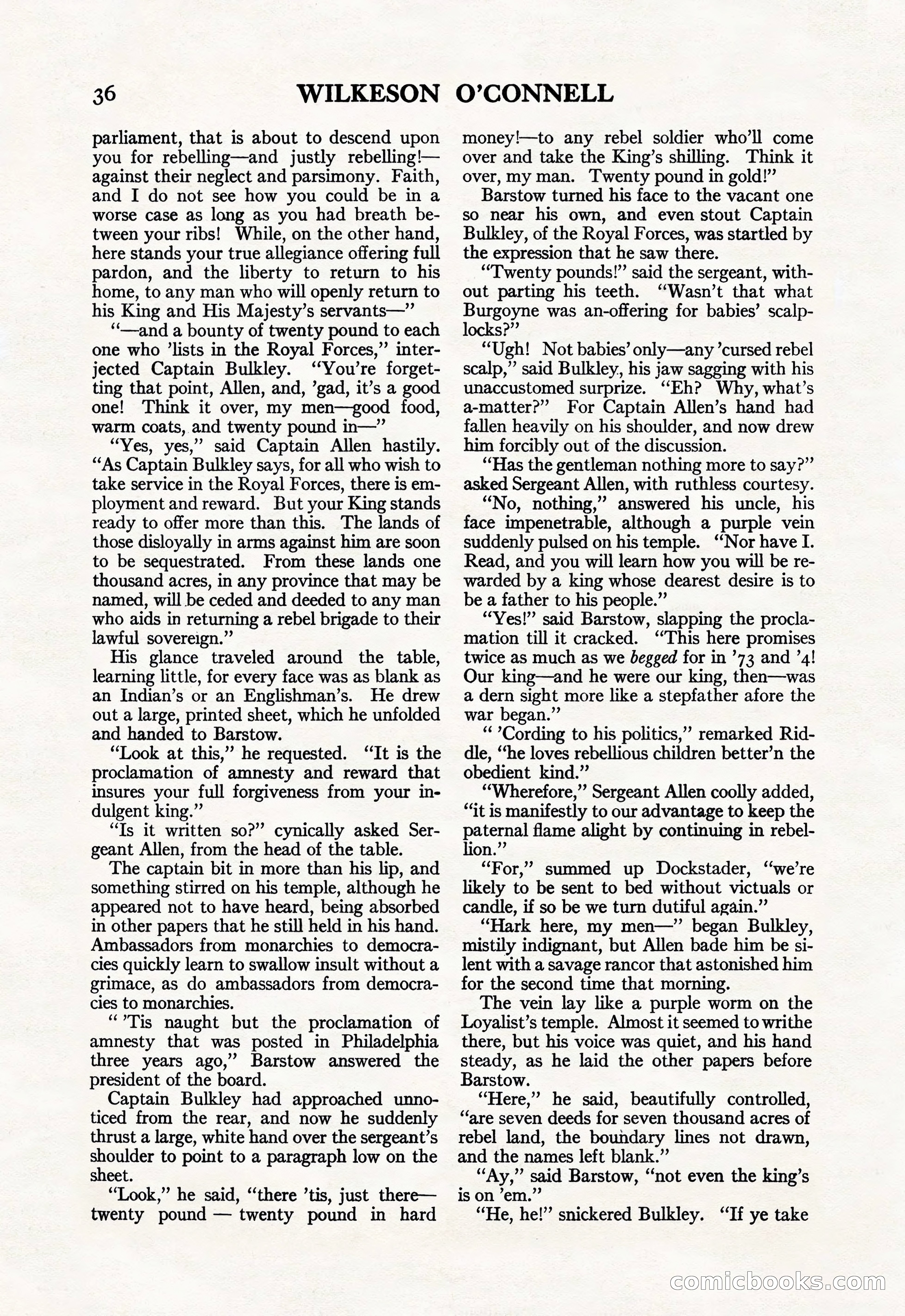
36 WILKESON parliament, that is about to descend upon you for rebelling—and justly rebelling!— against their neglect and parsimony. Faith, and I do not see how you could be in a worse case as long as you had breath be- tween your ribs! While, on the other hand, here stands your true allegiance offering full pardon, and the liberty to return to his home, to any man who will openly return to his King and His Majesty’s servants—”’ ‘and a bounty of twenty pound to each one who ’lists in the Royal Forces,” inter- jected Captain Bulkley. ‘‘You’re forget- ting that point, Allen, and, ’gad, it’s a good one! Think it over, my men—good food, warm coats, and twenty pound in—” “Yes, yes,” said Captain Allen hastily. “As Captain Bulkley says, for all who wish to take service in the Royal Forces, there is em- ployment and reward. But your King stands ready to offer more than this. The lands of those disloyally in arms against him are soon to be sequestrated. From these lands one thousand acres, in any province that may be named, will be ceded and deeded to any man who aids in returning a rebel brigade to their lawful sovereign.” His glance traveled around the table, learning little, for every face was as blank as an Indian’s or an Englishman’s. He drew out a large, printed sheet, which he unfolded and handed to Barstow. “Look at this,” he requested. “It is the proclamation of amnesty and reward that insures your full forgiveness from your in- dulgent king.” “Is it written so?” cynically asked Ser- geant Allen, from the head of the table. The captain bit in more than his lip, and something stirred on his temple, although he appeared not to have heard, being absorbed in other papers that he still held in his hand. Ambassadors from monarchies to democra- cies quickly learn to swallow insult without a grimace, as do ambassadors from democra- cies to monarchies. “Tis naught but the proclamation of amnesty that was posted in Philadelphia three years ago,” Barstow answered the president of the board. Captain Bulkley had approached unno- ticed from the rear, and now he suddenly thrust a large, white hand over the sergeant’s ae to point to a paragraph low on the eet. “Look,’’ he said, “there ’tis, just there— twenty pound — twenty pound in hard O’CONNELL money!—to any rebel soldier who’ll come over and take the King’s shilling. Think it over, my man. Twenty pound in gold!” Barstow turned his face to the vacant one so near his own, and even stout Captain Bulkley, of the Royal Forces, was startled by the expression that he saw there. “Twenty pounds!” said the sergeant, with- out parting his teeth. ‘‘Wasn’t that what Burgoyne was an-offering for babies’ scalp- locks?” “Ugh! Not babies’ only—any ’cursed rebel scalp,” said Bulkley, his jaw sagging with his unaccustomed surprize. ‘‘Eh? Why, what’s a-matter?” For Captain Allen’s hand had fallen heavily on his shoulder, and now drew him forcibly out of the discussion. “Has the gentleman nothing more to say?” asked Sergeant Allen, with ruthless courtesy. “No, nothing,”’ answered his uncle, his face impenetrable, although a purple vein suddenly pulsed on his temple. ‘‘Nor have I. Read, and you will learn how you will be re- warded by a king whose dearest desire is to be a father to his people.”’ “Yes!” said Barstow, slapping the procla- mation till it cracked. ‘This here promises twice as much as we begged for in ’73 and ’4! Our king—and he were our king, then—was a dern sight more like a stepfather afore the war began.” ‘*’Cording to his politics,’’ remarked Rid- dle, “‘he loves rebellious children better’n the obedient kind.” “‘Wherefore,”’ Sergeant Allen coolly added, “it is manifestly to our advantage to keep the paternal flame alight by continuing in rebel- lion.” “For,’’ summed up Dockstader, ‘‘we’re likely to be sent to bed without victuals or candle, if so be we turn dutiful again.” “Hark here, my men—” began Bulkley, mistily indignant, but Allen bade him be si- lent with a savage rancor that astonished him for the second time that morning. The vein lay like a purple worm on the Loyalist’s temple. Almost it seemed to writhe there, but his voice was quiet, and his hand steady, as he laid the other papers before Barstow. “Here,” he said, beautifully controlled, “are seven deeds for seven thousand acres of rebel land, the boundary lines not drawn, and the names left blank.” “Ay,” said Barstow, “not even the king’s is on ’em.” “He, he!”’ snickered Bulkley. “If ye take COMICLOOO S CO