
Pulp Fiction, 1926 · page 33 of 212
Adventure Magazine Cover — page 33: what you’re looking at
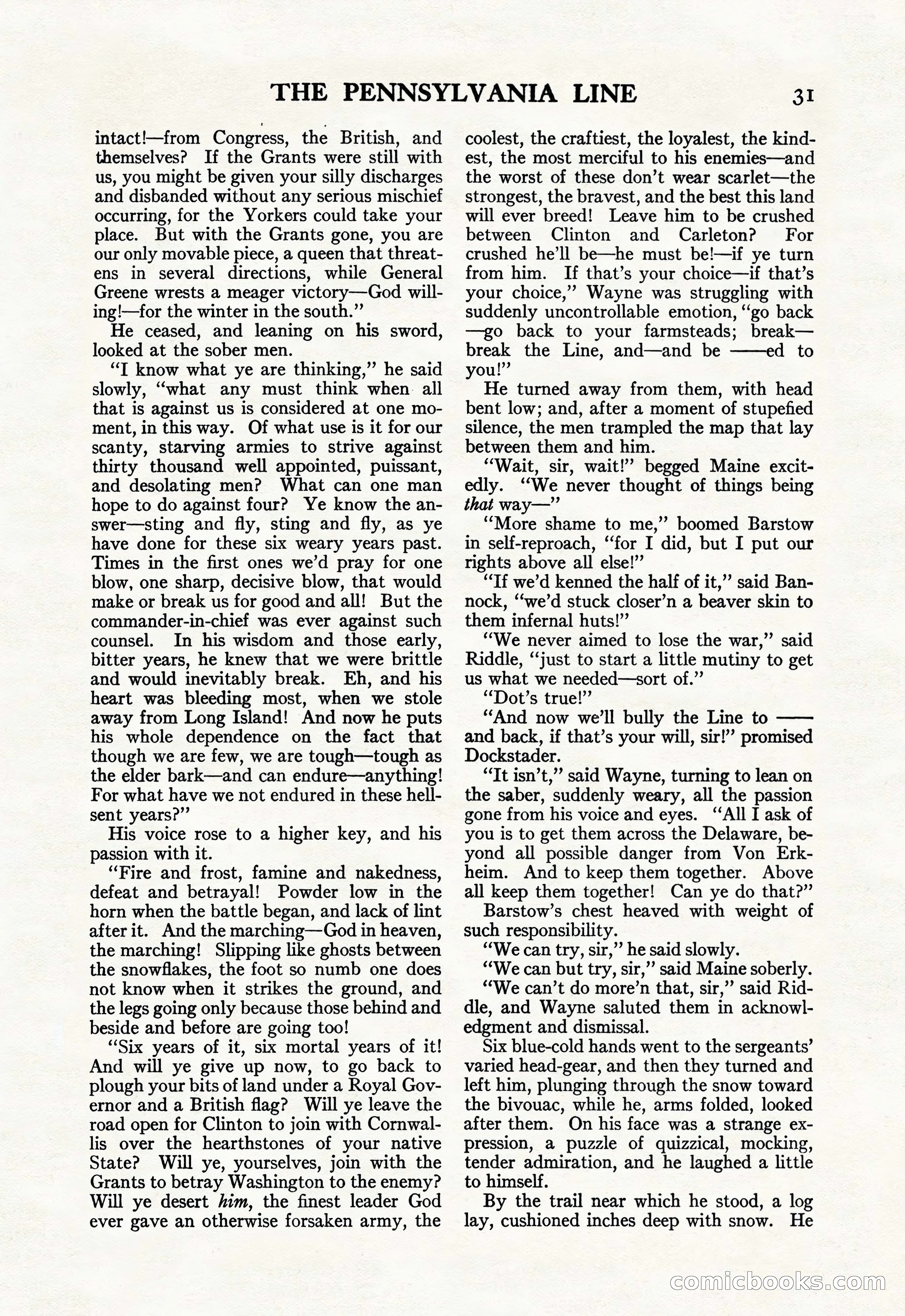
A restored page from Pulp Fiction, 1926. Page through the whole issue in the reader above.
📄 Transcribed text from this page (OCR, searchable)
Machine-transcribed from the original scan — historical spelling and the odd misread are preserved.
THE PENNSYLVANIA LINE intact!—from Congress, the British, and themselves? If the Grants were still with us, you might be given your silly discharges and disbanded without any serious mischief occurring, for the Yorkers could take your place. But with the Grants gone, you are our only movable piece, a queen that threat- ens in several directions, while General Greene wrests a meager victory—God will- ing!—for the winter in the south.” He ceased, and leaning on his sword, looked at the sober men. “T know what ye are thinking,” he said slowly, ““what any must think when. all that is against us is considered at one mo- ment, in this way. Of what use is it for our scanty, starving armies to strive against thirty thousand well appointed, puissant, and desolating men? What can one man hope to do against four? Ye know the an- swer—sting and fly, sting and fly, as ye have done for these six weary years past. Times in the first ones we’d pray for one blow, one sharp, decisive blow, that would make or break us for good and all! But the commander-in-chief was ever against such counsel. In his wisdom and those early, bitter years, he knew that we were brittle and would inevitably break. Eh, and his heart was bleeding most, when we stole away from Long Island! And now he puts his whole dependence on the fact that though we are few, we are tough—tough as the elder bark—and can endure—anything! For what have we not endured in these hell- sent years?” His voice rose to a higher key, and his passion with it. “Fire and frost, famine and nakedness, defeat and betrayal! Powder low in the horn when the battle began, and lack of lint after it. And the marching—God in heaven, the marching! Slipping like ghosts between the snowflakes, the foot so numb one does not know when it strikes the ground, and the legs going only because those behind and beside and before are going too! “Six years of it, six mortal years of it! And will ye give up now, to go back to plough your bits of land under a Royal Gov- ernor and a British flag? Will ye leave the road open for Clinton to join with Cornwal- lis over the hearthstones of your native State? Will ye, yourselves, join with the Grants to betray Washington to the enemy? Will ye desert him, the finest leader God ever gave an otherwise forsaken army, the 31 coolest, the craftiest, the loyalest, the kind- est, the most merciful to his enemies—and the worst of these don’t wear scarlet—the strongest, the bravest, and the best this land will ever breed! Leave him to be crushed between Clinton and Carleton? For crushed he’ll be—he must be!—if ye turn from him. If that’s your choice—if that’s your choice,’ Wayne was struggling with suddenly uncontrollable emotion, ‘‘go back —go back to your farmsteads; break— break the Line, and—and be ——ed to you!” He turned away from them, with head bent low; and, after a moment of stupefied silence, the men trampled the map that lay between them and him. ‘Wait, sir, wait!’ begged Maine excit- edly. ‘We never thought of things being that way—”’ ‘“‘More shame to me,” boomed Barstow in self-reproach, ‘for I did, but I put our rights above all else!” “If we’d kenned the half of it,” said Ban- nock, ‘‘we’d stuck closer’n a beaver skin to them infernal huts!” “‘We never aimed to lose the war,” said Riddle, “just to start a little mutiny to get us what we needed—sort of.”’ ‘“Dot’s true!” “And now we'll bully the Line to —— and back, if that’s your will, sir!” promised Dockstader. “It isn’t,”’ said Wayne, turning to lean on the saber, suddenly weary, all the passion gone from his voice and eyes. ‘All I ask of you is to get them across the Delaware, be- yond all possible danger from Von Erk- heim. And to keep them together. Above all keep them together! Can ye do that?” Barstow’s chest heaved with weight of such responsibility. “We can try, sir,’ he said slowly. “We can but try, sir,” said Maine soberly. “We can’t do more’n that, sir,”’ said Rid- dle, and Wayne saluted them in acknowl- edgment and dismissal. Six blue-cold hands went to the sergeants’ varied head-gear, and then they turned and left him, plunging through the snow toward the bivouac, while he, arms folded, looked after them. On his face was a strange ex- pression, a puzzle of quizzical, mocking, tender admiration, and he laughed a little to himself. By the trail near which he stood, a log lay, cushioned inches deep with snow. He COMMICLOO© S CO