
Pulp Fiction, 1926 · page 199 of 212
Adventure Magazine Cover — page 199: what you’re looking at
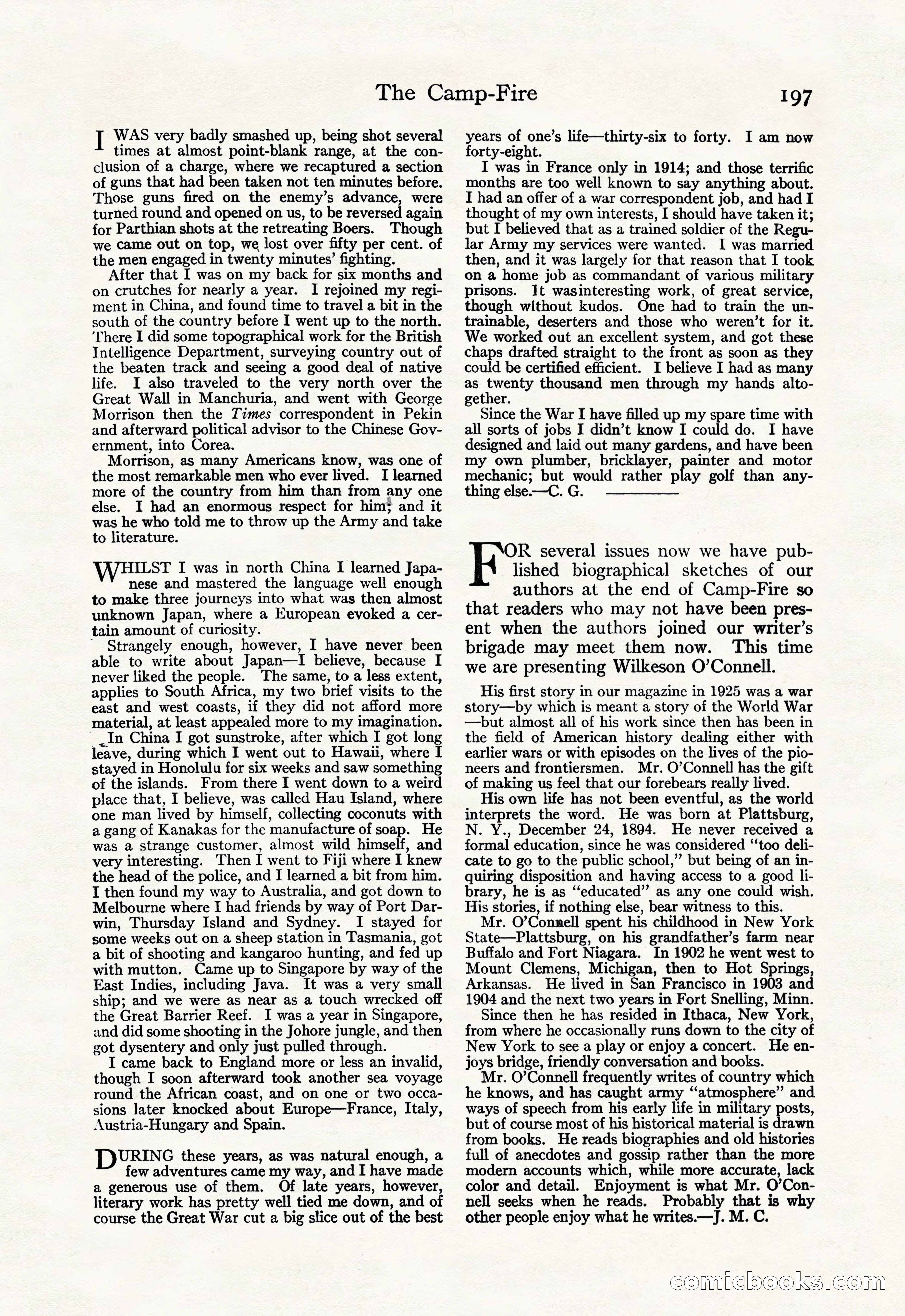
A restored page from Pulp Fiction, 1926. Page through the whole issue in the reader above.
📄 Transcribed text from this page (OCR, searchable)
Machine-transcribed from the original scan — historical spelling and the odd misread are preserved.
The Camp-Fire I WAS very badly smashed up, being shot several times at almost point-blank range, at the con- clusion of a charge, where we recaptured a section of guns that had been taken not ten minutes before. Those guns fired on the enemy’s advance, were turned round and opened on us, to be reversed again for Parthian shots at the retreating Boers. Though we came out on top, we lost over fifty per cent. of the men engaged in twenty minutes’ fighting. After that I was on my back for six months and on crutches for nearly a year. I rejoined my regi- ment in China, and found time to travel a bit in the south of the country before I went up to the north. There I did some topographical work for the British Intelligence Department, surveying country out of the beaten track and seeing a good deal of native life. I also traveled to the very north over the Great Wall in Manchuria, and went with George Morrison then the Times correspondent in Pekin and afterward political advisor to the Chinese Gov- ernment, into Corea. Morrison, as many Americans know, was one of the most remarkable men who ever lived. I learned more of the country from him than from any one else. I had an enormous respect for him; and it was he who told me to throw up the Army and take to literature. ILST I was in north China I learned Japa- nese and mastered the language well enough to make three journeys into what was then almost unknown Japan, where a European evoked a cer- tain amount of curiosity. ' Strangely enough, however, I have never been able to write about Japan—I believe, because I never liked the people. The same, to a less extent, applies to South Africa, my two brief visits to the east and west coasts, if they did not afford more material, at least appealed more to my imagination. _in China I got sunstroke, after which I got long leave, during which I went out to Hawaii, where I stayed in Honolulu for six weeks and saw something of the islands. From there I went down to a weird place that, I believe, was called Hau Island, where one man lived by himself, collecting coconuts with a gang of Kanakas for the manufacture of soap. He was a strange customer, almost wild himself, and very interesting. Then I went to Fiji where I knew the head of the police, and I learned a bit from him. I then found my way to Australia, and got down to Melbourne where I had friends by way of Port Dar- win, Thursday Island and Sydney. I stayed for some weeks out on a sheep station in Tasmania, got a bit of shooting and kangaroo hunting, and fed up with mutton. Came up to Singapore by way of the East Indies, including Java. It was a very small ship; and we were as near as a touch wrecked off the Great Barrier Reef. I was a year in Singapore, and did some shooting in the Johore jungle, and then got dysentery and only just pulled through. I came back to England more or less an invalid, though I soon afterward took another sea voyage round the African coast, and on one or two occa- sions later knocked about Europe—France, Italy, Austria-Hungary and Spain. DURING these years, as was natural enough, a few adventures came my way, and I have made a generous use of them. Of late years, however, literary work has pretty well tied me down, and of course the Great War cut a big slice out of the best 197 years of one’s life—thirty-six to forty. I am now forty-eight. I was in France only in 1914; and those terrific months are too well known to say anything about. I had an offer of a war correspondent job, and had I thought of my own interests, I should have taken it; but I believed that as a trained soldier of the Regu- lar Army my services were wanted. I was married then, and it was largely for that reason that I took on a home job as commandant of various military prisons. It wasinteresting work, of great service, though without kudos. One had to train the un- trainable, deserters and those who weren’t for it. We worked out an excellent system, and got these chaps drafted straight to the front as soon as they could be certified efficient. I believe I had as many as twenty thousand men through my hands alto- gether. Since the War I have filled up my spare time with all sorts of jobs I didn’t know I could do. I have designed and laid out many gardens, and have been my own plumber, bricklayer, painter and motor mechanic; but would rather play golf than any- thing else—C.G. —W——— OR several issues now we have pub- lished biographical sketches of our authors at the end of Camp-Fire so that readers who may not have been pres- ent when the authors joined our writer’s brigade may meet them now. This time we are presenting Wilkeson O’Connell. His first story in our magazine in 1925 was a war story—by which is meant a story of the World War —but almost all of his work since then has been in the field of American history dealing either with earlier wars or with episodes on the lives of the pio- neers and frontiersmen. Mr. O’Connell has the gift of making us feel that our forebears really lived. His own life has not been eventful, as the world interprets the word. He was born at Plattsburg, N. Y., December 24, 1894. He never received a formal education, since he was considered “too deli- cate to go to the public school,” but being of an in- quiring disposition and having access to a good li- brary, he is as ‘‘educated”’ as any one could wish. His stories, if nothing else, bear witness to this. Mr. O’Connmell spent his childhood in New York State—Plattsburg, on his grandfather’s farm near Buffalo and Fort Niagara. In 1902 he went west to Mount Clemens, Michigan, then to Hot Springs, Arkansas. He lived in San Francisco in 1903 and 1904 and the next two years in Fort Snelling, Minn. Since then he has resided in Ithaca, New York, from where he occasionally runs down to the city of New York to see a play or enjoy a concert. He en- joys bridge, friendly conversation and books. Mr. O’Connell frequently writes of country which he knows, and has caught army ‘‘atmosphere” and ways of speech from his early life in military posts, but of course most of his historical material is drawn from books. He reads biographies and old histories full of anecdotes and gossip rather than the more modern accounts which, while more accurate, lack color and detail. Enjoyment is what Mr. O’Con- nell seeks when he reads. Probably that is why other people enjoy what he writes.—J. M. C. COMICLOO© CO