
Pulp Fiction, 1926 · page 196 of 212
Adventure Magazine Cover — page 196: what you’re looking at
A restored page from Pulp Fiction, 1926. Page through the whole issue in the reader above.
📄 Transcribed text from this page (OCR, searchable)
Machine-transcribed from the original scan — historical spelling and the odd misread are preserved.
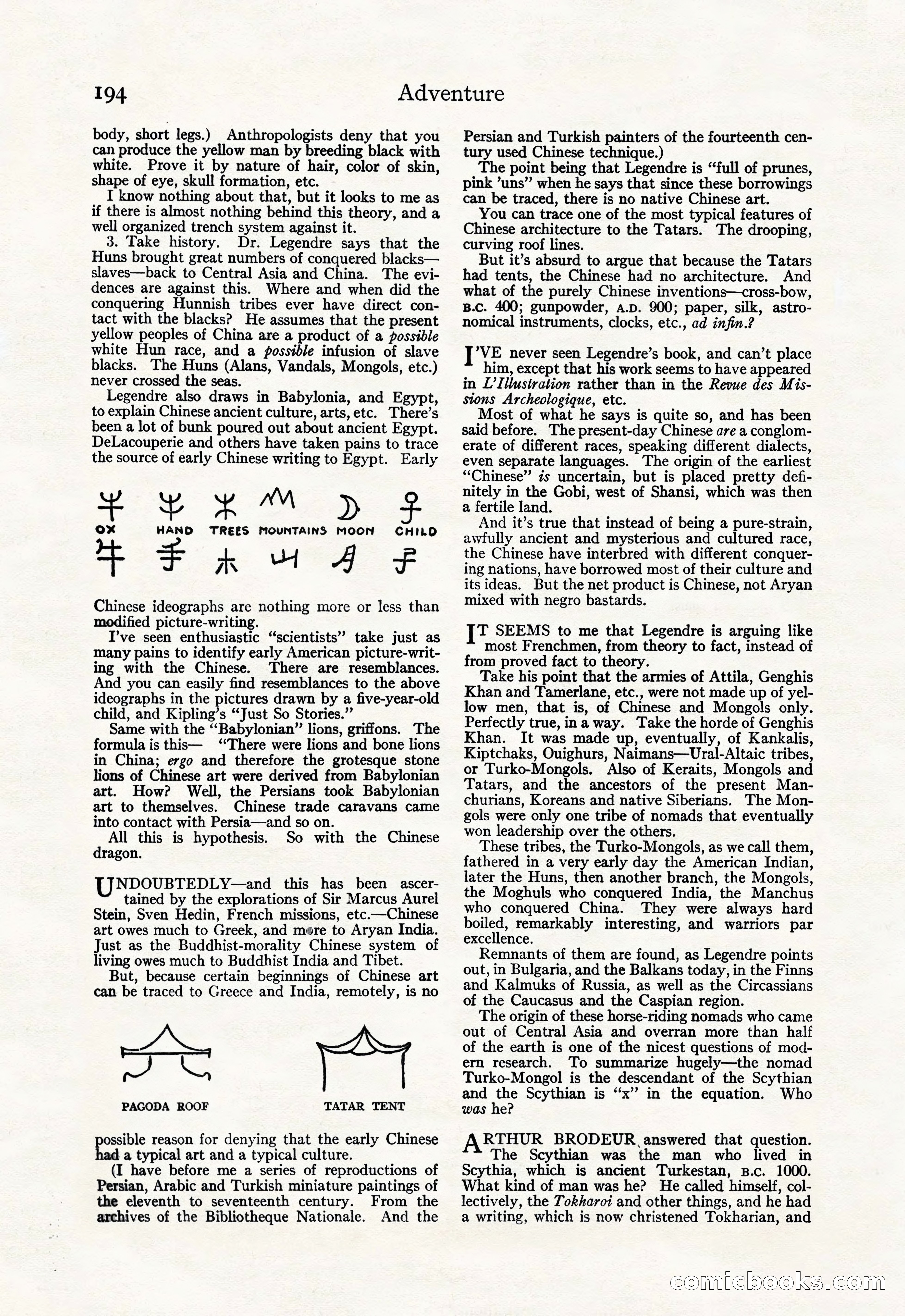
194 body, short legs.) Anthropologists deny that you can produce the yellow man by breeding black with white. Prove it by nature of hair, color of skin, shape of eye, skull formation, etc. I know nothing about that, but it looks to me as if there is almost nothing behind this theory, and a well organized trench system against it. 3. Take history. Dr. Legendre says that the Huns brought great numbers of conquered blacks— slaves—back to Central Asia and China. The evi- dences are against this. Where and when did the conquering Hunnish tribes ever have direct con- tact with the blacks? He assumes that the present yellow peoples of China are a product of a possible white Hun race, and a possible infusion of slave blacks. The Huns (Alans, Vandals, Mongols, etc.) never crossed the seas. Legendre also draws in Babylonia, and Egypt, to explain Chinese ancient culture, arts, etc. There’s been a lot of bunk poured out about ancient Egypt. DeLacouperie and others have taken pains to trace the source of early Chinese writing to Egypt. Early wy ee 3 HAND TREES MOUNTAINS MOON CHILO + tr H A Ff Chinese ideographs are nothing more or less than modified picture-writing. I’ve seen enthusiastic “scientists” take just as many pains to identify early American picture-writ- ing with the Chinese. There are resemblances. And you can easily find resemblances to the above ideographs in the pictures drawn by a five-year-old child, and Kipling’s “Just So Stories.” Same with the ‘‘Babylonian”’ lions, griffons. The formula is this— ‘There were lions and bone lions in China; ergo and therefore the grotesque stone lions of Chinese art were derived from Babylonian art. How? Well, the Persians took Babylonian art to themselves. Chinese trade caravans came into contact with Persia—and so on. All this is hypothesis. So with the Chinese dragon. U NDOUBTEDLY—and this has been ascer- tained by the explorations of Sir Marcus Aurel Stein, Sven Hedin, French missions, etc.—Chinese art owes much to Greek, and mere to Aryan India. Just as the Buddhist-morality Chinese system of living owes much to Buddhist India and Tibet. But, because certain beginnings of Chinese art can be traced to Greece and India, remotely, is no ms PAGODA ROOF TATAR TENT possible reason for denying that the early Chinese had a typical art and a typical culture. (I have before me a series of reproductions of Persian, Arabic and Turkish miniature paintings of the eleventh to seventeenth century. From the archives of the Bibliotheque Nationale. And the Adventure Persian and Turkish painters of the fourteenth cen- tury used Chinese technique.) The point being that Legendre is “full of prunes, pink ’uns” when he says that since these borrowings can be traced, there is no native Chinese art. You can trace one of the most typical features of Chinese architecture to the Tatars. The drooping, curving roof lines. But it’s absurd to argue that because the Tatars had tents, the Chinese had no architecture. And what of the purely Chinese inventions—cross-bow, B.c. 400; gunpowder, A.p. 900; paper, silk, astro- nomical instruments, clocks, etc., ad infin.? "VE never seen Legendre’s book, and can’t place him, except that his work seems to have appeared in L’Illustration rather than in the Revue des Mis- sions Archeologique, etc. Most of what he says is quite so, and has been said before. The present-day Chinese are a conglom- erate of different races, speaking different dialects, even separate languages. The origin of the earliest “Chinese” zs uncertain, but is placed pretty defi- nitely in the Gobi, west of Shansi, which was then a fertile land. And it’s true that instead of being a pure-strain, awfully ancient and mysterious and cultured race, the Chinese have interbred with different conquer- ing nations, have borrowed most of their culture and its ideas. But the net product is Chinese, not Aryan mixed with negro bastards. [t SEEMS to me that Legendre is arguing like most Frenchmen, from theory to fact, instead of from proved fact to theory. Take his point that the armies of Attila, Genghis Khan and Tamerlane, etc., were not made up of yel- low men, that is, of Chinese and Mongols only. Perfectly true, ina way. Take the horde of Genghis Khan. It was made up, eventually, of Kankalis, Kiptchaks, Ouighurs, Naimans—Ural-Altaic tribes, or Turko-Mongols. Also of Keraits, Mongols and Tatars, and the ancestors of the present Man- churians, Koreans and native Siberians. The Mon- gols were only one tribe of nomads that eventually won leadership over the others. These tribes, the Turko-Mongols, as we call them, fathered in a very early day the American Indian, later the Huns, then another branch, the Mongols, the Moghuls who conquered India, the Manchus who conquered China. They were always hard boiled, remarkably interesting, and warriors par excellence. Remnants of them are found, as Legendre points out, in Bulgaria, and the Balkans today, in the Finns and Kalmuks of Russia, as well as the Circassians of the Caucasus and the Caspian region. The origin of these horse-riding nomads who came out of Central Asia and overran more than half of the earth is one of the nicest questions of mod- ern research. To summarize hugely—the nomad Turko-Mongol is the descendant of the Scythian and the Scythian is ‘‘x” in the equation. Who was he? ARTHUR BRODEUR | answered that question. The Scythian was the man who lived in Scythia, which is ancient Turkestan, B.c. 1000. What kind of man was he? He called himself, col- lectively, the Tokharoi and other things, and he had a writing, which is now christened Tokharian, and COMmICLOOO S CO