
Pulp Fiction, 1926 · page 180 of 212
Adventure Magazine Cover — page 180: what you’re looking at
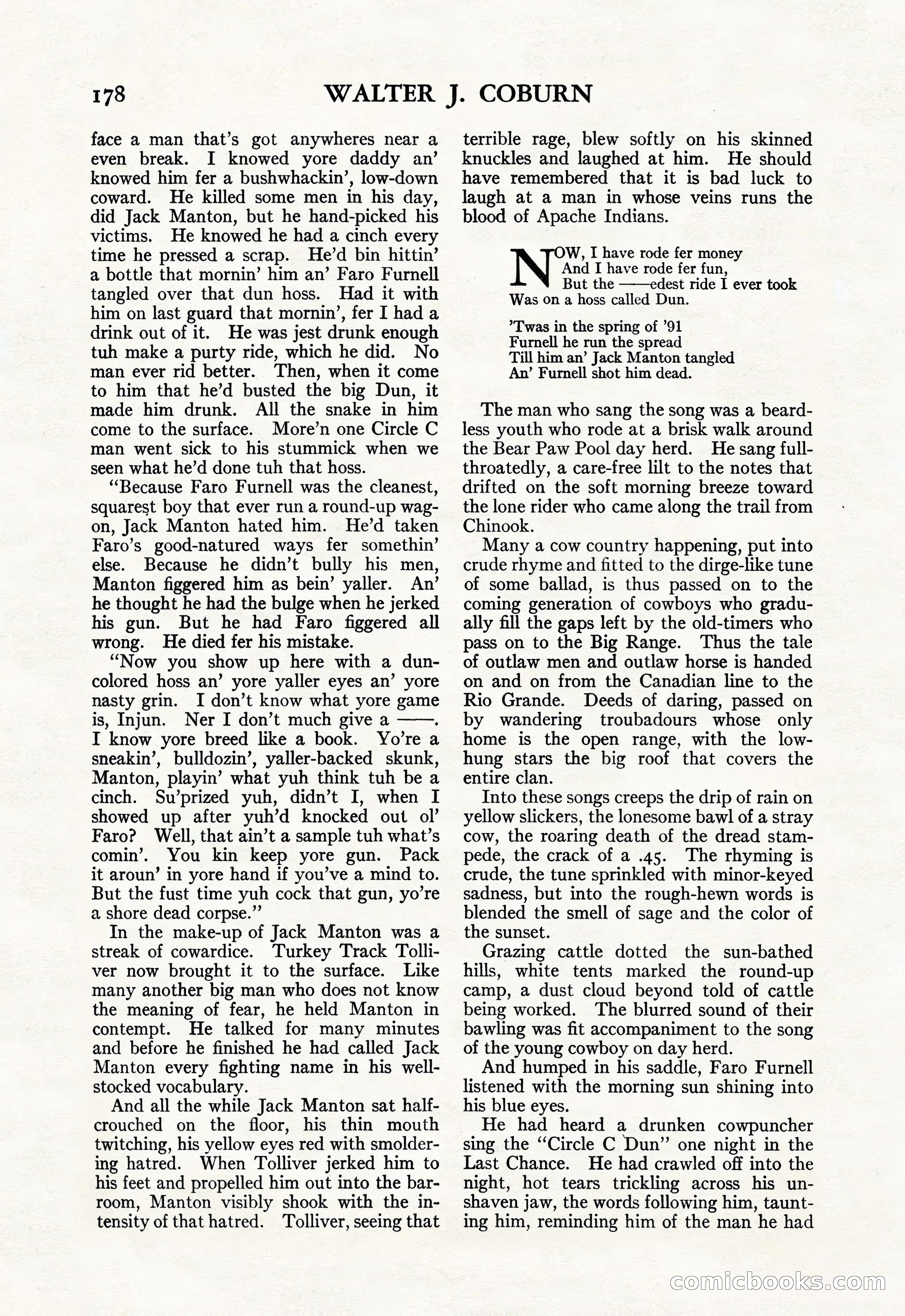
A restored page from Pulp Fiction, 1926. Page through the whole issue in the reader above.
📄 Transcribed text from this page (OCR, searchable)
Machine-transcribed from the original scan — historical spelling and the odd misread are preserved.
178 face a man that’s got anywheres near a even break. I knowed yore daddy an’ knowed him fer a bushwhackin’, low-down coward. He killed some men in his day, did Jack Manton, but he hand-picked his victims. He knowed he had a cinch every time he pressed a scrap. He’d bin hittin’ a bottle that mornin’ him an’ Faro Furnell tangled over that dun hoss. Had it with him on last guard that mornin’, fer I had a drink out of it. He was jest drunk enough tuh make a purty ride, which he did. No man ever rid better. Then, when it come to him that he’d busted the big Dun, it made him drunk. All the snake in him come to the surface. More’n one Circle C man went sick to his stummick when we seen what he’d done tuh that hoss. “Because Faro Furnell was the cleanest, squarest boy that ever run a round-up wag- on, Jack Manton hated him. He’d taken Faro’s good-natured ways fer somethin’ else. Because he didn’t bully his men, Manton figgered him as bein’ yaller. An’ he thought he had the bulge when he jerked his gun. But he had Faro figgered all wrong. He died fer his mistake. “Now you show up here with a dun- colored hoss an’ yore yaller eyes an’ yore nasty grin. I don’t know what yore game is, Injun. Ner I don’t much give a : I know yore breed like a book. Yo’re a sneakin’, bulldozin’, yaller-backed skunk, Manton, playin’ what yuh think tuh be a cinch. Su’prized yuh, didn’t I, when I showed up after yuh’d knocked out ol’ Faro? Well, that ain’t a sample tuh what’s comin’. You kin keep yore gun. Pack it aroun’ in yore hand if you’ve a mind to. But the fust time yuh cock that gun, yo’re a shore dead corpse.”’ In the make-up of Jack Manton was a streak of cowardice. Turkey Track Tolli- ver now brought it to the surface. Like many another big man who does not know the meaning of fear, he held Manton in contempt. He talked for many minutes and before he finished he had called Jack Manton every fighting name in his well- stocked vocabulary. And all the while Jack Manton sat half- crouched on the floor, his thin mouth twitching, his yellow eyes red with smolder- ing hatred. When Tolliver jerked him to his feet and propelled him out into the bar- room, Manton visibly shook with the in- tensity of that hatred. Tolliver, seeing that WALTER J. COBURN terrible rage, blew softly on his skinned knuckles and laughed at him. He should have remembered that it is bad luck to laugh at a man in whose veins runs the blood of Apache Indians. W, I have rode fer money And I have rode fer fun, But the edest ride I ever took Was on a hoss called Dun. ’Twas in the spring of ’91 Furnell he run the spread Till him an’ Jack Manton tangled An’ Furnell shot him dead. The man who sang the song was a beard- less youth who rode at a brisk walk around the Bear Paw Pool day herd. He sang full- throatedly, a care-free lilt to the notes that drifted on the soft morning breeze toward the lone rider who came along the trail from Chinook. Many a cow country happening, put into crude rhyme and fitted to the dirge-like tune of some ballad, is thus passed on to the coming generation of cowboys who gradu- ally fill the gaps left by the old-timers who pass on to the Big Range. Thus the tale of outlaw men and outlaw horse is handed on and on from the Canadian line to the Rio Grande. Deeds of daring, passed on by wandering troubadours whose only home is the open range, with the low- hung stars the big roof that covers the entire clan. Into these songs creeps the drip of rain on yellow slickers, the lonesome bawl of a stray cow, the roaring death of the dread stam- pede, the crack of a .45. The rhyming is crude, the tune sprinkled with minor-keyed sadness, but into the rough-hewn words is blended the smell of sage and the color of the sunset. Grazing cattle dotted the sun-bathed hills, white tents marked the round-up camp, a dust cloud beyond told of cattle being worked. The blurred sound of their bawling was fit accompaniment to the song of the young cowboy on day herd. And humped in his saddle, Faro Furnell listened with the morning sun shining into his blue eyes. He had heard a drunken cowpuncher sing the “Circle C Dun” one night in the Last Chance. He had crawled off into the night, hot tears trickling across his un- shaven jaw, the words following him, taunt- ing him, reminding him of the man he had COmICLOOO S CO