
Pulp Fiction, 1926 · page 174 of 212
Adventure Magazine Cover — page 174: what you’re looking at
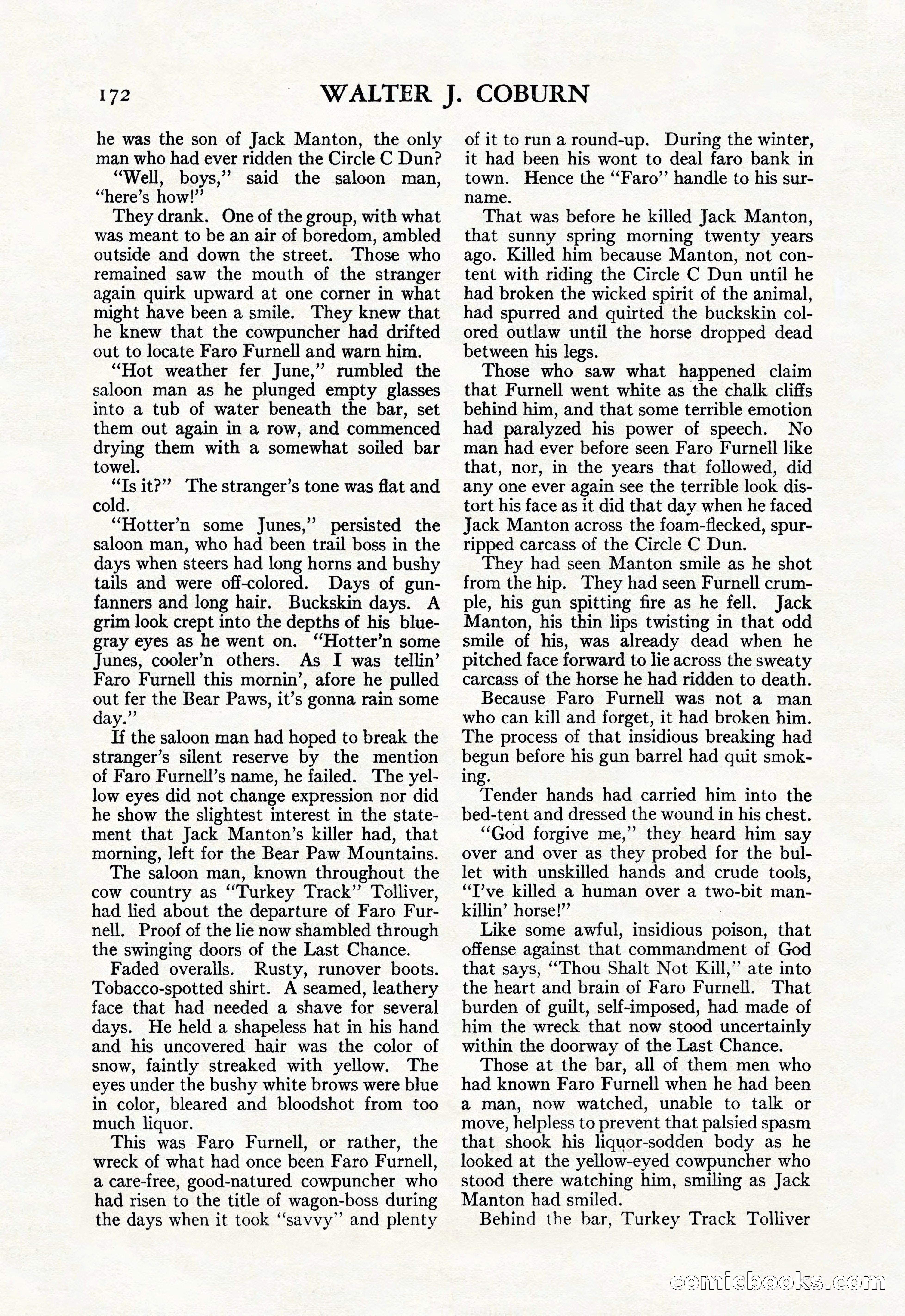
A restored page from Pulp Fiction, 1926. Page through the whole issue in the reader above.
📄 Transcribed text from this page (OCR, searchable)
Machine-transcribed from the original scan — historical spelling and the odd misread are preserved.
172 he was the son of Jack Manton, the only man who had ever ridden the Circle C Dun? “Well, boys,” said the saloon man, “here’s how!” They drank. One of the group, with what was meant to be an air of boredom, ambled outside and down the street. Those who remained saw the mouth of the stranger again quirk upward at one corner in what might have been a smile. They knew that he knew that the cowpuncher had drifted out to locate Faro Furnell and warn him. “Hot weather fer June,” rumbled the saloon man as he plunged empty glasses into a tub of water beneath the bar, set them out again in a row, and commenced drying them with a somewhat soiled bar towel. “Ts it?” The stranger’s tone was flat and cold. ‘“‘Hotter’n some Junes,’’ persisted the saloon man, who had been trail boss in the days when steers had long horns and bushy tails and were off-colored. Days of gun- fanners and long hair. Buckskin days. A grim look crept into the depths of his blue- gray eyes as he went on. ‘“‘Hotter’n some Junes, cooler’n others. As I was tellin’ Faro Furnell this mornin’, afore he pulled out fer the Bear Paws, it’s gonna rain some day.” If the saloon man had hoped to break the stranger’s silent reserve by the mention of Faro Furnell’s name, he failed. The yel- low eyes did not change expression nor did he show the slightest interest in the state- ment that Jack Manton’s killer had, that morning, left for the Bear Paw Mountains. The saloon man, known throughout the cow country as “Turkey Track” Tolliver, had lied about the departure of Faro Fur- nell. Proof of the lie now shambled through the swinging doors of the Last Chance. Faded overalls. Rusty, runover boots. Tobacco-spotted shirt. A seamed, leathery face that had needed a shave for several days. He held a shapeless hat in his hand and his uncovered hair was the color of snow, faintly streaked with yellow. The eyes under the bushy white brows were blue in color, bleared and bloodshot from too much liquor. This was Faro Furnell, or rather, the wreck of what had once been Faro Furnell, a care-free, good-natured cowpuncher who had risen to the title of wagon-boss during the days when it took “savvy” and plenty WALTER J. COBURN of it toruna round-up. During the winter, it had been his wont to deal faro bank in town. Hence the “Faro’’ handle to his sur- name. That was before he killed Jack Manton, that sunny spring morning twenty years ago. Killed him because Manton, not con- tent with riding the Circle C Dun until he had broken the wicked spirit of the animal, had spurred and quirted the buckskin col- ored outlaw until the horse dropped dead between his legs. Those who saw what happened claim that Furnell went white as the chalk cliffs behind him, and that some terrible emotion had paralyzed his power of speech. No man had ever before seen Faro Furnell like that, nor, in the years that followed, did any one ever again see the terrible look dis- tort his face as it did that day when he faced Jack Manton across the foam-flecked, spur- ripped carcass of the Circle C Dun. They had seen Manton smile as he shot from the hip. They had seen Furnell crum- ple, his gun spitting fire as he fell. Jack Manton, his thin lips twisting in that odd smile of his, was already dead when he pitched face forward to lie across the sweaty carcass of the horse he had ridden to death. Because Faro Furnell was not a man who can kill and forget, it had broken him. The process of that insidious breaking had begun before his gun barrel had quit smok- ing. Tender hands had carried him into the bed-tent and dressed the wound in his chest. “God forgive me,” they heard him say over and over as they probed for the bul- let with unskilled hands and crude tools, “T’ve killed a human over a two-bit man- killin’ horse!”’ . Like some awful, insidious poison, that offense against that commandment of God that says, ‘“Thou Shalt Not Kill,” ate into the heart and brain of Faro Furnell. That burden of guilt, self-imposed, had made of him the wreck that now stood uncertainly within the doorway of the Last Chance. Those at the bar, all of them men who had known Faro Furnell when he had been a man, now watched, unable to talk or move, helpless to prevent that palsied spasm that shook his liquor-sodden body as he looked at the yellow-eyed cowpuncher who stood there watching him, smiling as Jack Manton had smiled. Behind the bar, Turkey Track Tolliver CORICOOO S CO