
Pulp Fiction, 1926 · page 171 of 212
Adventure Magazine Cover — page 171: what you’re looking at
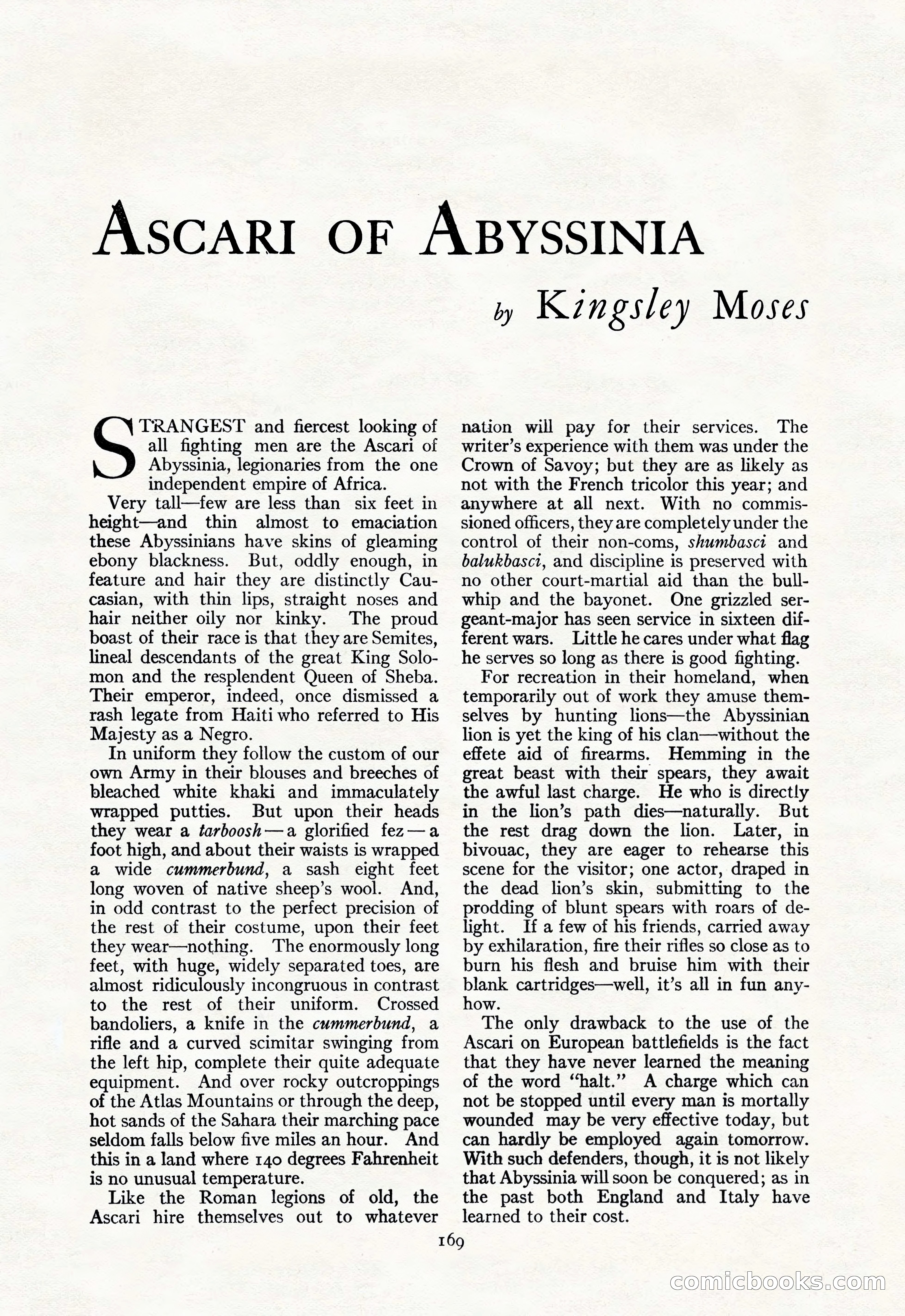
A restored page from Pulp Fiction, 1926. Page through the whole issue in the reader above.
📄 Transcribed text from this page (OCR, searchable)
Machine-transcribed from the original scan — historical spelling and the odd misread are preserved.
ASCARI OF ABYSSINIA TRANGEST and fiercest looking of all fighting men are the Ascari of Abyssinia, legionaries from the one independent empire of Africa. Very tall—few are less than six feet in height—and thin almost to emaciation these Abyssinians have skins of gleaming ebony blackness. But, oddly enough, in feature and hair they are distinctly Cau- casian, with thin lips, straight noses and hair neither oily nor kinky. The proud boast of their race is that they are Semites, lineal descendants of the great King Solo- mon and the resplendent Queen of Sheba. Their emperor, indeed, once dismissed a rash legate from Haiti who referred to His Majesty as a Negro. In uniform they follow the custom of our own Army in their blouses and breeches of bleached white khaki and immaculately wrapped putties. But upon their heads they wear a tarboosh—a glorified fez—a foot high, and about their waists is wrapped a wide cummerbund, a sash eight feet long woven of native sheep’s wool. And, in odd contrast to the perfect precision of the rest of their costume, upon their feet they wear—nothing. The enormously long feet, with huge, widely separated toes, are almost ridiculously incongruous in contrast to the rest of their uniform. Crossed bandoliers, a knife in the cummerbund, a rifle and a curved scimitar swinging from the left hip, complete their quite adequate equipment. And over rocky outcroppings of the Atlas Mountains or through the deep, hot sands of the Sahara their marching pace seldom falls below five miles an hour. And this in a land where 140 degrees Fahrenheit is no unusual temperature. Like the Roman legions of old, the Ascari hire themselves out to whatever ty Kingsley Moses nation will pay for their services. The writer’s experience with them was under the Crown of Savoy; but they are as likely as not with the French tricolor this year; and anywhere at all next. With no commis- sioned officers, they are completely under the control of their non-coms, shumbasct and balukbasct, and discipline is preserved with no other court-martial aid than the bull- whip and the bayonet. One grizzled ser- geant-major has seen service in sixteen dif- ferent wars. Little he cares under what flag he serves so long as there is good fighting. For recreation in their homeland, when temporarily out of work they amuse them- selves by hunting lions—the Abyssinian lion is yet the king of his clan—without the effete aid of firearms. Hemming in the great beast with their spears, they await the awful last charge. He who is directly in the lion’s path dies—naturally. But the rest drag down the lion. Later, in bivouac, they are eager to rehearse this scene for the visitor; one actor, draped in the dead lion’s skin, submitting to the prodding of blunt spears with roars of de- light. If a few of his friends, carried away by exhilaration, fire their rifles so close as to burn his flesh and bruise him with their blank cartridges—well, it’s all in fun any- how. The only drawback to the use of the Ascari on European battlefields is the fact that they have never learned the meaning of the word “halt.” A charge which can not be stopped until every man is mortally wounded may be very effective today, but can hardly be employed again tomorrow. With such defenders, though, it is not likely that Abyssinia will soon be conquered; as in the past both England and Italy have learned to their cost. 169 comiclboo CO