
Pulp Fiction, 1926 · page 14 of 212
Adventure Magazine Cover — page 14: what you’re looking at
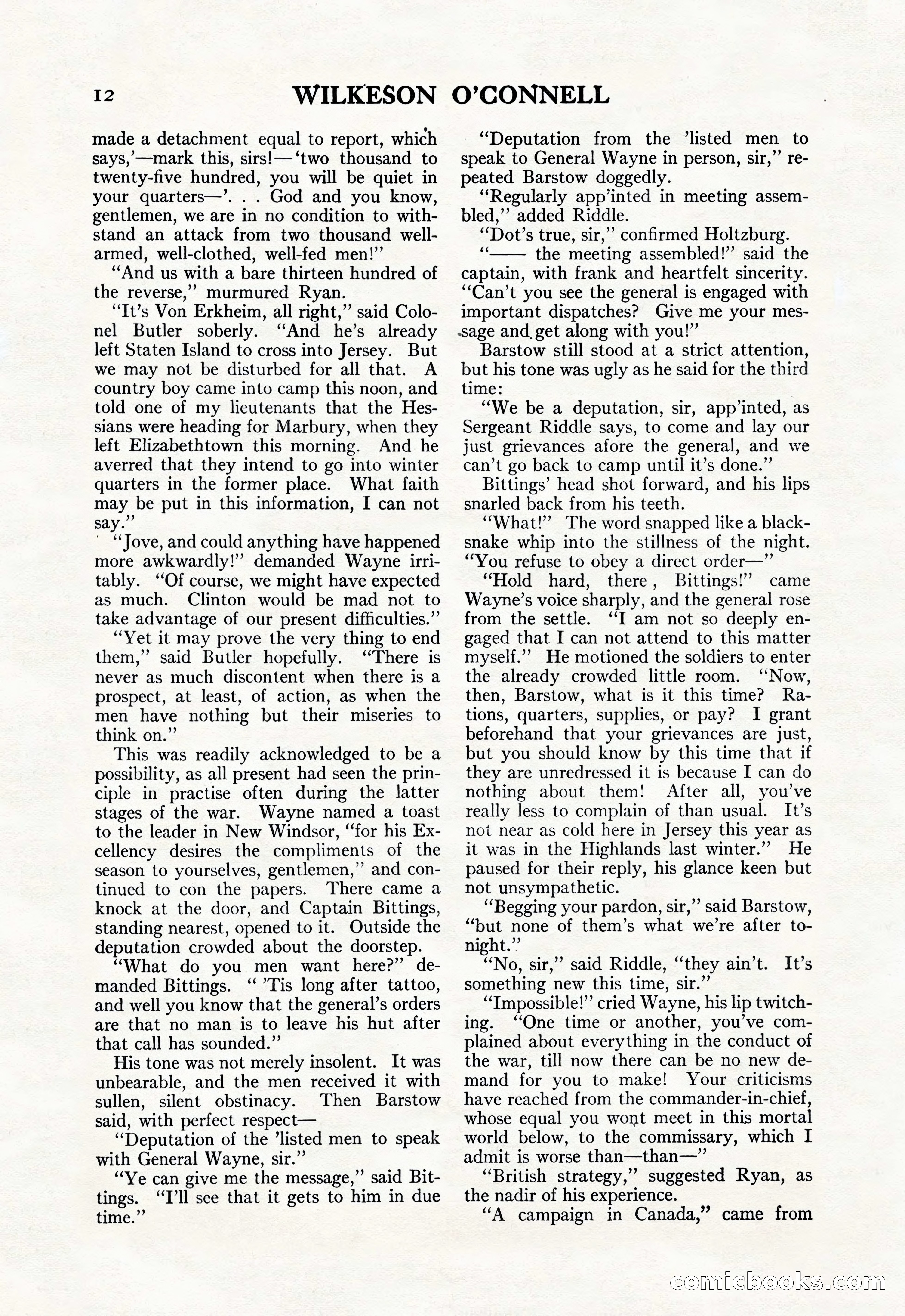
A restored page from Pulp Fiction, 1926. Page through the whole issue in the reader above.
📄 Transcribed text from this page (OCR, searchable)
Machine-transcribed from the original scan — historical spelling and the odd misread are preserved.
12 WILKESON made a detachment equal to report, which says, —mark this, sirs!—‘two thousand to twenty-five hundred, you will be quiet in your quarters—’. . . God and you know, gentlemen, we are in no condition to with- stand an attack from two thousand well- armed, well-clothed, well-fed men!”’ ‘And us with a bare thirteen hundred of the reverse,” murmured Ryan. “It’s Von Erkheim, all right,’ said Colo- nel Butler soberly. “And he’s already left Staten Island to cross into Jersey. But we may not be disturbed for all that. A country boy came into camp this noon, and told one of my lieutenants that the Hes- sians were heading for Marbury, when they left Elizabethtown this morning. And he averred that they intend to go into winter quarters in the former place. What faith may be put in this information, I can not say.” ‘‘Jove, and could anything have happened more awkwardly!’ demanded Wayne irri- tably. “Of course, we might have expected as much. Clinton would be mad not to take advantage of our present difficulties.” ‘Yet it may prove the very thing to end them,” said Butler hopefully. “There is never as much discontent when there is a prospect, at least, of action, as when the men have nothing but their miseries to think on.”’ This was readily acknowledged to be a possibility, as all present had seen the prin- ciple in practise often during the latter stages of the war. Wayne named a toast to the leader in New Windsor, “‘for his Ex- cellency desires the compliments of the season to yourselves, gentlemen,” and con- tinued to con the papers. There came a knock at the door, and Captain Bittings, standing nearest, opened to it. Outside the deputation crowded about the doorstep. “What do you men want here?” de- manded Bittings. ‘“‘ ’Tis long after tattoo, and well you know that the general’s orders are that no man is to leave his hut after that call has sounded.” His tone was not merely insolent. It was unbearable, and the men received it with sullen, silent obstinacy. Then Barstow said, with perfect respect— “Deputation of the ’listed men to speak with General Wayne, sir.”’ “Ye can give me the message,’ said Bit- tings. “I’ll see that it gets to him in due time.” O’CONNELL -“Deputation from the ’listed men to speak to General Wayne in person, sir,’’ re- peated Barstow doggedly. “Regularly app’inted in meeting assem- bled,’’ added Riddle. “Dot’s true, sir,’ confirmed Holtzburg. the meeting assembled!”’ said the captain, with frank and heartfelt sincerity. ‘‘Can’t you see the general is engaged with important dispatches? Give me your mes- sage and get along with you!” Barstow still stood at a strict attention, but his tone was ugly as he said for the third time: “We be a deputation, sir, app’inted, as Sergeant Riddle says, to come and lay our just grievances afore the general, and we can’t go back to camp until it’s done.” Bittings’ head shot forward, and his lips snarled back from his teeth. “What!” The word snapped like a black- snake whip into the stillness of the night. “You refuse to obey a direct order—”’ “Hold hard, there, Bittings!’’ came Wayne’s voice sharply, and the general rose from the settle. “I am not so deeply en- gaged that I can not attend to this matter myself.’’ He motioned the soldiers to enter the already crowded little room. ‘Now, then, Barstow, what is it this time? Ra- tions, quarters, supplies, or pay? I grant beforehand that your grievances are just, but you should know by this time that if they are unredressed it is because I can do nothing about them! After all, you’ve really less to complain of than usual. It’s not near as cold here in Jersey this year as it was in the Highlands last winter.” He paused for their reply, his glance keen but not unsympathetic. “Begging your pardon, sir,” said Barstow, “but none of them’s what we’re after to- night.” “No, sir,” said Riddle, ‘‘they ain’t. It’s something new this time, sir.” “Tmpossible!”’ cried Wayne, his lip twitch- ing. ‘One time or another, you’ve com- plained about everything in the conduct of the war, till now there can be no new de- mand for you to make! Your criticisms have reached from the commander-in-chief, whose equal you wont meet in this mortal world below, to the commissary, which I admit is worse than—than—” “British strategy,’’ suggested Ryan, as the nadir of his experience. “A campaign in Canada,” came from cComicloo S CO