
Pulp Fiction, 1926 · page 99 of 232
Adventure Magazine Cover — page 99: what you’re looking at
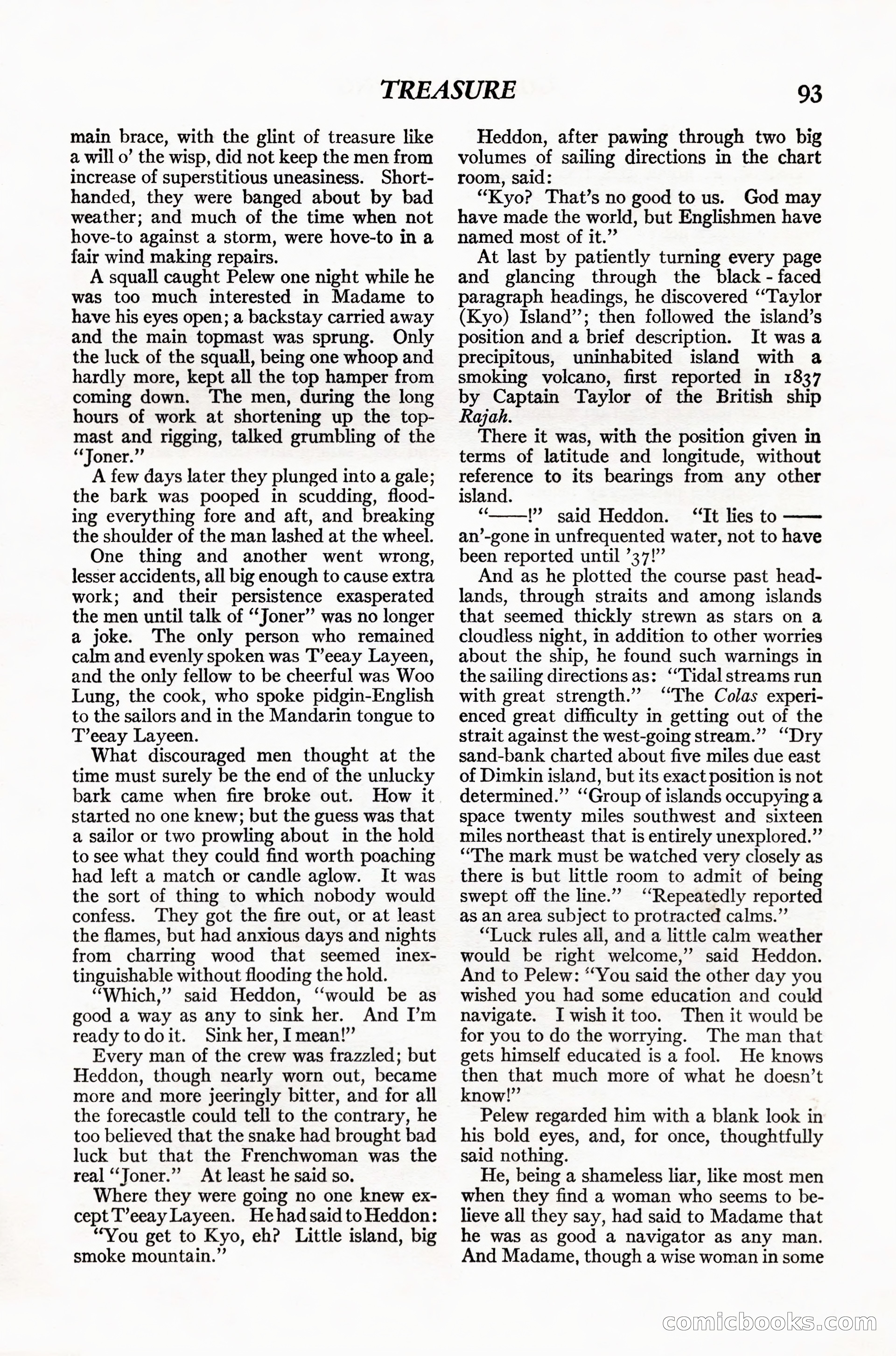
A restored page from Pulp Fiction, 1926. Page through the whole issue in the reader above.
📄 Transcribed text from this page (OCR, searchable)
Machine-transcribed from the original scan — historical spelling and the odd misread are preserved.
TREASURE 93 main brace, with the glint of treasure like a will o’ the wisp, did not keep the men from increase of superstitious uneasiness. Short- handed, they were banged about by bad weather; and much of the time when not hove-to against a storm, were hove-to in a fair wind making repairs. A squall caught Pelew one night while he was too much interested in Madame to have his eyes open; a backstay carried away and the main topmast was sprung. Only the luck of the squall, being one whoop and hardly more, kept all the top hamper from coming down. The men, during the long hours of work at shortening up the top- mast and rigging, talked grumbling of the “"Jouer.”” A few days later they plunged into a gale; the bark was pooped in scudding, flood- ing everything fore and aft, and breaking the shoulder of the man lashed at the wheel. One thing and another went wrong, lesser accidents, all big enough to cause extra work; and their persistence exasperated the men until talk of ‘“Joner’’ was no longer a joke. The only person who remained calm and evenly spoken was T’eeay Layeen, and the only fellow to be cheerful was Woo Lung, the cook, who spoke pidgin-English to the sailors and in the Mandarin tongue to T’eeay Layeen. What discouraged men thought at the time must surely be the end of the unlucky bark came when fire broke out. How it started no one knew; but the guess was that a sailor or two prowling about in the hold to see what they could find worth poaching had left a match or candle aglow. It was the sort of thing to which nobody would confess. ‘They got the fire out, or at least the flames, but had anxious days and nights from charring wood that seemed inex- tinguishable without flooding the hold. “Which,” said Heddon, “would be as good a way as any to sink her. And I’m ready todoit. Sink her, I mean!” Every man of the crew was frazzled; but Heddon, though nearly worn out, became more and more jeeringly bitter, and for all the forecastle could tell to the contrary, he too believed that the snake had brought bad luck but that the Frenchwoman was the real ‘‘Joner.” At least he said so. Where they were going no one knew ex- cept T’eeay Layeen. Hehad said to Heddon: “You get to Kyo, eh? Little island, big smoke mountain.” Heddon, after pawing through two big volumes of sailing directions in the chart room, said: “Kyor That’s no good to us. God may have made the world, but Englishmen have named most of it.” At last by patiently turning every page and glancing through the black - faced paragraph headings, he discovered ‘““Taylor (Kyo) Island”; then followed the island’s position and a brief description. It was a precipitous, uninhabited island with a smoking volcano, first reported in 1837 by Captain Taylor of the British ship Rajah. There it was, with the position given in terms of latitude and longitude, without reference to its bearings from any other island. “‘____!? said Heddon. “It lies to —— an’-gone in unfrequented water, not to have been reported until ’37!”’ And as he plotted the course past head- lands, through straits and among islands that seemed thickly strewn as stars on a cloudless night, in addition to other worries about the ship, he found such warnings in the sailing directions as: ‘“Tidal streams run with great strength.” ‘The Colas experi- enced great difficulty in getting out of the strait against the west-going stream.” “Dry sand-bank charted about five miles due east of Dimkin island, but its exact position is not determined.”’ “Group of islands occupying a space twenty miles southwest and sixteen miles northeast that is entirely unexplored.” ‘The mark must be watched very closely as there is but little room to admit of being swept off the line.” ‘‘Repeatedly reported as an area subject to protracted calms.” “Luck rules all, and a little calm weather would be right welcome,” said Heddon. And to Pelew: “‘You said the other day you wished you had some education and could navigate. Iwishit too. Then it would be for you to do the worrying. The man that gets himself educated is a fool. He knows then that much more of what he doesn’t know!” Pelew regarded him with a blank look in his bold eyes, and, for once, thoughtfully said nothing. He, being a shameless liar, like most men when they find a woman who seems to be- lieve all they say, had said to Madame that he was as good a navigator as any man. And Madame, though a wise woman in some COmiclbooks.c©