
Pulp Fiction, 1926 · page 95 of 232
Adventure Magazine Cover — page 95: what you’re looking at
A restored page from Pulp Fiction, 1926. Page through the whole issue in the reader above.
📄 Transcribed text from this page (OCR, searchable)
Machine-transcribed from the original scan — historical spelling and the odd misread are preserved.
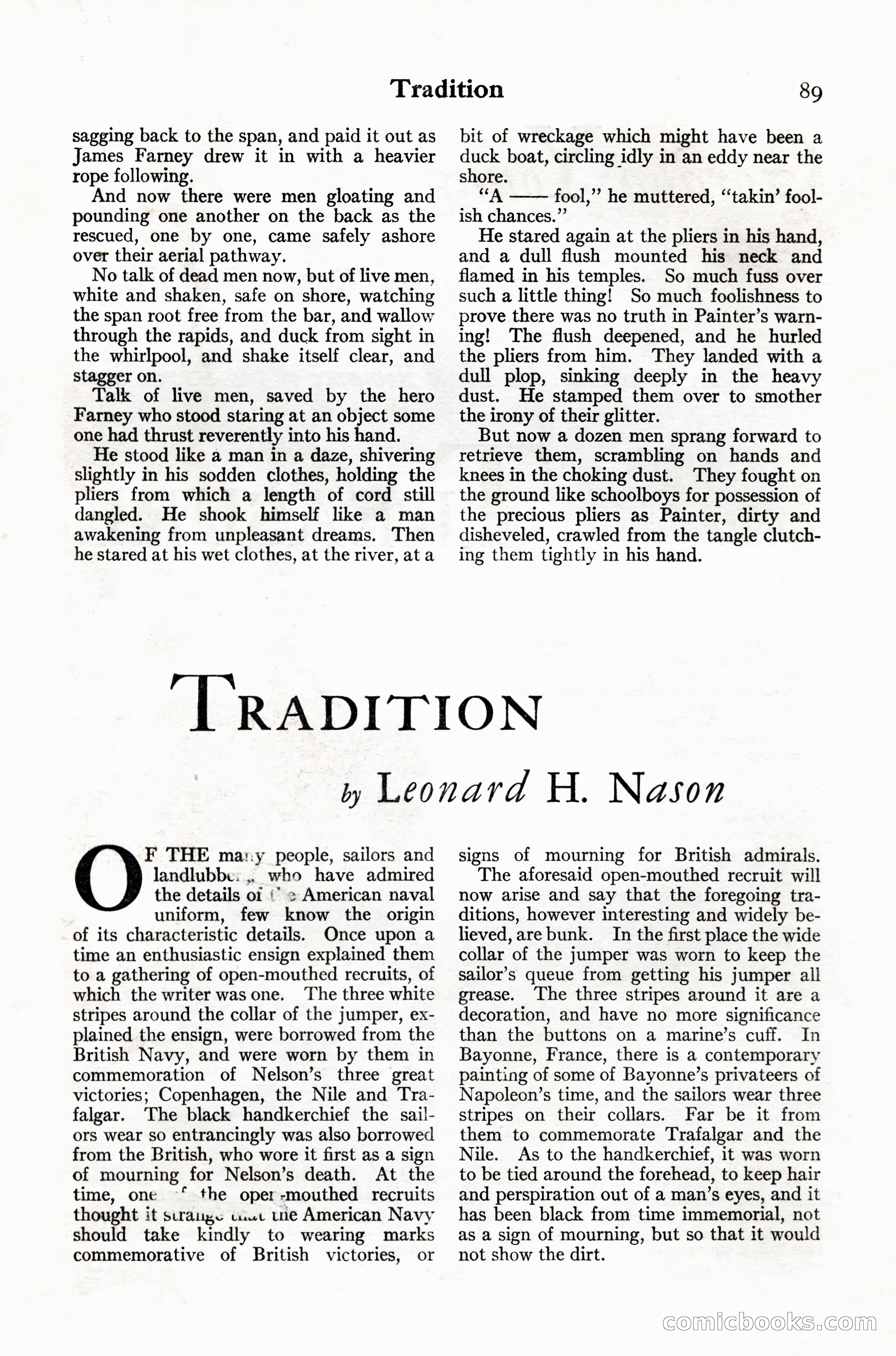
Tradition sagging back to the span, and paid it out as James Farney drew it in with a heavier rope following. And now there were men gloating and pounding one another on the back as the rescued, one by one, came safely ashore over their aerial pathway. No talk of dead men now, but of live men, white and shaken, safe on shore, watching the span root free from the bar, and wallow through the rapids, and duck from sight in the whirlpool, and shake itself clear, and stagger on. Talk of live men, saved by the hero Farney who stood staring at an object some one had thrust reverently into his hand. He stood like a man in a daze, shivering slightly in his sodden clothes, holding the pliers from which a length of cord still dangled. He shook himself like a man awakening from unpleasant dreams. Then he stared at his wet clothes, at the river, at a 89 bit of wreckage which might have been a duck boat, circling idly in an eddy near the shore. “A fool,’”’ he muttered, ‘‘takin’ fool- ish chances.”’ : He stared again at the pliers in his hand, and a dull flush mounted his neck and flamed in his temples. So much fuss over such a little thing! So much foolishness to prove there was no truth in Painter’s warn- ing! The flush deepened, and he hurled the pliers from him. They landed with a dull plop, sinking deeply in the heavy dust. He stamped them over to smother the irony of their glitter. But now a dozen men sprang forward to retrieve them, scrambling on hands and knees in the choking dust. They fought on the ground like schoolboys for possession of the precious pliers as Painter, dirty and disheveled, crawled from the tangle clutch- ing them tightly in his hand. “TRADITION w Leonard H. Nason F THE masy people, sailors and landlubbe: ,, who have admired the details oi ‘° 2 American naval uniform, few know the origin of its characteristic details. Once upon a time an enthusiastic ensign explained them to a gathering of open-mouthed recruits, of which the writer was one. The three white stripes around the collar of the jumper, ex- plained the ensign, were borrowed from the British Navy, and were worn by them in commemoration of Nelson’s three great victories; Copenhagen, the Nile and Tra- falgar. The black handkerchief the sail- ors wear so entrancingly was also borrowed from the British, who wore it first as a sign of mourning for Nelson’s death. At the time, one ©‘ the oper-mouthed recruits thought it surange uu ue American Navy should take kindly to wearing marks commemorative of British victories, or signs of mourning for British admirals. The aforesaid open-mouthed recruit will now arise and say that the foregoing tra- ditions, however interesting and widely be- lieved, are bunk. In the first place the wide collar of the jumper was worn to keep the sailor’s queue from getting his jumper all grease. The three stripes around it are a decoration, and have no more significance than the buttons on a marine’s cuff. In Bayonne, France, there is a contemporary painting of some of Bayonne’s privateers of Napoleon’s time, and the sailors wear three stripes on their collars. Far be it from them to commemorate Trafalgar and the Nile. As to the handkerchief, it was worn to be tied around the forehead, to keep hair and perspiration out of a man’s eyes, and it has been black from time immemorial, not as a sign of mourning, but so that it would not show the dirt. DOOLK C©