
Pulp Fiction, 1926 · page 73 of 232
Adventure Magazine Cover — page 73: what you’re looking at
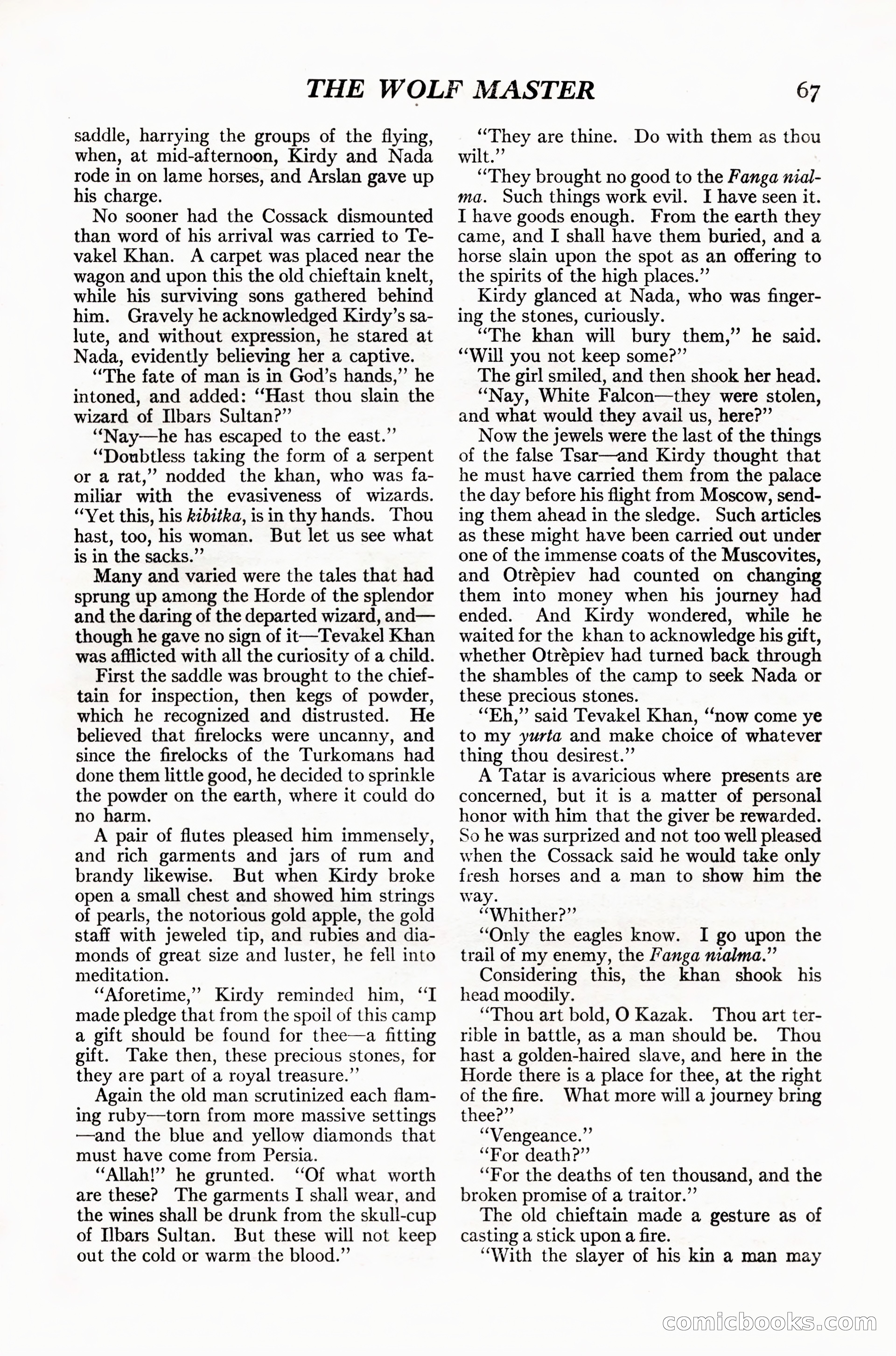
A restored page from Pulp Fiction, 1926. Page through the whole issue in the reader above.
📄 Transcribed text from this page (OCR, searchable)
Machine-transcribed from the original scan — historical spelling and the odd misread are preserved.
THE WOLF MASTER saddle, harrying the groups of the flying, when, at mid-afternoon, Kirdy and Nada rode in on Jame horses, and Arslan gave up his charge. No sooner had the Cossack dismounted than word of his arrival was carried to Te- vakel Khan. A carpet was placed near the wagon and upon this the old chieftain knelt, while his surviving sons gathered behind him. Gravely he acknowledged Kirdy’s sa- lute, and without expression, he stared at Nada, evidently believing her a captive. “The fate of man is in God’s hands,” he intoned, and added: “‘Hast thou slain the wizard of Ilbars Sultan?” ‘‘Nay—he has escaped to the east.”’ “Doubtless taking the form of a serpent or a rat,” nodded the khan, who was fa- miliar with the evasiveness of wizards. “Vet this, his kzbitka, isin thy hands. Thou hast, too, his woman. But let us see what is in the sacks.” Many and varied were the tales that had sprung up among the Horde of the splendor and the daring of the departed wizard, and— though he gave no sign of it—Tevakel Khan was afflicted with all the curiosity of a child. First the saddle was brought to the chief- tain for inspection, then kegs of powder, which he recognized and distrusted. He believed that firelocks were uncanny, and since the firelocks of the Turkomans had done them little good, he decided to sprinkle the powder on the earth, where it could do no harm. A pair of flutes pleased him immensely, and rich garments and jars of rum and brandy likewise. But when Kirdy broke open a small chest and showed him strings of pearls, the notorious gold apple, the gold staff with jeweled tip, and rubies and dia- monds of great size and luster, he fell into meditation. ‘“‘Aforetime,”’ Kirdy reminded him, “TI made pledge that from the spoil of this camp a gift should be found for thee—a fitting gift. Take then, these precious stones, for they are part of a royal treasure.”’ Again the old man scrutinized each flam- ing ruby—torn from more massive settings —and the blue and yellow diamonds that must have come from Persia. “Allah!’ he grunted. “Of what worth are these? The garments I shall wear, and the wines shall be drunk from the skull-cup of Ilbars Sultan. But these will not keep out the cold or warm the blood.”’ 67 “They are thine. Do with them as thou wilt.” “They brought no good to the Fanga nial- ma. Such things work evil. I have seen it. I have goods enough. From the earth they came, and I shall have them buried, and a horse slain upon the spot as an offering to the spirits of the high places.” Kirdy glanced at Nada, who was finger- ing the stones, curiously. “The khan will bury them,” he said. “Will you not keep some?”’ The girl smiled, and then shook her head. “Nay, White Falcon—they were stolen, and what would they avail us, here?” Now the jewels were the last of the things of the false Tsar—and Kirdy thought that he must have carried them from the palace the day before his flight from Moscow, send- ing them ahead in the sledge. Such articles as these might have been carried out under one of the immense coats of the Muscovites, and Otrépiev had counted on changing them into money when his journey had ended. And Kirdy wondered, while he waited for the khan to acknowledge his gift, whether Otrépiev had turned back through the shambles of the camp to seek Nada or these precious stones. “Eh,” said Tevakel Khan, ‘now come ye to my yurita and make choice of whatever thing thou desirest.”’ A Tatar is avaricious where presents are concerned, but it is a matter of personal honor with him that the giver be rewarded. So he was surprized and not too well pleased when the Cossack said he would take only fresh horses and a man to show him the way. “Whither?” “Only the eagles know. I go upon the trail of my enemy, the ’anga nialma.” Considering this, the khan shook his head moodily. “Thou art bold, O Kazak. Thou art ter- rible in battle, as a man should be. Thou hast a golden-haired slave, and here in the Horde there is a place for thee, at the right of the fire. What more will a journey bring thee?”’ “Vengeance.”’ “For death?” ‘For the deaths of ten thousand, and the broken promise of a traitor.”’ The old chieftain made a gesture as of casting a stick upon a fire. ‘With the slayer of his kin a man may Co DOO nn) S C©