
Pulp Fiction, 1926 · page 68 of 232
Adventure Magazine Cover — page 68: what you’re looking at
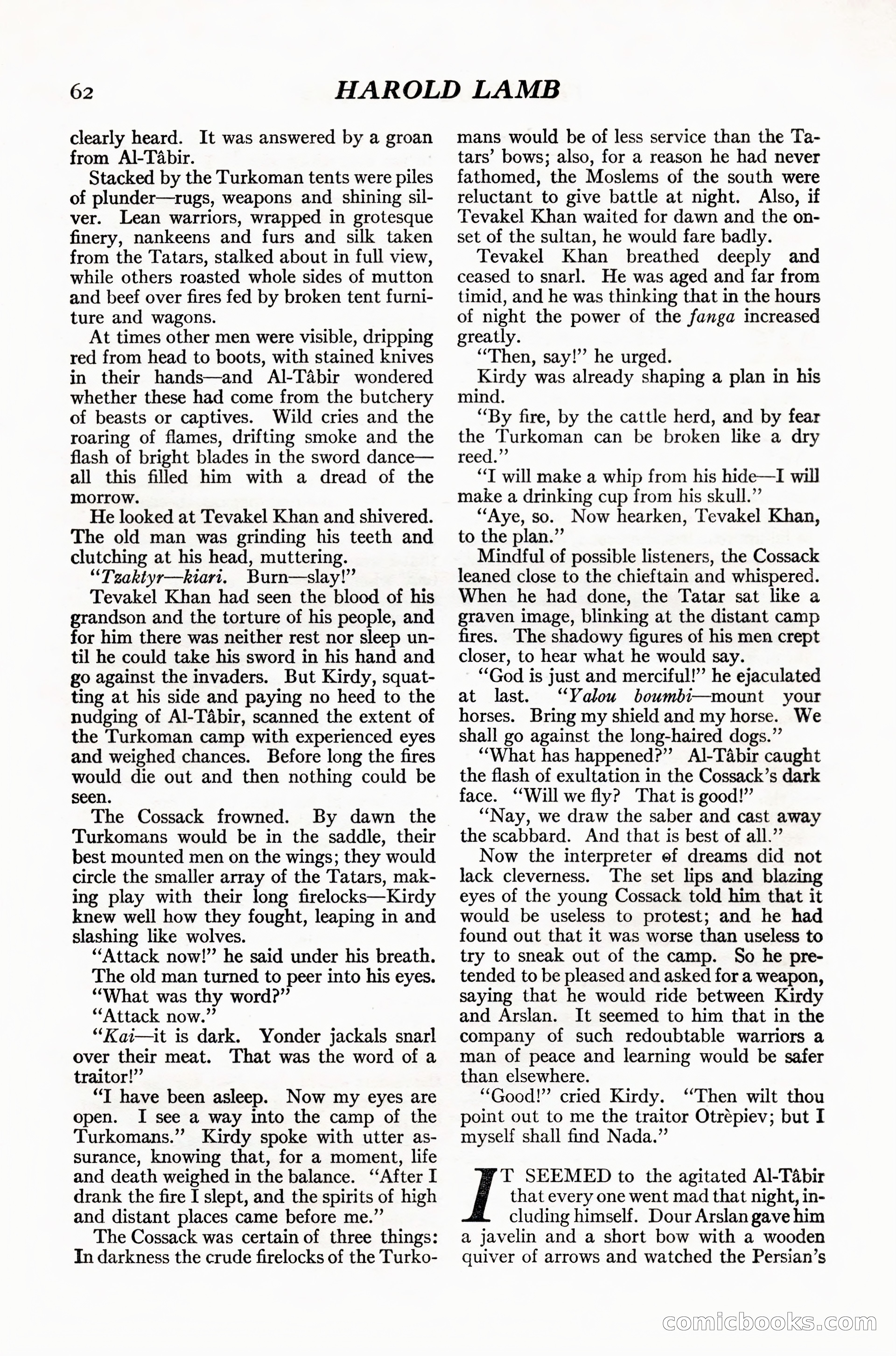
A restored page from Pulp Fiction, 1926. Page through the whole issue in the reader above.
📄 Transcribed text from this page (OCR, searchable)
Machine-transcribed from the original scan — historical spelling and the odd misread are preserved.
62 HAROLD LAMB clearly heard. It was answered by a groan from Al-Tabir. Stacked by the Turkoman tents were piles of plunder—rugs, weapons and shining sil- ver. Lean warriors, wrapped in grotesque finery, nankeens and furs and silk taken from the Tatars, stalked about in full view, while others roasted whole sides of mutton and beef over fires fed by broken tent furni- ture and wagons. At times other men were visible, dripping red from head to boots, with stained knives in their hands—and Al-Tabir wondered whether these had come from the butchery of beasts or captives. Wild cries and the roaring of flames, drifting smoke and the flash of bright blades in the sword dance— all this filled him with a dread of the morrow. He looked at Tevakel Khan and shivered. The old man was grinding his teeth and clutching at his head, muttering. “Tzaktyr—kiari. Burn—slay!” Tevakel Khan had seen the blood of his grandson and the torture of his people, and for him there was neither rest nor sleep un- til he could take his sword in his hand and go against the invaders. But Kirdy, squat- ting at his side and paying no heed to the nudging of Al-Tabir, scanned the extent of the Turkoman camp with experienced eyes and weighed chances. Before long the fires would die out and then nothing could be seen. The Cossack frowned. By dawn the Turkomans would be in the saddle, their best mounted men on the wings; they would circle the smaller array of the Tatars, mak- ing play with their long firelocks—Kirdy knew well how they fought, leaping in and slashing like wolves. “Attack now!” he said under his breath. The old man turned to peer into his eyes. “‘What was thy word?” “Attack now.” “Kai—it is dark. Yonder jackals snarl over their meat. That was the word of a traitor!” “T have been asleep. Now my eyes are open. I see a way into the camp of the Turkomans.”’ Kirdy spoke with utter as- surance, knowing that, for a moment, life and death weighed in the balance. “After I drank the fire I slept, and the spirits of high and distant places came before me.” The Cossack was certain of three things: In darkness the crude firelocks of the Turko- mans would be of less service than the Ta- tars’ bows; also, for a reason he had never fathomed, the Moslems of the south were reluctant to give battle at night. Also, if Tevakel Khan waited for dawn and the on- set of the sultan, he would fare badly. Tevakel Khan breathed deeply and ceased to snarl. He was aged and far from timid, and he was thinking that in the hours of night the power of the fanga increased greatly. “Then, say!” he urged. Kirdy was already shaping a plan in his mind. “By fire, by the cattle herd, and by fear the Turkoman can be broken like a dry reed.” “T will make a whip from his hide—I will make a drinking cup from his skull.” “Aye, so. Now hearken, Tevakel Khan, to the plan.” Mindful of possible listeners, the Cossack leaned close to the chieftain and whispered. When he had done, the Tatar sat like a graven image, blinking at the distant camp fires. The shadowy figures of his men crept closer, to hear what he would say. “God is just and merciful!’ he ejaculated at last. ‘“Yalou boumbi—mount your horses. Bring my shield and my horse. We shall go against the long-haired dogs.” “‘What has happened?” Al-Tabir caught the flash of exultation in the Cossack’s dark face. ‘‘Will we fly? That is good!” “Nay, we draw the saber and cast away the scabbard. And that is best of all.” Now the interpreter ef dreams did not lack cleverness. The set lips and blazing eyes of the young Cossack told him that it would be useless to protest; and he had found out that it was worse than useless to try to sneak out of the camp. So he pre- tended to be pleased and asked for a weapon, saying that he would ride between Kirdy and Arslan. It seemed to him that in the company of such redoubtable warriors a man of peace and learning would be safer than elsewhere. “Good!” cried Kirdy. “Then wilt thou point out to me the traitor Otrépiev; but I myself shall find Nada.” T SEEMED to the agitated Al-Tabir [ that every one went mad that night, in- cluding himself. Dour Arslan gave him a javelin and a short bow with a wooden quiver of arrows and watched the Persian’s COnmiclboooks.c© 5}