
Pulp Fiction, 1926 · page 62 of 232
Adventure Magazine Cover — page 62: what you’re looking at
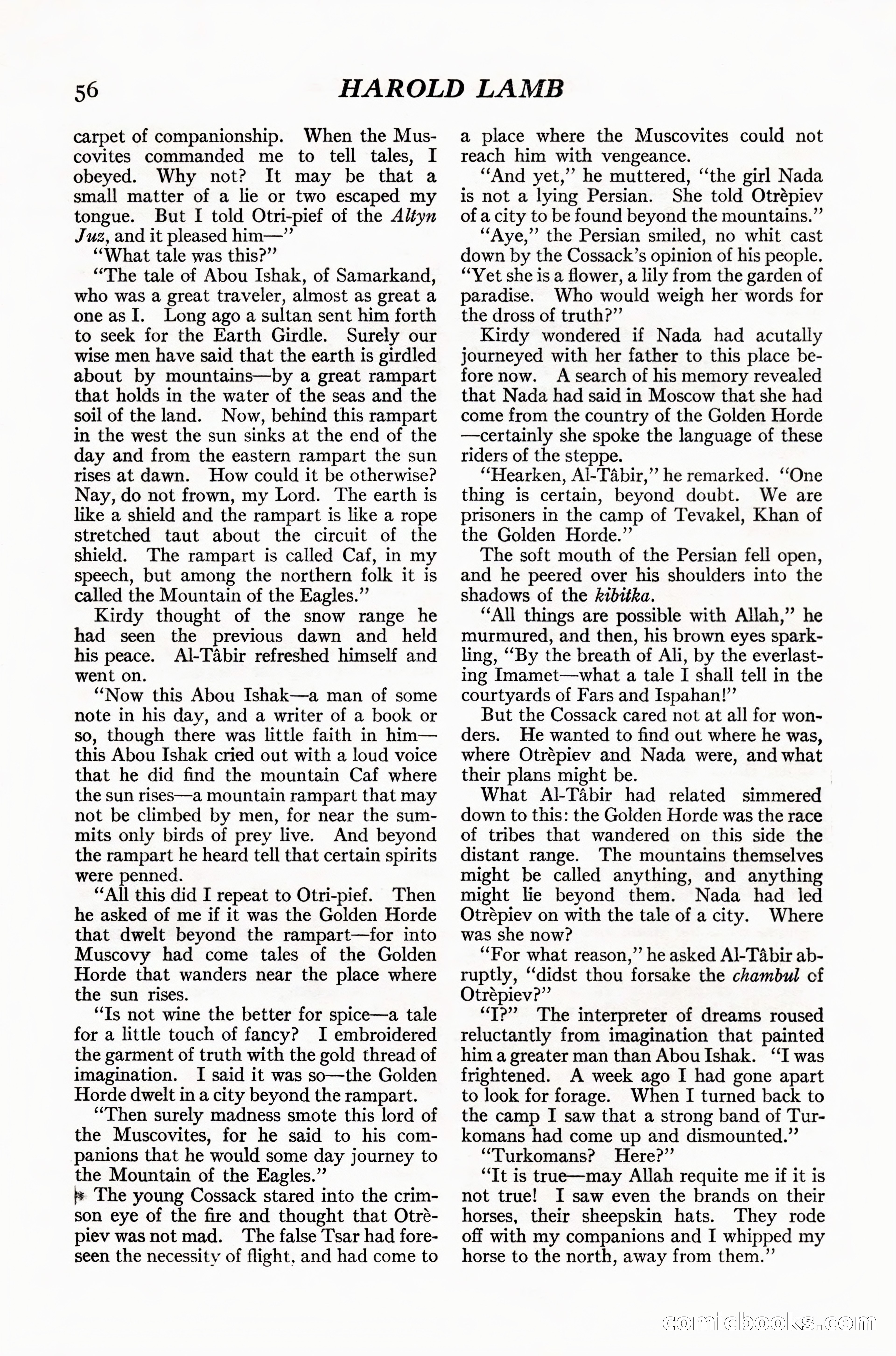
A restored page from Pulp Fiction, 1926. Page through the whole issue in the reader above.
📄 Transcribed text from this page (OCR, searchable)
Machine-transcribed from the original scan — historical spelling and the odd misread are preserved.
56 HAROLD LAMB carpet of companionship. When the Mus- covites commanded me to tell tales, I obeyed. Why not? It may be that a small matter of a lie or two escaped my tongue. But I told Otri-pief of the Altyn Juz, and it pleased him—”’ ‘What tale was this?”’ “The tale of Abou Ishak, of Samarkand, who was a great traveler, almost as great a one asI. Long ago a sultan sent him forth to seek for the Earth Girdle. Surely our wise men have said that the earth is girdled about by mountains—by a great rampart that holds in the water of the seas and the soil of the land. Now, behind this rampart in the west the sun sinks at the end of the day and from the eastern rampart the sun rises at dawn. How could it be otherwise? Nay, do not frown, my Lord. The earth is like a shield and the rampart is like a rope stretched taut about the circuit of the shield. The rampart is called Caf, in my speech, but among the northern folk it is called the Mountain of the Eagles.” Kirdy thought of the snow range he had seen the previous dawn and held his peace. Al-Tabir refreshed himself and went on. “Now this Abou Ishak—a man of some note in his day, and a writer of a book or so, though there was little faith in him— this Abou Ishak cried out with a loud voice that he did find the mountain Caf where the sun rises—a mountain rampart that may not be climbed by men, for near the sum- mits only birds of prey live. And beyond the rampart he heard tell that certain spirits were penned. ‘All this did I repeat to Otri-pief. Then he asked of me if it was the Golden Horde that dwelt beyond the rampart—for into Muscovy had come tales of the Golden Horde that wanders near the place where the sun rises. “Ts not wine the better for spice—a tale for a little touch of fancy? I embroidered the garment of truth with the gold thread of imagination. I said it was so—the Golden Horde dwelt in a city beyond the rampart. ‘Then surely madness smote this lord of the Muscovites, for he said to his com- panions that he would some day journey to the Mountain of the Eagles.”’ ls: The young Cossack stared into the crim- son eye of the fire and thought that Otré- plev was not mad. The false Tsar had fore- seen the necessity of flight, and had come to a place where the Muscovites could not reach him with vengeance. ‘And yet,” he muttered, ‘‘the girl Nada is not a lying Persian. She told Otrépiev of a city to be found beyond the mountains.”’ “fAye,” the Persian smiled, no whit cast down by the Cossack’s opinion of his people. “Yet she is a flower, a lily from the garden of paradise. Who would weigh her words for the dross of truth?” Kirdy wondered if Nada had acutally journeyed with her father to this place be- fore now. A search of his memory revealed that Nada had said in Moscow that she had come from the country of the Golden Horde —certainly she spoke the language of these riders of the steppe. ‘“‘Hearken, Al-Tabir,” he remarked. ‘One thing is certain, beyond doubt. We are prisoners in the camp of Tevakel, Khan of the Golden Horde.” The soft mouth of the Persian fell open, and he peered over his shoulders into the shadows of the kibitka. “All things are possible with Allah,” he murmured, and then, his brown eyes spark- ling, ‘“By the breath of Ali, by the everlast- ing Imamet—what a tale I shall tell in the courtyards of Fars and Ispahan!’’ But the Cossack cared not at all for won- ders. He wanted to find out where he was, where Otrépiev and Nada were, and what their plans might be. What Al-Tabir had related simmered down to this: the Golden Horde was the race of tribes that wandered on this side the distant range. The mountains themselves might be called anything, and anything might lie beyond them. Nada had led Otrépiev on with the tale of a city. Where was she now? ‘For what reason,” he asked Al-TAbir ab- ruptly, “didst thou forsake the chambul of Otrépiev?”’ “TP?” The interpreter of dreams roused reluctantly from imagination that painted him a greater man than Abou Ishak. “TI was frightened. A week ago I had gone apart to look for forage. When I turned back to the camp I saw that a strong band of Tur- komans had come up and dismounted.” ‘“Turkomans? Here?” “Tt is true—may Allah requite me if it is not true! I saw even the brands on their horses, their sheepskin hats. They rode off with my companions and I whipped my horse to the north, away from them.” COnmiclboooks.cO 5}