
Pulp Fiction, 1926 · page 50 of 232
Adventure Magazine Cover — page 50: what you’re looking at
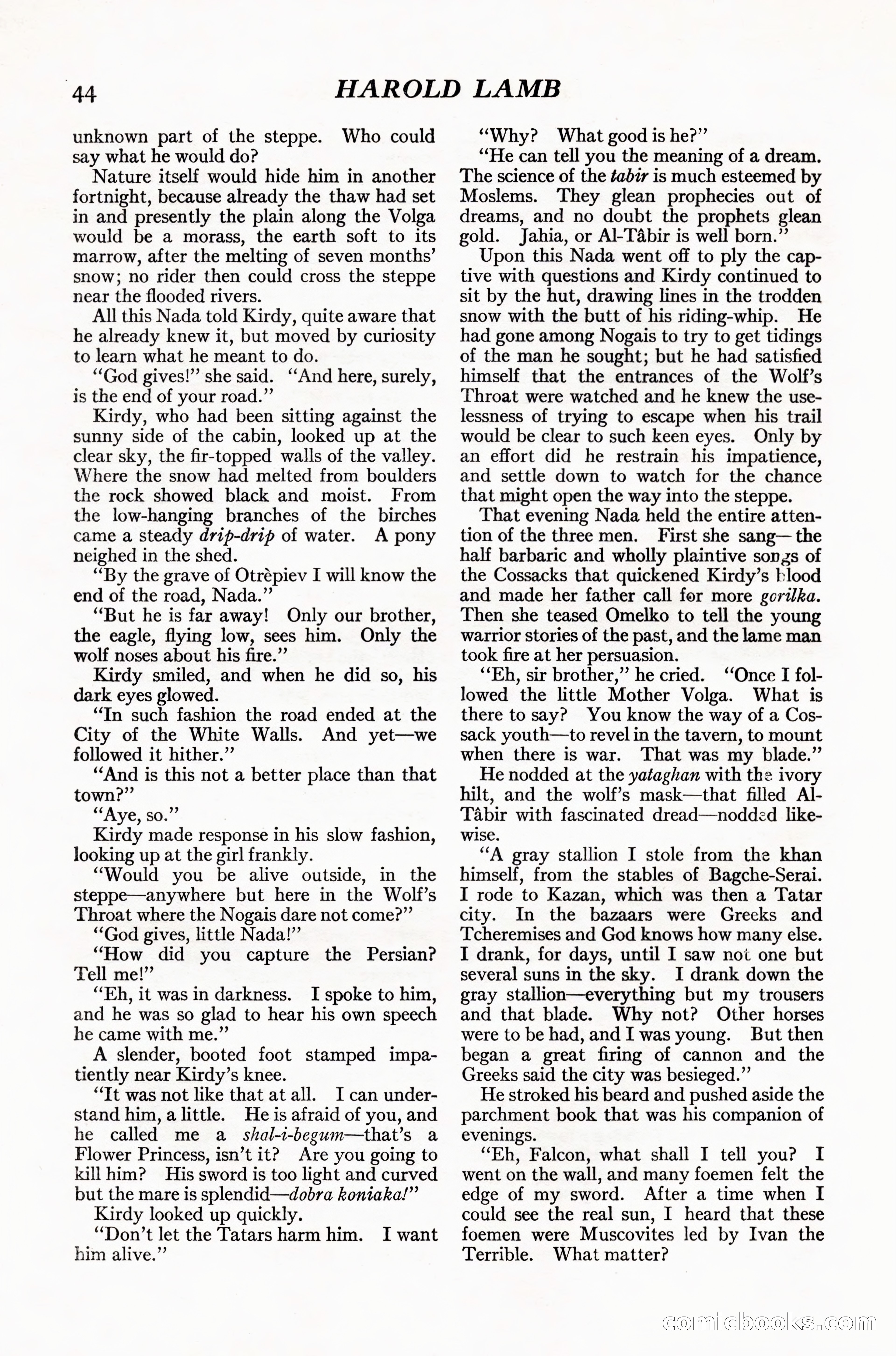
A restored page from Pulp Fiction, 1926. Page through the whole issue in the reader above.
📄 Transcribed text from this page (OCR, searchable)
Machine-transcribed from the original scan — historical spelling and the odd misread are preserved.
“44 HAROLD LAMB unknown part of the steppe. Who could say what he would do? Nature itself would hide him in another fortnight, because already the thaw had set in and presently the plain along the Volga would be a morass, the earth soft to its marrow, after the melting of seven months’ snow; no rider then could cross the steppe near the flooded rivers. All this Nada told Kirdy, quite aware that he already knew it, but moved by curiosity to learn what he meant to do. “God gives!”’ she said. ‘And here, surely, is the end of your road.” Kirdy, who had been sitting against the sunny side of the cabin, looked up at the clear sky, the fir-topped walls of the valley. Where the snow had melted from boulders the rock showed black and moist. From the low-hanging branches of the birches came a steady drip-drip of water. A pony neighed in the shed. “By the grave of Otrépiev I will know the end of the road, Nada.” “But he is far away! Only our brother, the eagle, flying low, sees him. Only the wolf noses about his fire.”’ Kirdy smiled, and when he did so, his dark eyes glowed. “In such fashion the road ended at the City of the White Walls. And yet—we followed it hither.” “And is this not a better place than that town?” <9 Aye, Ss go Kirdy made response in his slow fashion, looking up at the girl frankly. “Would you be alive outside, in the steppe—anywhere but here in the Wolf’s Throat where the Nogais dare not come?” “God gives, little Nada!”’ “How did you capture the Persian? Tell me!’’ “Eh, it was in darkness. I spoke to him, and he was so glad to hear his own speech he came with me.” A slender, booted foot stamped impa- tiently near Kirdy’s knee. “It was not like that at all. I can under- stand him, a little. He is afraid of you, and he called me a_ shal-t-begum—that’s a Flower Princess, isn’t it? Are you going to kill him? His sword is too light and curved but the mare is splendid—dobra koniaka!”’ Kirdy looked up quickly. “Don’t let the Tatars harm him. I want him alive.” “Why? What good is he?” “He can tell you the meaning of a dream. The science of the éabir is much esteemed by Moslems. They glean prophecies out of dreams, and no doubt the prophets glean gold. Jahia, or Al-Tabir is well born.” Upon this Nada went off to ply the cap- tive with questions and Kirdy continued to sit by the hut, drawing lines in the trodden snow with the butt of his riding-whip. He had gone among Nogais to try to get tidings of the man he sought; but he had satisfied himself that the entrances of the Wolf’s Throat were watched and he knew the use- lessness of trying to escape when his trail would be clear to such keen eyes. Only by an effort did he restrain his impatience, and settle down to watch for the chance that might open the way into the steppe. That evening Nada held the entire atten- tion of the three men. First she sang— the half barbaric and wholly plaintive sonzs of the Cossacks that quickened Kirdy’s blood and made her father call for more gorlka. Then she teased Omelko to tell the young warrior stories of the past, and the lame man took fire at her persuasion. “Eh, sir brother,” he cried. “Once I fol- lowed the little Mother Volga. What is there to say? You know the way of a Cos- sack youth—to revel in the tavern, to mount when there is war. That was my blade.” He nodded at the yataghan with the ivory hilt, and the wolf’s mask—that filled Al- Tabir with fascinated dread—nodded like- wise. “A gray stallion I stole from the khan himself, from the stables of Bagche-Serai. I rode to Kazan, which was then a Tatar city. In the bazaars were Greeks and Tcheremises and God knows how many else. I drank, for days, until I saw not one but several suns in the sky. I drank down the gray stallion—everything but my trousers and that blade. Why not? Other horses were to be had, and I was young. But then began a great firing of cannon and the Greeks said the city was besieged.”’ He stroked his beard and pushed aside the parchment book that was his companion of evenings. “Eh, Falcon, what shall I tell you? I went on the wall, and many foemen felt the edge of my sword. After a time when [ could see the real sun, I heard that these foemen were Muscovites led by Ivan the Terrible. What matter? cCoOmiclbooks C© 5}