
Pulp Fiction, 1926 · page 48 of 232
Adventure Magazine Cover — page 48: what you’re looking at
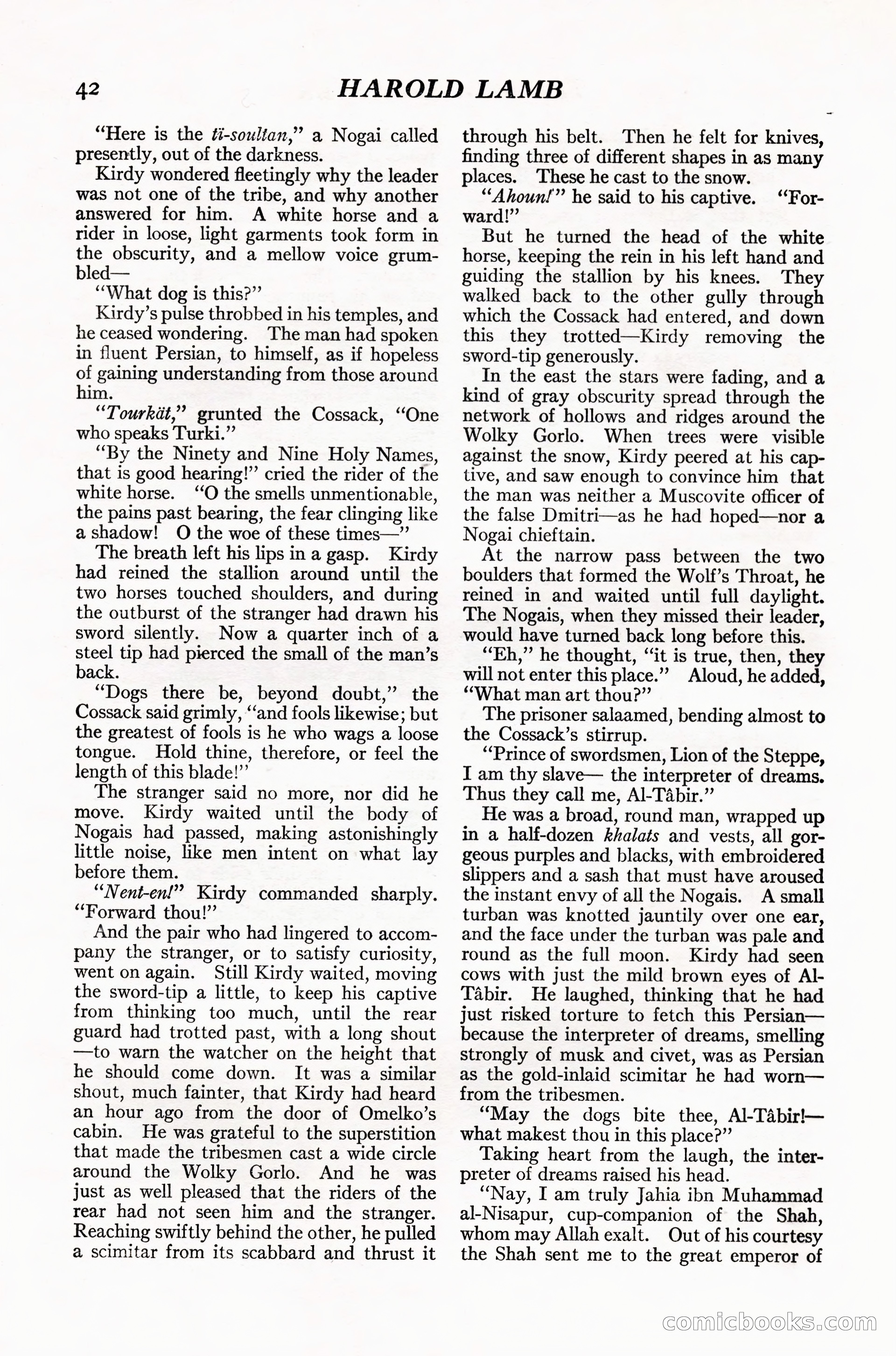
A restored page from Pulp Fiction, 1926. Page through the whole issue in the reader above.
📄 Transcribed text from this page (OCR, searchable)
Machine-transcribed from the original scan — historical spelling and the odd misread are preserved.
42 “Here is the ¢i-soulian,”’ a Nogai called presently, out of the darkness. Kirdy wondered fleetingly why the leader was not one of the tribe, and why another answered for him. A white horse and a rider in loose, light garments took form in the obscurity, and a mellow voice grum- bled— ‘What dog is this?” Kirdy’s pulse throbbed in his temples, and he ceased wondering. The man had spoken in fluent Persian, to himself, as if hopeless of gaining understanding from those around him. “Tourkdat,” grunted the Cossack, ‘One who speaks Turki.” “By the Ninety and Nine Holy Names, that is good hearing!” cried the rider of the white horse. ‘“O the smells unmentionable, the pains past bearing, the fear clinging like a shadow! O the woe of these times—” The breath left his lips in a gasp. Kirdy had reined the stallion around until the two horses touched shoulders, and during the outburst of the stranger had drawn his sword silently. Now a quarter inch of a steel tip had pierced the small of the man’s back. “Dogs there be, beyond doubt,” the Cossack said grimly, ‘“‘and fools likewise; but the greatest of fools is he who wags a loose tongue. Hold thine, therefore, or feel the length of this blade!”’ The stranger said no more, nor did he move. Kirdy waited until the body of Nogais had passed, making astonishingly little noise, like men intent on what lay before them. ‘“Nent-enl” Kirdy commanded sharply. “Forward thou!” And the pair who had lingered to accom- pany the stranger, or to satisfy curiosity, went on again. Still Kirdy waited, moving the sword-tip a little, to keep his captive from thinking too much, until the rear guard had trotted past, with a long shout —to warn the watcher on the height that he should come down. It was a similar shout, much fainter, that Kirdy had heard an hour ago from the door of Omelko’s cabin. He was grateful to the superstition that made the tribesmen cast a wide circle around the Wolky Gorlo. And he was just as well pleased that the riders of the rear had not seen him and the stranger. Reaching swiftly behind the other, he pulled a scimitar from its scabbard and thrust it HAROLD LAMB through his belt. Then he felt for knives, finding three of different shapes in as many places. These he cast to the snow. “Ahoun!” he said to his captive. ward!” But he turned the head of the white horse, keeping the rein in his left hand and guiding the stallion by his knees. They walked back to the other gully through which the Cossack had entered, and down this they trotted—Kirdy removing the sword-tip generously. In the east the stars were fading, and a kind of gray obscurity spread through the network of hollows and ridges around the Wolky Gorlo. When trees were visible against the snow, Kirdy peered at his cap- tive, and saw enough to convince him that the man was neither a Muscovite officer of the false Dmitri—as he had hoped—nor a Nogai chieftain. At the narrow pass between the two boulders that formed the Wolf’s Throat, he reined in and waited until full daylight. The Nogais, when they missed their leader, would have turned back long before this. “Eh,” he thought, “‘it is true, then, they will not enter this place.” Aloud, he added, “What man art thou?” The prisoner salaamed, bending almost to the Cossack’s stirrup. “Prince of swordsmen, Lion of the Steppe, I am thy slave— the interpreter of dreams. Thus they call me, Al-Tabir.”’ He was a broad, round man, wrapped up in a half-dozen khalats and vests, all gor- geous purples and blacks, with embroidered slippers and a sash that must have aroused the instant envy of all the Nogais. A small turban was knotted jauntily over one ear, and the face under the turban was pale and round as the full moon. Kirdy had seen cows with just the mild brown eyes of Al- Tabir. He laughed, thinking that he had just risked torture to fetch this Persian— because the interpreter of dreams, smelling strongly of musk and civet, was as Persian as the gold-inlaid scimitar he had worn— from the tribesmen. “May the dogs bite thee, Al-Tabir!— what makest thou in this place?” Taking heart from the laugh, the inter- preter of dreams raised his head. “Nay, I am truly Jahia ibn Muhammad al-Nisapur, cup-companion of the Shah, whom may Allah exalt. Out of his courtesy the Shah sent me to the great emperor of “For- COMICOOokKS C©