
Pulp Fiction, 1926 · page 46 of 232
Adventure Magazine Cover — page 46: what you’re looking at
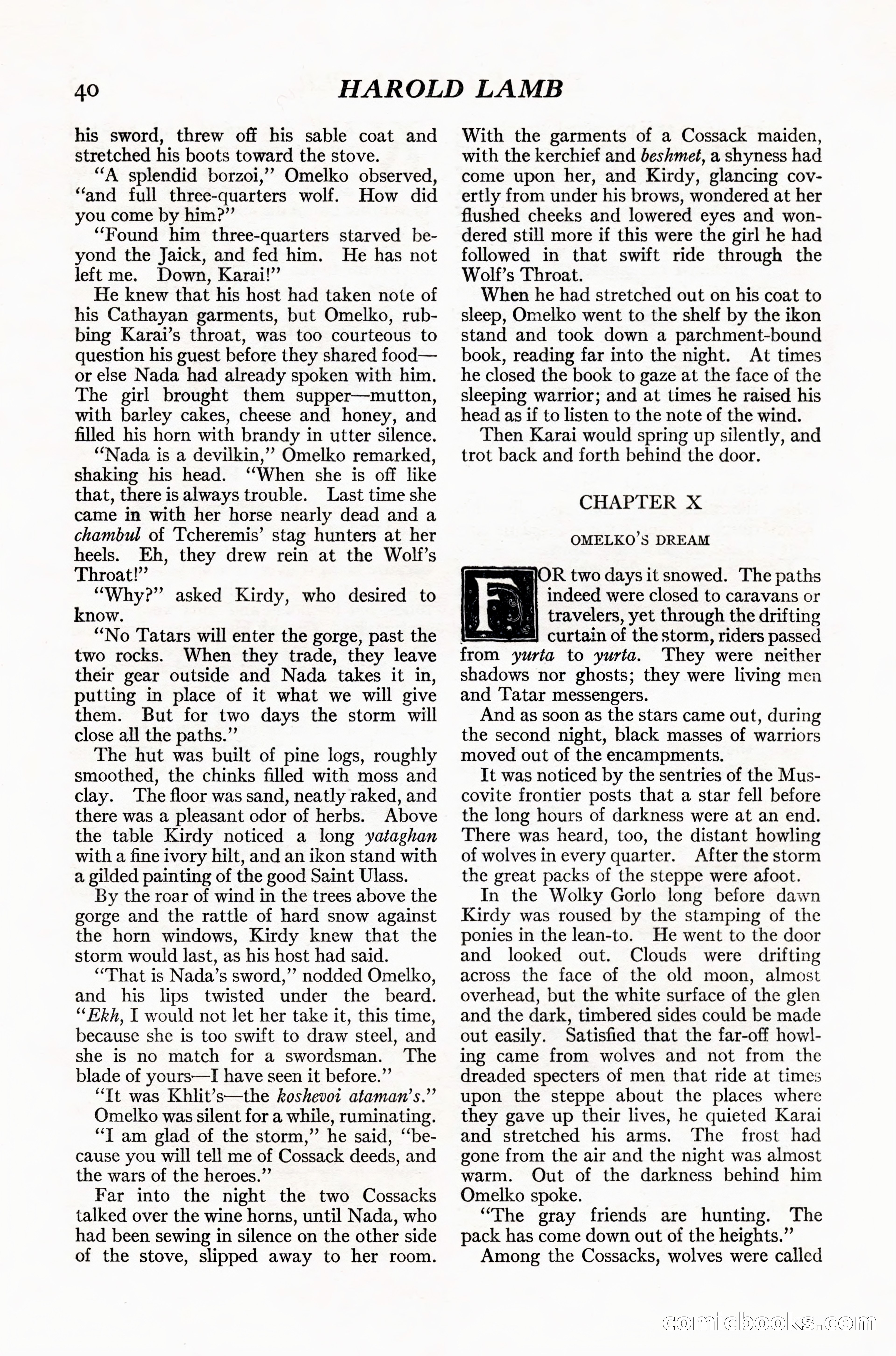
A restored page from Pulp Fiction, 1926. Page through the whole issue in the reader above.
📄 Transcribed text from this page (OCR, searchable)
Machine-transcribed from the original scan — historical spelling and the odd misread are preserved.
40 his sword, threw off his sable coat and stretched his boots toward the stove. “A splendid borzoi,’’ Omelko observed, ‘and full three-quarters wolf. How did you come by him?” “Found him three-quarters starved be- yond the Jaick, and fed him. He has not left me. Down, Karai!”’ He knew that his host had taken note of his Cathayan garments, but Omelko, rub- bing Karai’s throat, was too courteous to question his guest before they shared food— or else Nada had already spoken with him. The girl brought them supper—mutton, with barley cakes, cheese and honey, and filled his horn with brandy in utter silence. ‘“‘Nada is a devilkin,’”? Omelko remarked, shaking his head. ‘When she is off like that, there is always trouble. Last time she came in with her horse nearly dead and a chambul of Tcheremis’ stag hunters at her heels. Eh, they drew rein at the Wolf’s Throat!’ “Why?” asked Kirdy, who desired to know. “No Tatars will enter the gorge, past the two rocks. When they trade, they leave their gear outside and Nada takes it in, putting in place of it what we will give them. But for two days the storm will close all the paths.” The hut was built of pine logs, roughly smoothed, the chinks filled with moss and clay. The floor was sand, neatly raked, and there was a pleasant odor of herbs. Above the table Kirdy noticed a long yataghan with a fine ivory hilt, and an ikon stand with a gilded painting of the good Saint Ulass. By the roar of wind in the trees above the gorge and the rattle of hard snow against the horn windows, Kirdy knew that the storm would last, as his host had said. “That is Nada’s sword,”’ nodded Omelko, and his lips twisted under the beard. “Ekh, I would not let her take it, this time, because she is too swift to draw steel, and she is no match for a swordsman. The blade of yours—I have seen it before.” “It was Khlit’s—the koshevoi ataman’s.” Omelko was silent for a while, ruminating. “YT am glad of the storm,” he said, ‘‘be- cause you will tell me of Cossack deeds, and the wars of the heroes.” Far into the night the two Cossacks talked over the wine horns, until Nada, who had been sewing in silence on the other side of the stove, slipped away to her room. HAROLD LAMB With the garments of a Cossack maiden, with the kerchief and beshmet, a shyness had come upon her, and Kirdy, glancing cov- ertly from under his brows, wondered at her flushed cheeks and lowered eyes and won- dered still more if this were the girl he had followed in that swift ride through the Wolf’s Throat. When he had stretched out on his coat to sleep, Omelko went to the shelf by the ikon stand and took down a parchment-bound book, reading far into the night. At times he closed the book to gaze at the face of the sleeping warrior; and at times he raised his head as if to listen to the note of the wind. Then Karai would spring up silently, and trot back and forth behind the door. CHAPTER X OMELKO’S DREAM “a OR two days it snowed. The paths Bie| indeed were closed to caravans or fwme| travelers, yet through the drifting wie) curtain of the storm, riders passed from yurta to yurta. They were neither shadows nor ghosts; they were living men and Tatar messengers. And as soon as the stars came out, during the second night, black masses of warriors moved out of the encampments. It was noticed by the sentries of the Mus- covite frontier posts that a star fell before the long hours of darkness were at an end. There was heard, too, the distant howling of wolves in every quarter. After the storm the great packs of the steppe were afoot. In the Wolky Gorlo long before dawn Kirdy was roused by the stamping of the ponies in the lean-to. He went to the door and looked out. Clouds were drifting across the face of the old moon, almost overhead, but the white surface of the glen and the dark, timbered sides could be made out easily. Satisfied that the far-off howl- ing came from wolves and not from the dreaded specters of men that ride at times upon the steppe about the places where they gave up their lives, he quieted Karai and stretched his arms. The frost had gone from the air and the night was almost warm. Out of the darkness behind him Omelko spoke. “The gray friends are hunting. The pack has come down out of the heights.” Among the Cossacks, wolves were called COMmMiCoooks C©