
Pulp Fiction, 1926 · page 29 of 232
Adventure Magazine Cover — page 29: what you’re looking at
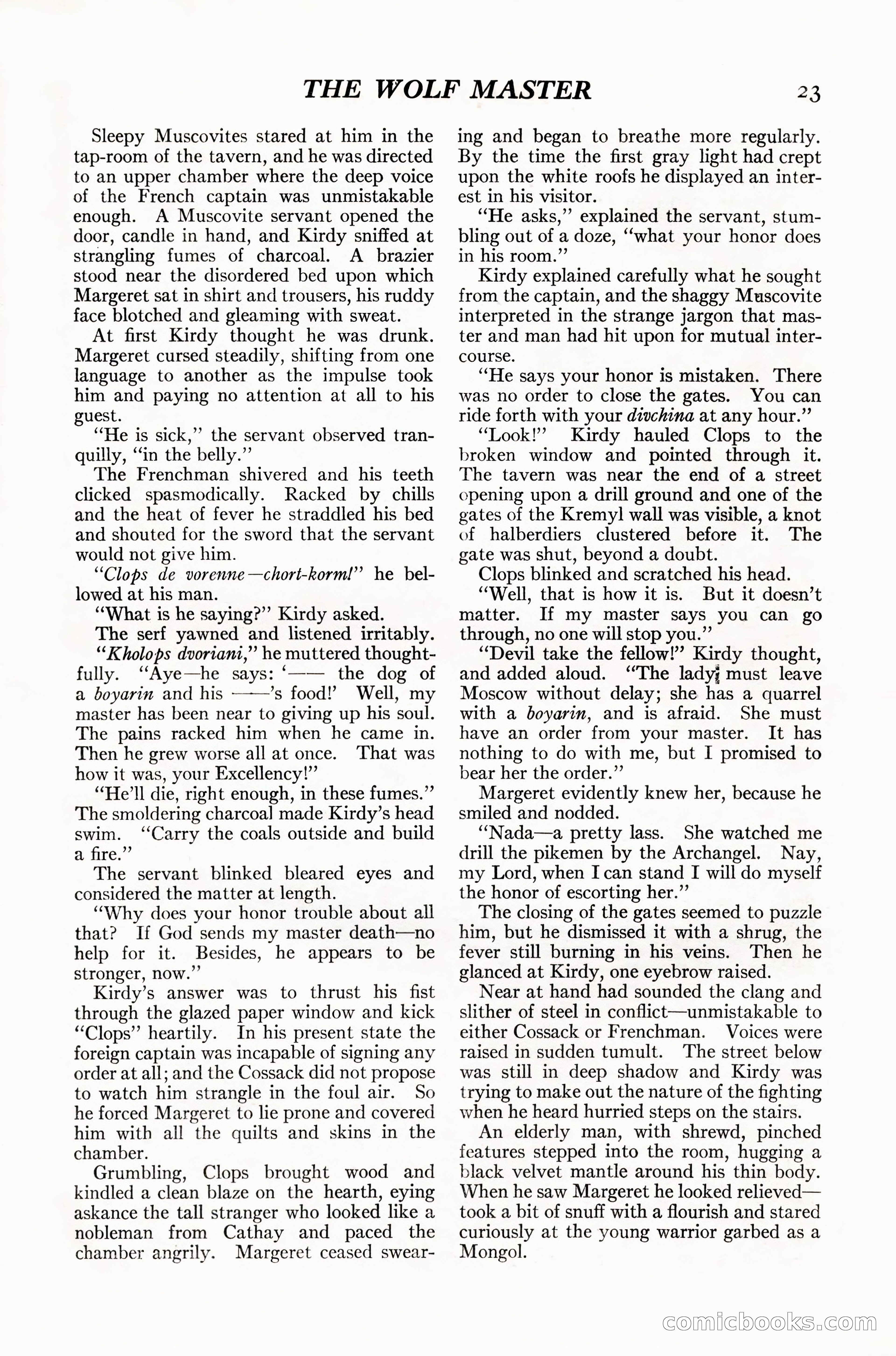
A restored page from Pulp Fiction, 1926. Page through the whole issue in the reader above.
📄 Transcribed text from this page (OCR, searchable)
Machine-transcribed from the original scan — historical spelling and the odd misread are preserved.
THE WOLF MASTER Sleepy Muscovites stared at him in the tap-room of the tavern, and he was directed to an upper chamber where the deep voice of the French captain was unmistakable enough. A Muscovite servant opened the door, candle in hand, and Kirdy sniffed at strangling fumes of charcoal. A_ brazier stood near the disordered bed upon which Margeret sat in shirt and trousers, his ruddy face blotched and gleaming with sweat. At first Kirdy thought he was drunk. Margeret cursed steadily, shifting from one language to another as the impulse took him and paying no attention at all to his guest. “He is sick,” the servant observed tran- quilly, “in the belly.” The Frenchman shivered and his teeth clicked spasmodically. Racked by chills and the heat of fever he straddled his bed and shouted for the sword that the servant would not give him. “Clops de vorenne—chori-korml!” he bel- lowed at his man. ‘What is he saying?” Kirdy asked. The serf yawned and listened irritably. “Kholops dvoriant,” he muttered thought- fully. ‘“‘Aye—he says: ‘—— the dog of a boyarin and his ’s food! Well, my master has been near to giving up his soul. The pains racked him when he came in. Then he grew worse all at once. That was how it was, your Excellency!” “He'll die, right enough, in these fumes.” The smoldering charcoal made Kirdy’s head swim. ‘Carry the coals outside and build a fire.” The servant blinked bleared eyes and considered the matter at length. “Why does your honor trouble about all that? If God sends my master death—no help for it. Besides, he appears to be stronger, now.”’ Kirdy’s answer was to thrust his fist through the glazed paper window and kick “Clops” heartily. In his present state the foreign captain was incapable of signing any order at all; and the Cossack did not propose to watch him strangle in the foul air. So he forced Margeret to lie prone and covered him with all the quilts and skins in the chamber. Grumbling, Clops brought wood and kindled a clean blaze on the hearth, eying askance the tall stranger who looked like a nobleman from Cathay and paced the chamber angrily. Margeret ceased swear- 23 ing and began to breathe more regularly. By the time the first gray light had crept upon the white roofs he displayed an inter- est in his visitor. “He asks,” explained the servant, stum- bling out of a doze, “what your honor does in his room.” Kirdy explained carefully what he sought from the captain, and the shaggy Muscovite interpreted in the strange jargon that mas- ter and man had hit upon for mutual inter- course. ‘“‘He says your honor is mistaken. There was no order to close the gates. You can ride forth with your divchina at any hour.”’ “Look!” Kirdy hauled Clops to the broken window and pointed through it. The tavern was near the end of a street opening upon a drill ground and one of the gates of the Kremyl wall was visible, a knot of halberdiers clustered before it. The gate was shut, beyond a doubt. Clops blinked and scratched his head. “Well, that is how it is. But it doesn’t matter. If my master says you can go through, no one will stop you.” “Devil take the fellow!’ Kirdy thought, and added aloud. “The ladyj must leave Moscow without delay; she has a quarrel with a boyarin, and is afraid. She must have an order from your master. It has nothing to do with me, but I promised to bear her the order.”’ Margeret evidently knew her, because he smiled and nodded. ‘“‘Nada—a pretty lass. She watched me drill the pikemen by the Archangel. Nay, my Lord, when I can stand I will do myself the honor of escorting her.”’ The closing of the gates seemed to puzzle him, but he dismissed it with a shrug, the fever still burning in his veins. Then he glanced at Kirdy, one eyebrow raised. Near at hand had sounded the clang and slither of steel in conflict—unmistakable to either Cossack or Frenchman. Voices were raised in sudden tumult. The street below was still in deep shadow and Kirdy was trying to make out the nature of the fighting when he heard hurried steps on the stairs. An elderly man, with shrewd, pinched features stepped into the room, hugging a black velvet mantle around his thin body. When he saw Margeret he looked relieved— took a bit of snuff with a flourish and stared curiously at the young warrior garbed as a Mongol. DOOK C©@