
Pulp Fiction, 1926 · page 23 of 232
Adventure Magazine Cover — page 23: what you’re looking at
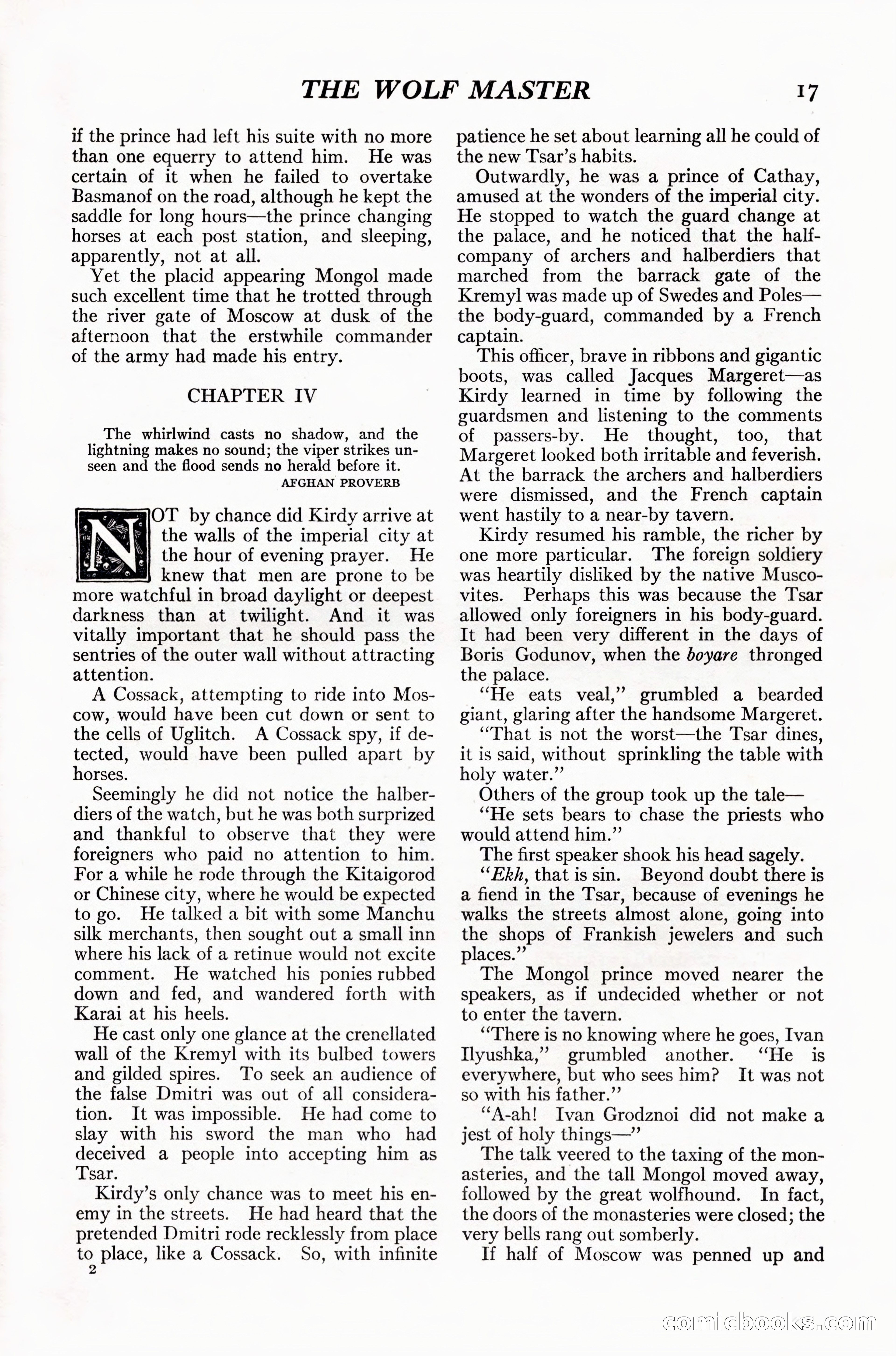
A restored page from Pulp Fiction, 1926. Page through the whole issue in the reader above.
📄 Transcribed text from this page (OCR, searchable)
Machine-transcribed from the original scan — historical spelling and the odd misread are preserved.
THE WOLF MASTER 17 if the prince had left his suite with no more than one equerry to attend him. He was certain of it when he failed to overtake Basmanof on the road, although he kept the saddle for long hours—the prince changing horses at each post station, and sleeping, apparently, not at all. Yet the placid appearing Mongol made such excellent time that he trotted through the river gate of Moscow at dusk of the afternoon that the erstwhile commander of the army had made his entry. CHAPTER IV The whirlwind casts no shadow, and the lightning makes no sound; the viper strikes un- seen and the flood sends no herald before it. AFGHAN PROVERB pyeea|OT by chance did Kirdy arrive at Wiig] the walls of the imperial city at the hour of evening prayer. He knew that men are prone to be more watchful in broad daylight or deepest darkness than at twilight. And it was vitally important that he should pass the sentries of the outer wall without attracting attention. A Cossack, attempting to ride into Mos- cow, would have been cut down or sent to the cells of Uglitch. A Cossack spy, if de- tected, would have been pulled apart by horses. Seemingly he did not notice the halber- diers of the watch, but he was both surprized and thankful to observe that they were foreigners who paid no attention to him. For a while he rode through the Kitaigorod or Chinese city, where he would be expected to go. He talked a bit with some Manchu silk merchants, then sought out a small inn where his lack of a retinue would not excite comment. He watched his ponies rubbed down and fed, and wandered forth with Karai at his heels. He cast only one glance at the crenellated wall of the Kremyl with its bulbed towers and gilded spires. To seek an audience of the false Dmitri was out of all considera- tion. It was impossible. He had come to slay with his sword the man who had deceived a people into accepting him as Tsar. Kirdy’s only chance was to meet his en- emy in the streets. He had heard that the pretended Dmitri rode recklessly from place te place, like a Cossack. So, with infinite patience he set about learning all he could of the new Tsar’s habits. Outwardly, he was a prince of Cathay, amused at the wonders of the imperial city. He stopped to watch the guard change at the palace, and he noticed that the half- company of archers and halberdiers that marched from the barrack gate of the Kremyl was made up of Swedes and Poles— the body-guard, commanded by a French captain. This officer, brave in ribbons and gigantic boots, was called Jacques Margeret—as Kirdy learned in time by following the guardsmen and listening to the comments of passers-by. He thought, too, that Margeret looked both irritable and feverish. At the barrack the archers and halberdiers were dismissed, and the French captain went hastily to a near-by tavern. Kirdy resumed his ramble, the richer by one more particular. The foreign soldiery was heartily disliked by the native Musco- vites. Perhaps this was because the Tsar allowed only foreigners in his body-guard. It had been very different in the days of Boris Godunov, when the boyare thronged the palace. “He eats veal,’ grumbled a_ bearded giant, glaring after the handsome Margeret. “That is not the worst—the Tsar dines, it is said, without sprinkling the table with holy water.” Others of the group took up the tale— “He sets bears to chase the priests who would attend him.” The first speaker shook his head sagely. “Ekh, that is sin. Beyond doubt there is a fiend in the Tsar, because of evenings he walks the streets almost alone, going into the shops of Frankish jewelers and such places.” The Mongol prince moved nearer the speakers, as if undecided whether or not to enter the tavern. ‘There is no knowing where he goes, Ivan Tlyushka,” grumbled another. “He is everywhere, but who sees him? It was not so with his father.”’ ‘‘A-ah! Ivan Grodznoi did not make a jest of holy things—” The talk veered to the taxing of the mon- asteries, and the tall Mongol moved away, followed by the great wolfhound. In fact, the doors of the monasteries were closed; the very bells rang out somberly. If half of Moscow was penned up and COnmicCloooks. CO