
Pulp Fiction, 1926 · page 197 of 232
Adventure Magazine Cover — page 197: what you’re looking at
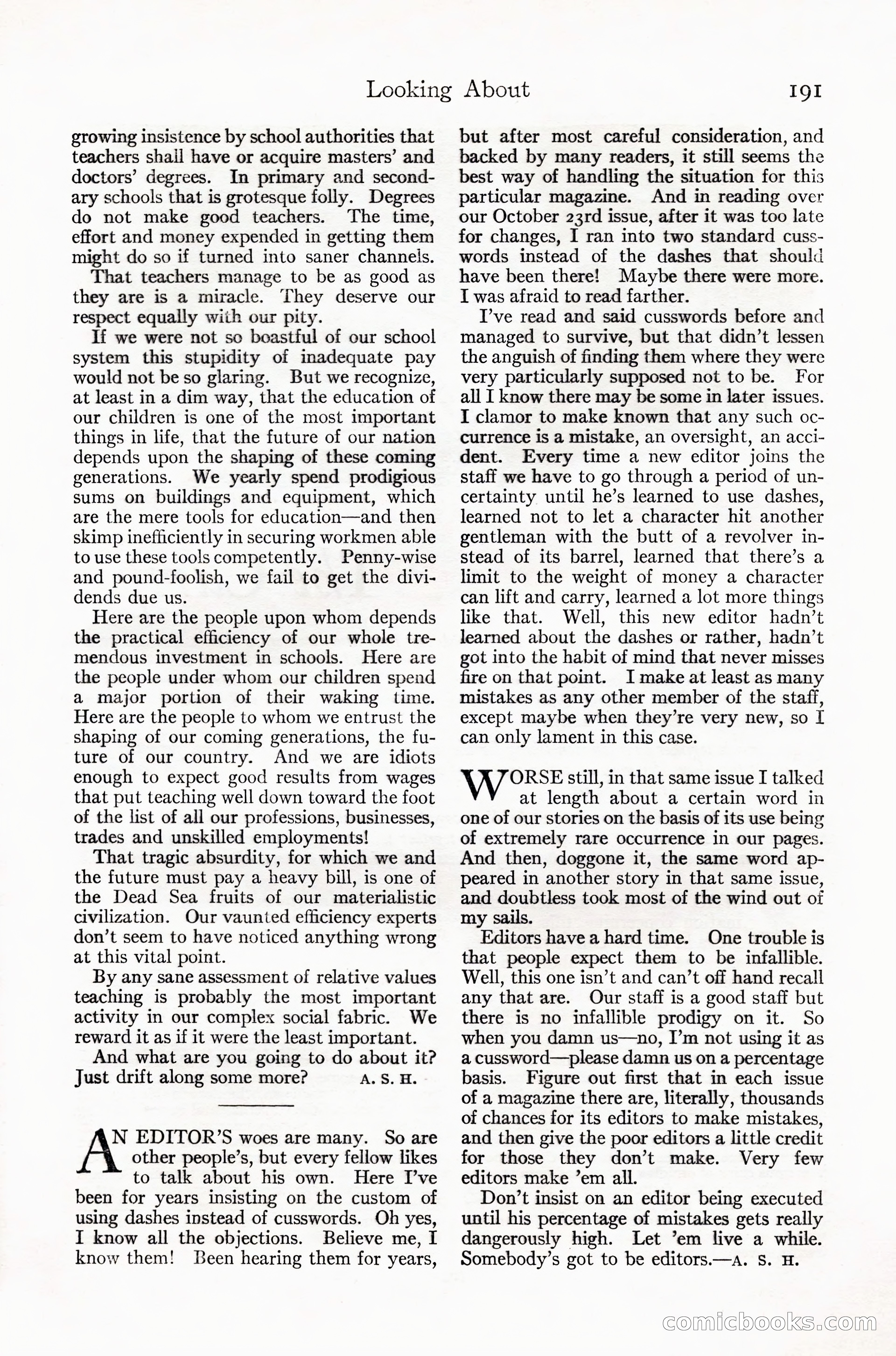
A restored page from Pulp Fiction, 1926. Page through the whole issue in the reader above.
📄 Transcribed text from this page (OCR, searchable)
Machine-transcribed from the original scan — historical spelling and the odd misread are preserved.
Looking About growing insistence by school authorities that teachers shail have or acquire masters’ and doctors’ degrees. In primary and second- ary schools that is grotesque folly. Degrees do not make good teachers. The time, effort and money expended in getting them might do so if turned into saner channels. That teachers manage to be as good as they are is a miracle. They deserve our respect equally wiih our pity. If we were not so boastful of our school system this stupidity of madequate pay would not beso glaring. But we recognize, at least in a dim way, that the education of our children is one of the most important things in life, that the future of our nation depends upon the shaping of these coming generations. We yearly spend prodigious sums on buildings and equipment, which are the mere tools for education—and then skimp inefficiently in securing workmen able to use these tools competently. Penny-wise and pound-foolish, we fail to get the divi- dends due us. Here are the people upon whom depends the practical efficiency of our whole tre- mendous investment in schools. Here are the people under whom our children spend a major portion of their waking time. Here are the people to whom we entrust the shaping of our coming generations, the fu- ture of our country. And we are idiots enough to expect good results from wages that put teaching well down toward the foot of the list of all our professions, businesses, trades and unskilled employments! That tragic absurdity, for which we and the future must pay a heavy bill, is one of the Dead Sea fruits of our materialistic civilization. Our vaunted efficiency experts don’t seem to have noticed anything wrong at this vital point. By any sane assessment of relative values teaching is probably the most important activity in our complex social fabric. We reward it as if it were the least important. And what are you going to do about it? Just drift along some more? A. S. H. N EDITOR’S woes are many. So are other people’s, but every fellow likes to talk about his own. Here I’ve been for years insisting on the custom of using dashes instead of cusswords. Oh yes, I know all the objections. Believe me, I know them! Been hearing them for years, IQI but after most careful consideration, and backed by many readers, it still seems the best way of handling the situation for this particular magazine. And in reading over our October 23rd issue, after it was too late for changes, I ran into two standard cuss- words instead of the dashes that should have been there! Maybe there were more. I was afraid to read farther. I’ve read and said cusswords before and managed to survive, but that didn’t lessen the anguish of finding them where they were very particularly supposed not to be. For all I know there may be some in later issues. I clamor to make known that any such oc- currence is a mistake, an oversight, an acci- dent. Every time a new editor joins the staff we have to go through a period of un- certainty until he’s learned to use dashes, learned not to let a character hit another gentleman with the butt of a revolver in- stead of its barrel, learned that there’s a limit to the weight of money a character can lift and carry, learned a lot more things like that. Well, this new editor hadn’t learned about the dashes or rather, hadn’t got into the habit of mind that never misses fire on that point. I make at least as many mistakes as any other member of the staff, except maybe when they’re very new, so I can only lament in this case. ORSE still, in that same issue I talked at length about a certain word in one of our stories on the basis of its use being of extremely rare occurrence in our pages. And then, doggone it, the same word ap- peared in another story in that same issue, and doubtless took most of the wind out of my sails. Editors have a hard time. One trouble is that people expect them to be infallible. Well, this one isn’t and can’t off hand recall any that are. Our staff is a good staff but there is no infallible prodigy on it. So when you damn us—no, I’m not using it as a cussword—please damn us on a percentage basis. Figure out first that in each issue of a magazine there are, literally, thousands of chances for its editors to make mistakes, and then give the poor editors a little credit for those they don’t make. Very few editors make ’em all. Don’t insist on an editor being executed until his percentage of mistakes gets really dangerously high. Let ’em live a while. Somebody’s got to be editors.—a. Ss. H. COnmiclbooolkks.c©