
Pulp Fiction, 1926 · page 195 of 232
Adventure Magazine Cover — page 195: what you’re looking at
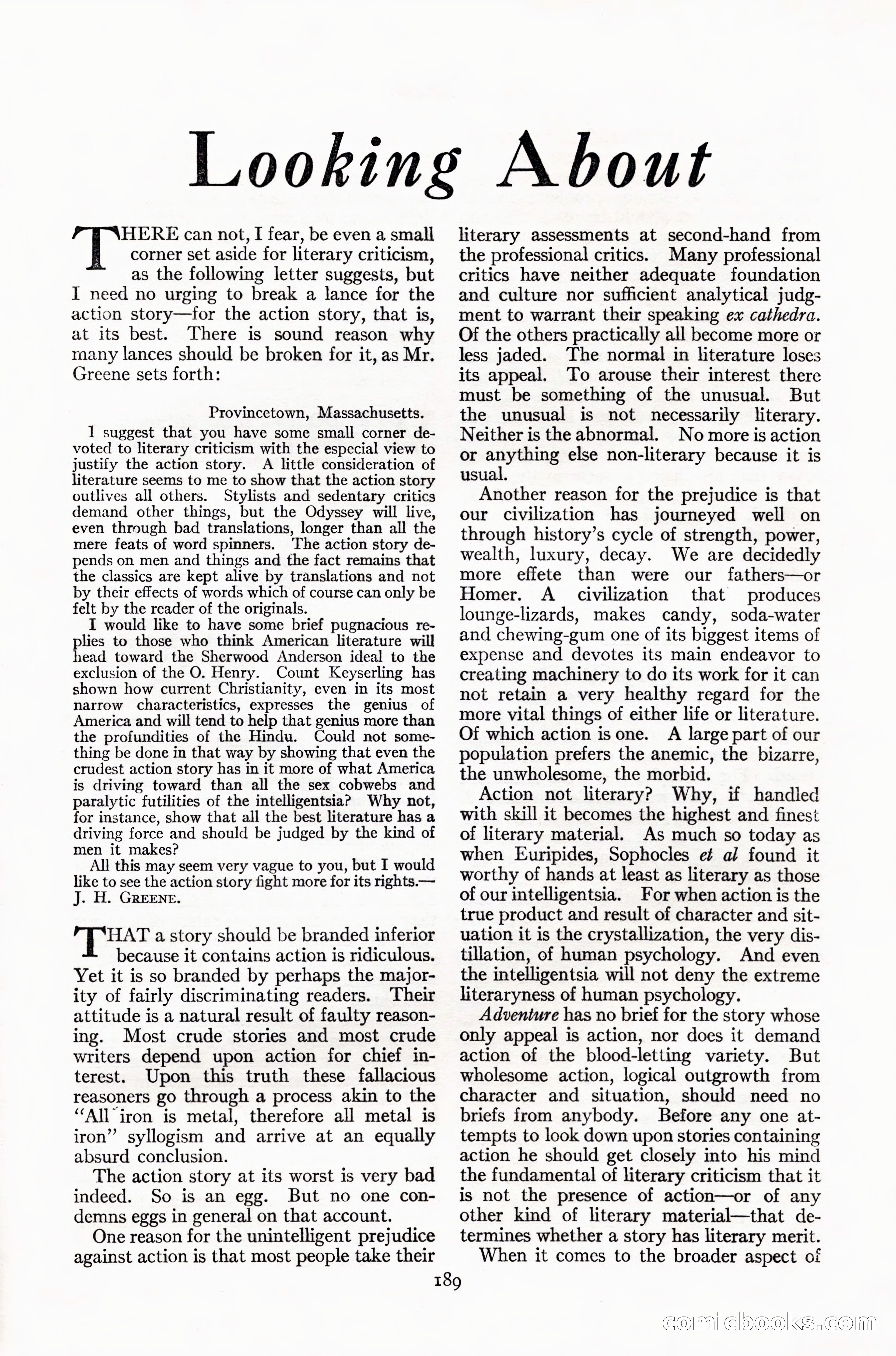
A restored page from Pulp Fiction, 1926. Page through the whole issue in the reader above.
📄 Transcribed text from this page (OCR, searchable)
Machine-transcribed from the original scan — historical spelling and the odd misread are preserved.
Looking About HERE can not, I fear, be even a small corner set aside for literary criticism, as the following letter suggests, but IT need no urging to break a lance for the action story—for the action story, that is, at its best. There is sound reason why raany lances should be broken for it, as Mr. Greene sets forth: Provincetown, Massachusetts. I suggest that you have some small corner de- voted to literary criticism with the especial view to justify the action story. A little consideration of literature seems to me to show that the action story outlives all others. Stylists and sedentary critics demand other things, but the Odyssey will live, even through bad translations, longer than all the mere feats of word spinners. ‘The action story de- pends on men and things and the fact remains that the classics are kept alive by translations and not by their effects of words which of course can only be felt by the reader of the originals. I would like to have some brief pugnacious re- plies to those who think American literature will head toward the Sherwood Anderson ideal to the exclusion of the O. Henry. Count Keyserling has shown how current Christianity, even in its most narrow characteristics, expresses the genius of America and will tend to help that genius more than the profundities of the Hindu. Could not some- thing be done in that way by showing that even the crudest action story has in it more of what America is driving toward than all the sex cobwebs and paralytic futilities of the intelligentsia? Why not, for instance, show that all the best literature has a driving force and should be judged by the kind of men it makes? All this may seem very vague to you, but I would like to see the action story fight more for its rights.— per a story should be branded inferior because it contains action is ridiculous. Yet it is so branded by perhaps the major- ity of fairly discriminating readers. ‘Their attitude is a natural result of faulty reason- ing. Most crude stories and most crude writers depend upon action for chief in- terest. Upon this truth these fallacious reasoners go through a process akin to the “All iron is metal, therefore all metal is iron” syllogism and arrive at an equally absurd conclusion. The action story at its worst is very bad indeed. So is an egg. But no one con- demns eggs in general on that account. One reason for the unintelligent prejudice against action is that most people take their literary assessments at second-hand from the professional critics. Many professional critics have neither adequate foundation and culture nor sufficient analytical judg- ment to warrant their speaking ex cathedra. Of the others practically all become more or less jaded. The normal in literature loses its appeal. To arouse their interest there must be something of the unusual. But the unusual is not necessarily literary. Neither is the abnormal. No more is action or anything else non-literary because it is usual. Another reason for the prejudice is that our civilization has journeyed well on through history’s cycle of strength, power, wealth, luxury, decay. We are decidedly more effete than were our fathers—or Homer. A_ civilization that produces lounge-lizards, makes candy, soda-water and chewing-gum one of its biggest items of expense and devotes its main endeavor to creating machinery to do its work for it can not retain a very healthy regard for the more vital things of either life or literature. Of which action isone. A large part of our population prefers the anemic, the bizarre, the unwholesome, the morbid. Action not literary? Why, if handled with skill it becomes the highest and finest of literary material. As much so today as when Euripides, Sophocles e¢ ai found it worthy of hands at least as literary as those of our intelligentsia. For when action is the true product and result of character and sit- uation it is the crystallization, the very dis- tillation, of human psychology. And even the intelligentsia will not deny the extreme literaryness of human psychology. Adventure has no brief for the story whose only appeal is action, nor does it demand action of the blood-letting variety. But wholesome action, logical outgrowth from character and situation, should need no briefs from anybody. Before any one at- tempts to look down upon stories containing action he should get closely into his mind the fundamental of literary criticism that it is not the presence of action—or of any other kind of literary material—that de- termines whether a story has literary merit. When it comes to the broader aspect of 189 MICLOOO© <“S C©@