
Pulp Fiction, 1926 · page 184 of 232
Adventure Magazine Cover — page 184: what you’re looking at
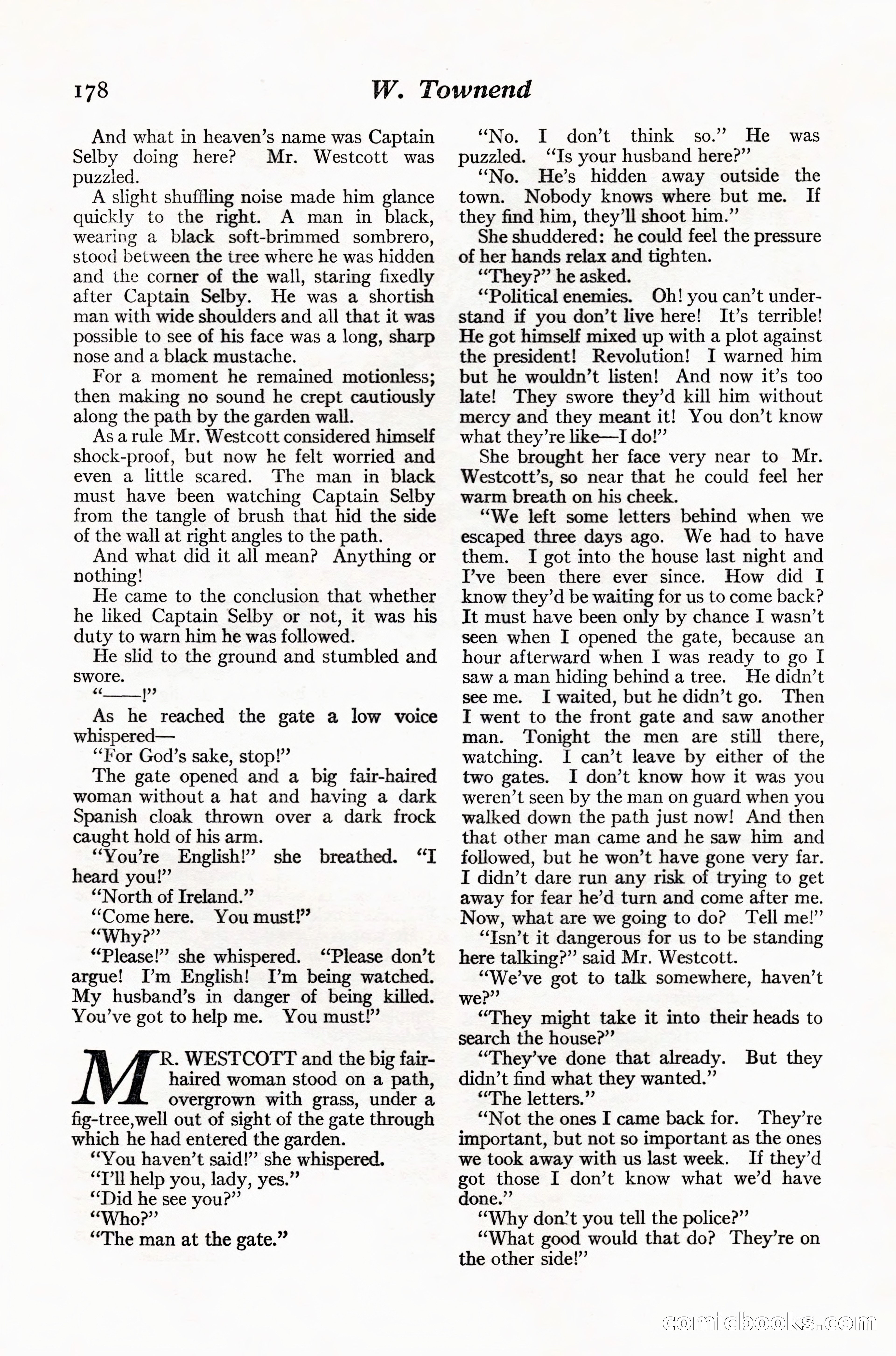
A restored page from Pulp Fiction, 1926. Page through the whole issue in the reader above.
📄 Transcribed text from this page (OCR, searchable)
Machine-transcribed from the original scan — historical spelling and the odd misread are preserved.
178 And what in heaven’s name was Captain Selby doing here? Mr. Westcott was puzzied. A slight shuffling noise made him glance quickly to the rnght. A man in black, wearing a black soft-brimmed sombrero, stood between the tree where he was hidden and the corner of the wall, staring fixedly after Captain Selby. He was a shortish man with wide shoulders and all that it was possible to see of his face was a long, sharp nose and a black mustache. For a moment he remained motionless; then making no sound he crept cautiously along the path by the garden wall. Asarule Mr. Westcott considered himself shock-proof, but now he felt worried and even a little scared. The man in black must have been watching Captain Selby from the tangle of brush that hid the side of the wall at right angles to the path. And what did it all mean? Anything or nothing! He came to the conclusion that whether he liked Captain Selby or not, it was his duty to warn him he was followed. He slid to the ground and stumbled and swore. "ee, As he reached the gate a low voice whispered— “For God’s sake, stop!’ The gate opened and a big fair-haired woman without a hat and having a dark Spanish cloak thrown over a dark frock caught hold of his arm. “You’re English!” she breathed. “TI heard you!” “North of Ireland.” “Come here. You must!” “Why?” “Please!” she whispered. ‘Please don’t argue! I’m English! I’m being watched. My husband’s in danger of being killed. You’ve got to help me. You must?’ R. WESTCOTT and the big fair- haired woman stood on a path, overgrown with grass, under a fig-tree,well out of sight of the gate through which he had entered the garden. “You haven’t said!’ she whispered. “T’ll help you, lady, yes.” “Did he see you?” “Who?’’ “‘The man at the gate.” W. Townend “No. I don’t think so.” He _ was puzzled. ‘Is your husband here?” “No. He’s hidden away outside the town. Nobody knows where but me. If they find him, they’ll shoot him.” She shuddered: he could feel the pressure of her hands relax and tighten. “They?” he asked. ‘Political enemies. Oh! you can’t under- stand if you don’t live here! It’s terrible! He got himself mixed up with a plot against the president! Revolution! I warned him but he wouldn’t listen! And now it’s too late! They swore they’d kill him without mercy and they meant it! You don’t know what they’re like—I do!” She brought her face very near to Mr. Westcott’s, so near that he could feel her warm breath on his cheek. “We left some letters behind when we escaped three days ago. We had to have them. I got into the house last night and I’ve been there ever since. How did I know they’d be waiting for us to come back? It must have been only by chance I wasn’t seen when I opened the gate, because an hour afterward when I was ready to go I saw a man hiding behind a tree. He didn’t see me. I waited, but he didn’t go. Then I went to the front gate and saw another man. Tonight the men are still there, watching. I can’t leave by either of the two gates. I don’t know how it was you weren’t seen by the man on guard when you walked down the path just now! And then that other man came and he saw him and followed, but he won’t have gone very far. I didn’t dare run any risk of trying to get away for fear he’d turn and come after me. Now, what are we going to do? Tell me!” “Isn’t it dangerous for us to be standing here talking?” said Mr. Westcott. “‘We’ve got to talk somewhere, haven’t wer” “They might take it into their heads to search the house?” “‘They’ve done that already. But they didn’t find what they wanted.” “The letters.” ““Not the ones I came back for. They’re important, but not so important as the ones we took away with us last week. If they’d got those I don’t know what we’d have done.” “Why don’t you tell the police?” “What good would that do? They’re on the other side!” cCoOmiclbooks C© 5}