
Pulp Fiction, 1926 · page 176 of 232
Adventure Magazine Cover — page 176: what you’re looking at
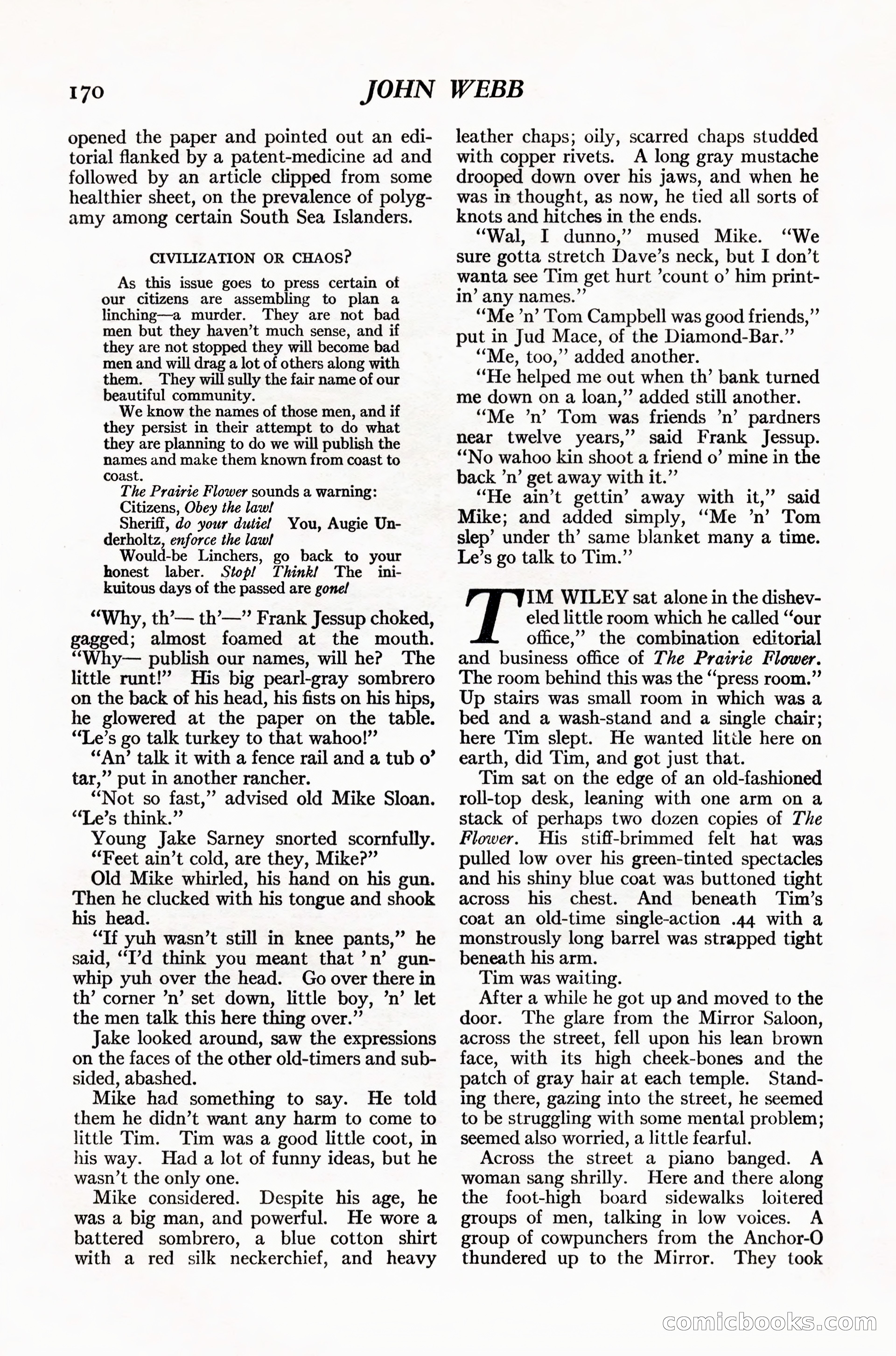
A restored page from Pulp Fiction, 1926. Page through the whole issue in the reader above.
📄 Transcribed text from this page (OCR, searchable)
Machine-transcribed from the original scan — historical spelling and the odd misread are preserved.
170 JOHN opened the paper and pointed out an edi- torial flanked by a patent-medicine ad and followed by an article chpped from some healthier sheet, on the prevalence of polyg- amy among certain South Sea Islanders. CIVILIZATION OR CHAOS? As this issue goes to press certain of our citizens are assembling to plan a linching—a murder. They are not bad men but they haven’t much sense, and if they are not stopped they will become bad men and will drag a lot of others along with them. They will sully the fair name of our beautiful community. We know the names of those men, and if they persist in their attempt to do what they are planning to do we will publish the names and make them known from coast to coast. The Prairie Flower sounds a warning: Citizens, Obey the lawl Sheriff, do your dutiel You, Augie Un- derholtz, enforce the lawl Would-be Linchers, go back to your honest laber. Stop! Think! The ini- kuitous days of the passed are gone/ “Why, th’— th’—” Frank Jessup choked, gagged; almost foamed at the mouth. “‘Why— publish our names, will he? The little runt!’ His big pearl-gray sombrero on the back of his head, his fists on his hips, he glowered at the paper on the table. “Le’s go talk turkey to that wahoo!” “An’ talk it with a fence rail and a tub o’ tar,” put in another rancher. “Not so fast,’ advised old Mike Sloan. “‘Le’s think.” Young Jake Sarney snorted scornfully. “Feet ain’t cold, are they, Mike?” Old Mike whirled, his hand on his gun. Then he clucked with his tongue and shook his head. “Tf yuh wasn’t still in knee pants,” he said, “I’d think you meant that ’n’ gun- whip yuh over the head. Go over there in th’ corner ’n’ set down, little boy, ’n’ let the men talk this here thing over.” Jake looked around, saw the expressions on the faces of the other old-timers and sub- sided, abashed. Mike had something to say. He told them he didn’t want any harm to come to little Tim. Tim was a good little coot, in his way. Had a lot of funny ideas, but he wasn’t the only one. Mike considered. Despite his age, he was a big man, and powerful. He wore a battered sombrero, a blue cotton shirt with a red silk neckerchief, and heavy WEBB leather chaps; oily, scarred chaps studded with copper rivets. A long gray mustache drooped down over his jaws, and when he was in thought, as now, he tied all sorts of knots and hitches in the ends. “Wal, I dunno,” mused Mike. ‘‘We sure gotta stretch Dave’s neck, but I don’t wanta see Tim get hurt ’count o’ him print- in’ any names.” “Me ’n’ Tom Campbell was good friends,” put in Jud Mace, of the Diamond-Bar.”’ ““Me, too,” added another. “He helped me out when th’ bank turned me down on a loan,” added still another. “Me ’n’ Tom was friends ’n’ pardners near twelve years,” said Frank Jessup. “No wahoo kin shoot a friend o’ mine in the back ’n’ get away with it.” “He ain’t gettin’ away with it,” said Mike; and added simply, “Me ’n’ Tom slep’ under th’ same blanket many a time. Le’s go talk to Tim.”’ IM WILEY sat alone in the dishev- eled little room which he called “‘our office,” the combination editorial and business office of The Prairie Flower. The room behind this was the “press room.” Up stairs was small room in which was a bed and a wash-stand and a single chair; here Tim slept. He wanted litile here on earth, did Tim, and got just that. Tim sat on the edge of an old-fashioned roll-top desk, leaning with one arm on a stack of perhaps two dozen copies of The Flower. His stiff-brimmed felt hat was pulled low over his green-tinted spectacles and his shiny blue coat was buttoned tight across his chest. And beneath Tim’s coat an old-time single-action .44 with a monstrously long barrel was strapped tight beneath his arm. Tim was waiting. After a while he got up and moved to the door. The glare from the Mirror Saloon, across the street, fell upon his lean brown face, with its high cheek-bones and the patch of gray hair at each temple. Stand- ing there, gazing into the street, he seemed to be struggling with some mental problem; seemed also worried, a little fearful. Across the street a piano banged. A woman sang shrilly. Here and there along the foot-high board sidewalks loitered groups of men, talking in low voices. A group of cowpunchers from the Anchor-O thundered up to the Mirror. They took COmiclbooks.c©