
Pulp Fiction, 1926 · page 170 of 232
Adventure Magazine Cover — page 170: what you’re looking at
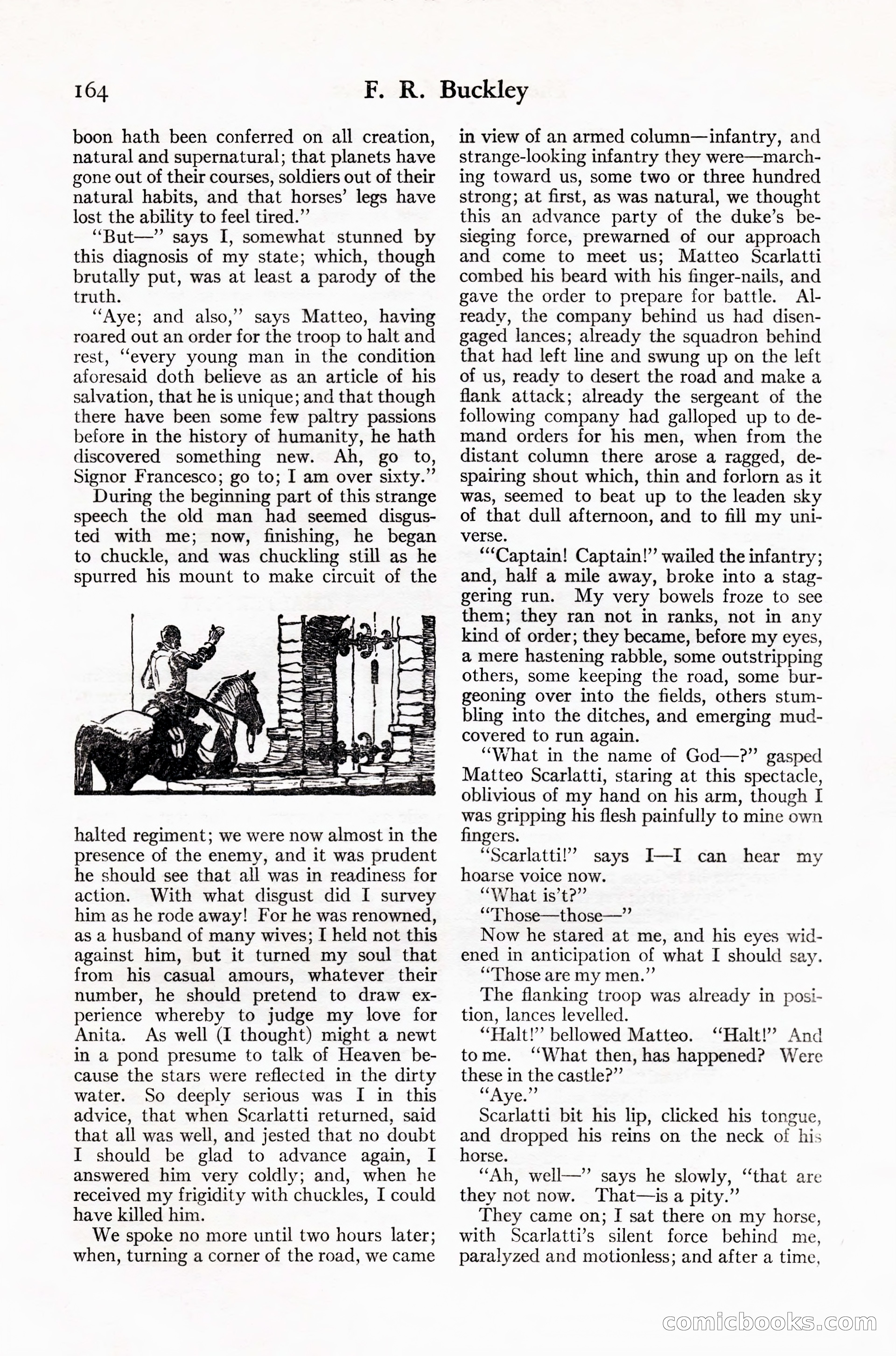
A restored page from Pulp Fiction, 1926. Page through the whole issue in the reader above.
📄 Transcribed text from this page (OCR, searchable)
Machine-transcribed from the original scan — historical spelling and the odd misread are preserved.
164 boon hath been conferred on all creation, natural and supernatural; that planets have gone out of their courses, soldiers out of their natural habits, and that horses’ legs have lost the ability to feel tired.”’ ‘“But—” says I, somewhat stunned by this diagnosis of my state; which, though brutally put, was at least a parody of the truth. ‘““Aye; and also,” says Matteo, having roared out an order for the troop to halt and rest, “every young man in the condition aforesaid doth believe as an article of his salvation, that he is unique; and that though there have been some few paltry passions before in the history of humanity, he hath discovered something new. Ah, go to, Signor Francesco; go to; I am over sixty.” During the beginning part of this strange speech the old man had seemed disgus- ted with me; now, finishing, he began to chuckle, and was chuckling still as he spurred his mount to make circuit of the ee WA se _ ET ‘ —- - le <= } | | A my halted regiment; we were now almost in the presence of the enemy, and it was prudent he should see that all was in readiness for action. With what disgust did I survey him as he rode away! For he was renowned, as a husband of many wives; I held not this against him, but it turned my soul that from his casual amours, whatever their number, he should pretend to draw ex- perience whereby to judge my love for Anita. As well (I thought) might a newt in a pond presume to talk of Heaven be- cause the stars were reflected in the dirty water. So deeply serious was I in this advice, that when Scarlatti returned, said that all was well, and jested that no doubt I should be glad to advance again, I answered him very coldly; and, when he received my frigidity with chuckles, I could have killed him. We spoke no more until two hours later; when, turning a corner of the road, we came F. R. Buckley in view of an armed column—infantry, and strange-looking infantry they were—march- ing toward us, some two or three hundred strong; at first, as was natural, we thought this an advance party of the duke’s be- sieging force, prewarned of our approach and come to meet us; Matteo Scarlatti combed his beard with his finger-nails, and gave the order to prepare for battle. Al- ready, the company behind us had disen- gaged lances; already the squadron behind that had left line and swung up on the left of us, ready to desert the road and make a flank attack; already the sergeant of the following company had galloped up to de- mand orders for his men, when from the distant column there arose a ragged, de- spairing shout which, thin and forlorn as it was, seemed to beat up to the leaden sky of that dull afternoon, and to fill my uni- verse. “Captain! Captain!’’ wailed the infantry; and, half a mile away, broke into a stag- gering run. My very bowels froze to see them; they ran not in ranks, not in any kind of order; they became, before my eyes, a mere hastening rabble, some outstripping others, some keeping the road, some bur- geoning over into the fields, others stum- bling into the ditches, and emerging mud- covered to run again. “What in the name of God—?” gasped Matteo Scarlatti, staring at this spectacle, oblivious of my hand on his arm, though I was gripping his flesh painfully to mine own fingers. ‘Scarlatti!’ says I—I can hear my hoarse voice now. “What is’t?” ‘“Those—those—” Now he stared at me, and his eyes wid- ened in anticipation of what I should say. ‘Those are my men.” The flanking troop was already in posi- tion, lances levelled. “Halt!” bellowed Matteo. ‘Halt!’ And tome. ‘What then, has happened? Were these in the castle?” “aye.” Scarlatti bit his lip, clicked his tongue, and dropped his reins on the neck of his horse. “Ah, well—” says he slowly, “that are they not now. That—is a pity.” They came on; I sat there on my horse, with Scarlatti’s silent force behind me, paralyzed and motionless; and after a time, ANIECLOOOKS C©