
Pulp Fiction, 1926 · page 168 of 232
Adventure Magazine Cover — page 168: what you’re looking at
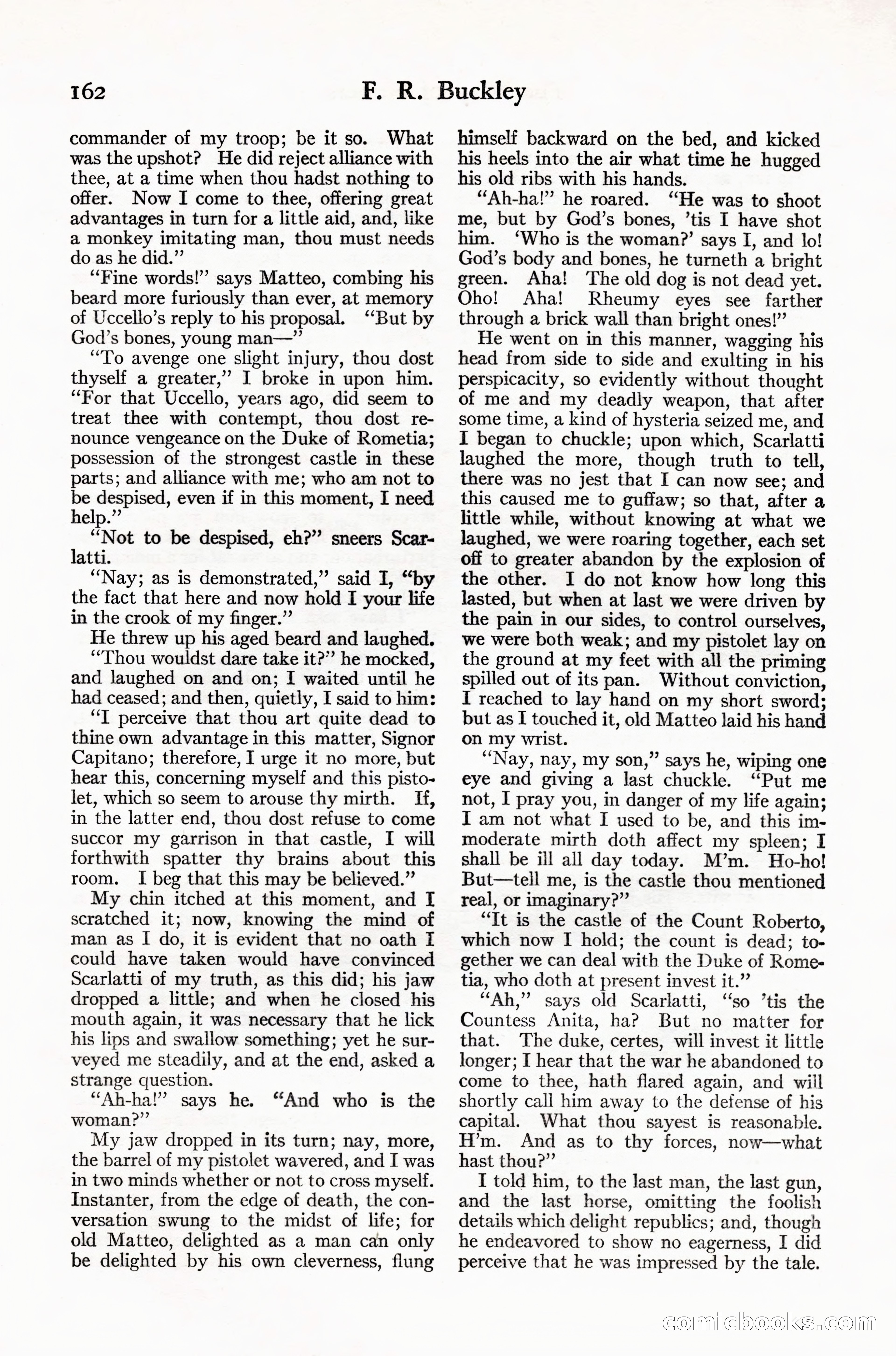
A restored page from Pulp Fiction, 1926. Page through the whole issue in the reader above.
📄 Transcribed text from this page (OCR, searchable)
Machine-transcribed from the original scan — historical spelling and the odd misread are preserved.
162 commander of my troop; be it so. What was the upshot? He did reject alliance with thee, at a time when thou hadst nothing to offer. Now I come to thee, offering great advantages in turn for a little aid, and, like a monkey imitating man, thou must needs do as he did.” “Fine words!” says Matteo, combing his beard more furiously than ever, at memory of Uccello’s reply to his proposal. ‘But by God’s bones, young man—” “To avenge one slight injury, thou dost thyself a greater,” I broke in upon him. “For that Uccello, years ago, did seem to treat thee with contempt, thou dost re- nounce vengeance on the Duke of Rometia; possession of the strongest castle in these parts; and alliance with me; who am not to be despised, even if in this moment, I need help.” “Not to be despised, eh?” sneers Scar- atti. “Nay; as is demonstrated,” said I, “by the fact that here and now hold I your life in the crook of my finger.” He threw up his aged beard and laughed. ‘Thou wouldst dare take it?”’ he mocked, and laughed on and on; I waited until he had ceased; and then, quietly, I said to him: “T perceive that thou art quite dead to thine own advantage in this matter, Signor Capitano; therefore, I urge it no more, but hear this, concerning myself and this pisto- let, which so seem to arouse thy mirth. If, in the latter end, thou dost refuse to come succor my garrison in that castle, I will forthwith spatter thy brains about this room. I beg that this may be believed.” My chin itched at this moment, and I scratched it; now, knowing the mind of man as I do, it is evident that no oath I could have taken would have convinced Scarlatti of my truth, as this did; his jaw dropped a little; and when he closed his mouth again, it was necessary that he lick his lips and swallow something; yet he sur- veyed me steadily, and at the end, asked a strange question. “‘Ah-ha!” says he. “And who is the woman?” My jaw dropped in its turn; nay, more, the barrel of my pistolet wavered, and I was in two minds whether or not to cross myself. Instanter, from the edge of death, the con- versation swung to the midst of life; for old Matteo, delighted as a man can only be delighted by his own cleverness, flung F. R. Buckley himself backward on the bed, and kicked his heels into the air what time he hugged his old ribs with his hands. “‘Ah-ha!” he roared. “He was to shoot me, but by God’s bones, ’tis I have shot him. ‘Who is the woman?’ says I, and lo! God’s body and bones, he turneth a bright green. Aha! The old dog is not dead yet. Oho! Aha! Rheumy eyes see farther through a brick wall than bright ones!” He went on in this manner, wagging his head from side to side and exulting in his perspicacity, so evidently without thought of me and my deadly weapon, that after some time, a kind of hysteria seized me, and I began to chuckle; upon which, Scarlatti laughed the more, though truth to tell, there was no jest that I can now see; and this caused me to guffaw; so that, after a little while, without knowing at what we laughed, we were roaring together, each set off to greater abandon by the explosion of the other. I do not know how long this lasted, but when at last we were driven by the pain in our sides, to control ourselves, we were both weak; and my pistolet lay on the ground at my feet with all the priming spilled out of its pan. Without conviction, I reached to lay hand on my short sword; but as I touched it, old Matteo laid his hand on my wrist. ‘‘Nay, nay, my son,” says he, wiping one eye and giving a last chuckle. “Put me not, I pray you, in danger of my life again; I am not what I used to be, and this im- moderate mirth doth affect my spleen; I shall be ill all day today. M’m. Ho-ho! But—tell me, is the castle thou mentioned real, or imaginary?” “Tt is the castle of the Count Roberto, which now I hold; the count is dead; to- gether we can deal with the Duke of Rome- tia, who doth at present invest it.”’ “Ah,” says old Scarlatti, “so ’tis the Countess Anita, ha? But no matter for that. The duke, certes, will invest it little longer; I hear that the war he abandoned to come to thee, hath flared again, and will shortly call him away to the defense of his capital. What thou sayest is reasonable. H’m. And as to thy forces, now—what hast thou?” I told him, to the last man, the last gun, and the last horse, omitting the foolish details which delight republics; and, though he endeavored to show no eagerness, I did perceive that he was impressed by the tale. COnmiclboooks.c©