
Pulp Fiction, 1926 · page 157 of 232
Adventure Magazine Cover — page 157: what you’re looking at
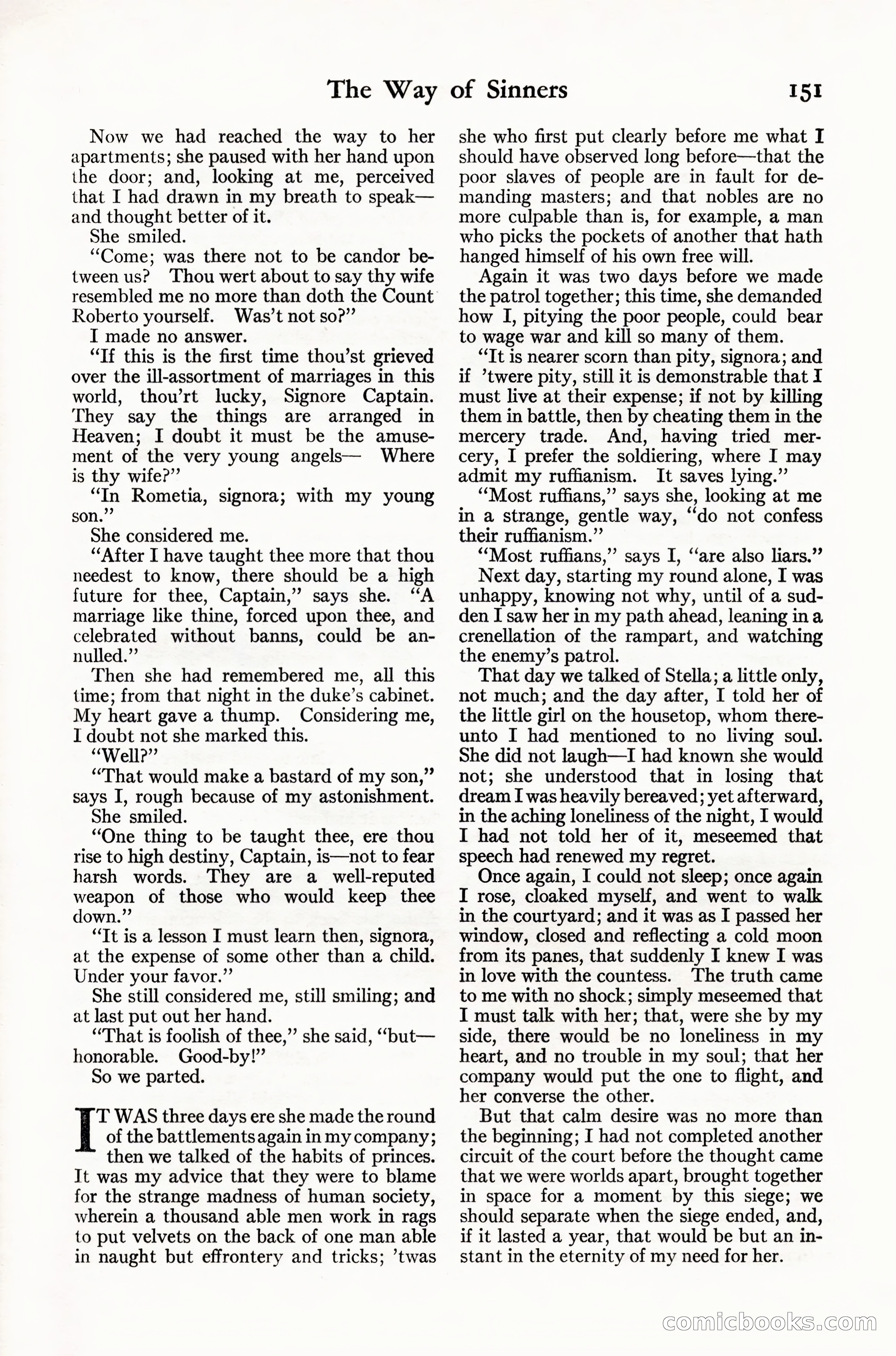
A restored page from Pulp Fiction, 1926. Page through the whole issue in the reader above.
📄 Transcribed text from this page (OCR, searchable)
Machine-transcribed from the original scan — historical spelling and the odd misread are preserved.
The Way of Sinners Now we had reached the way to her apartments; she paused with her hand upon the door; and, looking at me, perceived that I had drawn in my breath to speak— and thought better of it. She smiled. “Come; was there not to be candor be- tween us? Thou wert about to say thy wife resembled me no more than doth the Count Roberto yourself. Was’t not so?” I made no answer. “Tf this is the first time thou’st grieved over the ill-assortment of marriages in this world, thou’rt lucky, Signore Captain. They say the things are arranged in Heaven; I doubt it must be the amuse- ment of the very young angels— Where is thy wife?” “In Rometia, signora; with my young son.” She considered me. “After I have taught thee more that thou needest to know, there should be a high future for thee, Captain,” says she. ‘“‘A marriage like thine, forced upon thee, and celebrated without banns, could be an- nulled.”’ Then she had remembered me, all this time; from that night in the duke’s cabinet. My heart gave a thump. Considering me, I doubt not she marked this. ¢ “Well?” “That would make a bastard of my son,” says I, rough because of my astonishment. She smiled. “One thing to be taught thee, ere thou rise to high destiny, Captain, is—not to fear harsh words. They are a_well-reputed weapon of those who would keep thee down.” “Tt is a lesson I must learn then, signora, at the expense of some other than a child. Under your favor.”’ She still considered me, still smiling; and at last put out her hand. “That is foolish of thee,”’ she said, ‘‘but— honorable. Good-by!”’ So we parted. T WAS three days ere she made the round of the battlements again in my company; then we talked of the habits of princes. It was my advice that they were to blame for the strange madness of human society, wherein a thousand able men work in rags to put velvets on the back of one man able in naught but effrontery and tricks; ’twas 151 she who first put clearly before me what I should have observed long before—that the poor slaves of people are in fault for de- manding masters; and that nobles are no more culpable than is, for example, a man who picks the pockets of another that hath hanged himself of his own free will. Again it was two days before we made the patrol together; this time, she demanded how I, pitying the poor people, could bear to wage war and kill so many of them. “Tt is nearer scorn than pity, signora; and if ’twere pity, still it is demonstrable that I must live at their expense; if not by killing them in battle, then by cheating them in the mercery trade. And, having tried mer- cery, I prefer the soldiering, where I may admit my ruffanism. It saves lying.” ‘Most ruffians,”’ says she, looking at me in a strange, gentle way, “do not confess their ruffianism.”’ “Most ruffians,” says I, “are also liars.” Next day, starting my round alone, I was unhappy, knowing not why, until of a sud- den I saw her in my path ahead, leaning ina crenellation of the rampart, and watching the enemy’s patrol. That day we talked of Stella; a little only, not much; and the day after, I told her of the little girl on the housetop, whom there- unto I had mentioned to no living soul. She did not laugh—I had known she would not; she understood that in losing that dream I was heavily bereaved; yet afterward, in the aching loneliness of the night, I would I had not told her of it, meseemed that speech had renewed my regret. Once again, I could not sleep; once again I rose, cloaked myself, and went to walk in the courtyard; and it was as I passed her window, closed and reflecting a cold moon from its panes, that suddenly I knew I was in love with the countess. The truth came to me with no shock; simply meseemed that I must talk with her; that, were she by my side, there would be no loneliness in my heart, and no trouble in my soul; that her company would put the one to flight, and her converse the other. But that calm desire was no more than the beginning; I had not completed another circuit of the court before the thought came that we were worlds apart, brought together in space for a moment by this siege; we should separate when the siege ended, and, if it lasted a year, that would be but an in- stant in the eternity of my need for her. COnmulcoooks.c©