
Pulp Fiction, 1926 · page 154 of 232
Adventure Magazine Cover — page 154: what you’re looking at
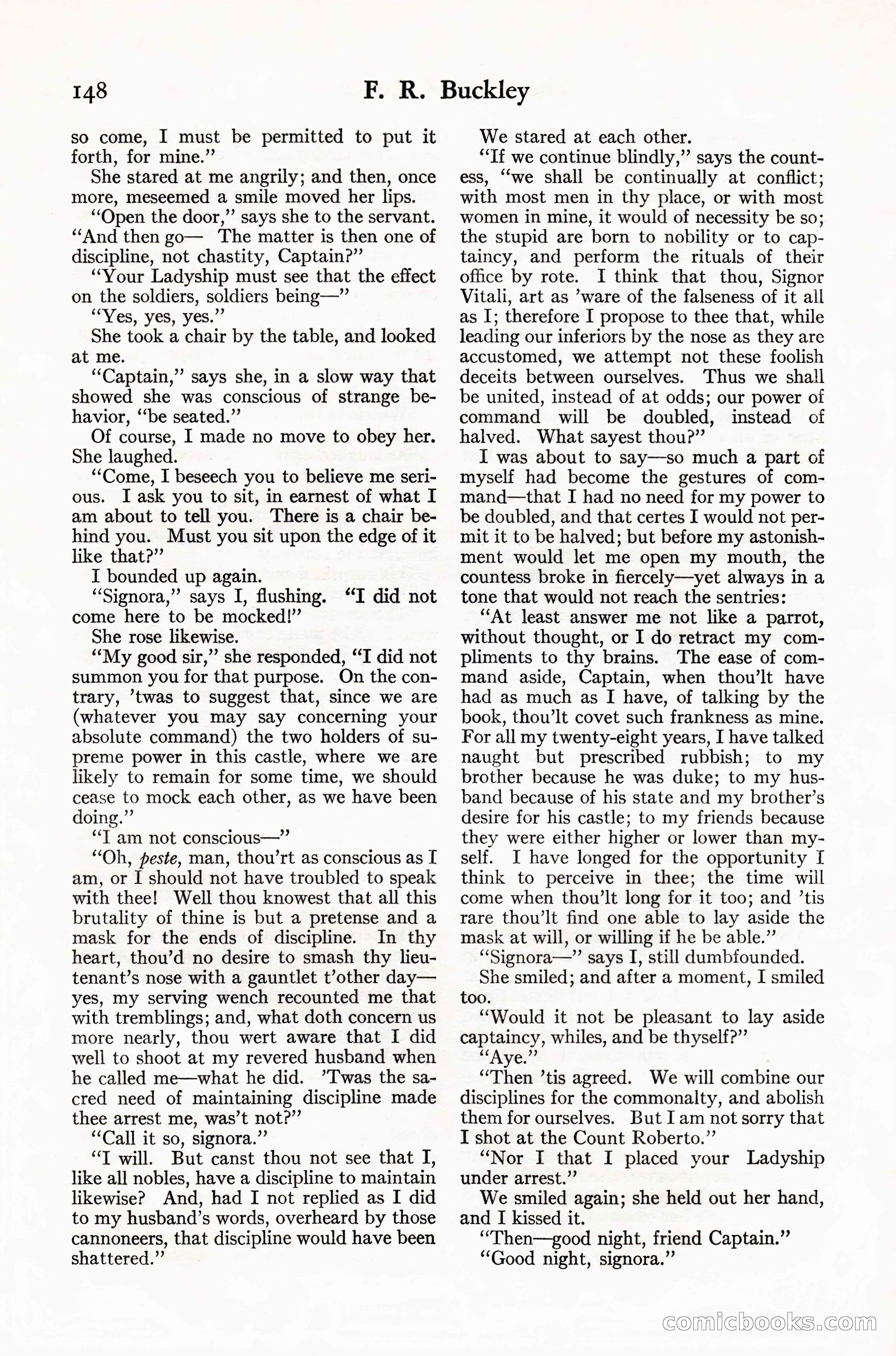
A restored page from Pulp Fiction, 1926. Page through the whole issue in the reader above.
📄 Transcribed text from this page (OCR, searchable)
Machine-transcribed from the original scan — historical spelling and the odd misread are preserved.
148 so come, I must be permitted to put it forth, for mine.”’ She stared at me angrily; and then, once more, meseemed a smile moved her lips. ‘“‘Open the door,”’ says she to the servant. ‘“‘And then go— The matter is then one of discipline, not chastity, Captain?” “Your Ladyship must see that the effect on the soldiers, soldiers being—” “Yes, yes, yes.” She took a chair by the table, and looked at me. ‘“‘Captain,” says she, in a slow way that showed she was conscious of strange be- havior, ‘‘be seated.” Of course, I made no move to obey her. She laughed. ‘“‘Come, I beseech you to believe me seri- ous. I ask you to sit, in earnest of what I am about to tell you. There is a chair be- hind you. Must you sit upon the edge of it like that?” I bounded up again. ‘“Signora,” says I, flushing. come here to be mocked!’’ She rose likewise. ““My good sir,” she responded, “TI did not summon you for that purpose. On the con- trary, ’twas to suggest that, since we are (whatever you may say concerning your absolute command) the two holders of su- preme power in this castle, where we are likely to remain for some time, we should cease to mock each other, as we have been doing.”’ “T am not conscious—” “Oh, peste, man, thou’rt as conscious as [ am, or I should not have troubled to speak with thee! Well thou knowest that all this brutality of thine is but a pretense and a mask for the ends of discipline. In thy heart, thou’d no desire to smash thy lieu- tenant’s nose with a gauntlet t’other day— yes, my serving wench recounted me that with tremblings; and, what doth concern us more nearly, thou wert aware that I did well to shoot at my revered husband when he called me—what he did. Twas the sa- cred need of maintaining discipline made thee arrest me, was’t not?” “Call it so, signora.”’ “T will. But canst thou not see that I, like all nobles, have a discipline to maintain likewise? And, had I not replied as I did to my husband’s words, overheard by those cannoneers, that discipline would have been shattered.” “T did not F. R. Buckley We stared at each other. ‘If we continue blindly,” says the count- ess, “‘we shall be continually at conflict; with most men in thy place, or with most women in mine, it would of necessity be so; the stupid are born to nobility or to cap- taincy, and perform the rituals of their office by rote. I think that thou, Signor Vitali, art as ’ware of the falseness of it all as I; therefore I propose to thee that, while leading our inferiors by the nose as they are accustomed, we attempt not these foolish deceits between ourselves. Thus we shall be united, instead of at odds; our power of command will be doubled, instead of halved. What sayest thou?” I was about to say—so much a part of myself had become the gestures of com- mand—that I had no need for my power to be doubled, and that certes I would not per- mit it to be halved; but before my astonish- ment would let me open my mouth, the countess broke in fiercely—yet always in a tone that would not reach the sentries: “At least answer me not like a parrot, without thought, or I do retract my com- pliments to thy brains. The ease of com- mand aside, Captain, when thou’lt have had as much as I have, of talking by the book, thou’lt covet such frankness as mine. For all my twenty-eight years, I have talked naught but prescribed rubbish; to my brother because he was duke; to my hus- band because of his state and my brother’s desire for his castle; to my friends because they were either higher or lower than my- self. I have longed for the opportunity I think to perceive in thee; the time will come when thou’lt long for it too; and ’tis rare thou’lt find one able to lay aside the mask at will, or willing if he be able.” ‘“Signora—’”’ says I, still dumbfounded. She smiled; and after a moment, I smiled too. “Would it not be pleasant to lay aside captaincy, whiles, and be thyself?” Aye?’ “Then ’tis agreed. We will combine our disciplines for the commonalty, and abolish them for ourselves. But Iam not sorry that I shot at the Count Roberto.” “Nor I that I placed your Ladyship under arrest.” We smiled again; she held out her hand, and I kissed it. ‘“‘Then—good night, friend Captain.” ‘Good night, signora.”’ cCoOnmiclbooks C©