
Pulp Fiction, 1926 · page 152 of 232
Adventure Magazine Cover — page 152: what you’re looking at
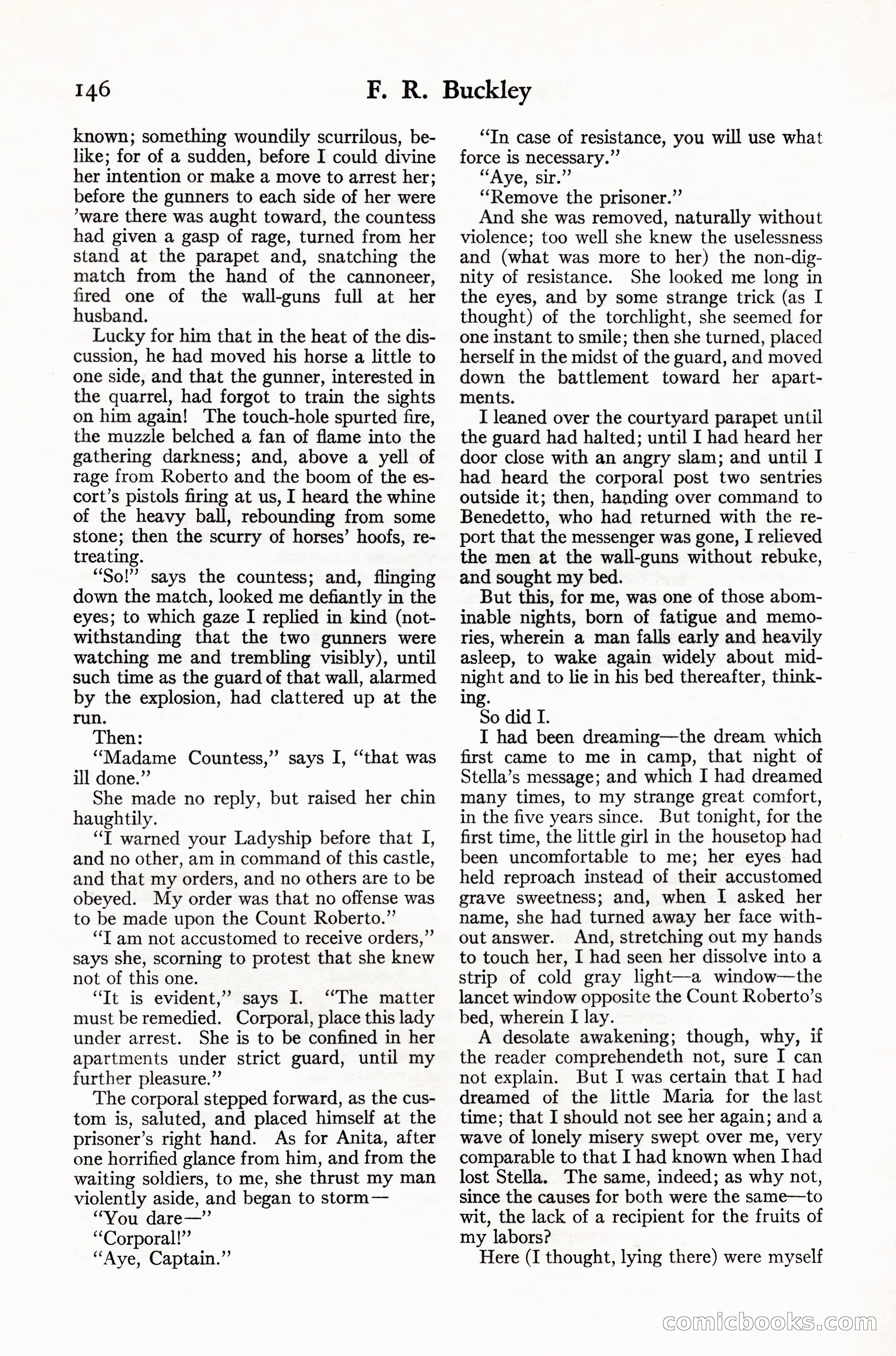
A restored page from Pulp Fiction, 1926. Page through the whole issue in the reader above.
📄 Transcribed text from this page (OCR, searchable)
Machine-transcribed from the original scan — historical spelling and the odd misread are preserved.
146 known; something woundily scurrilous, be- like; for of a sudden, before I could divine her intention or make a move to arrest her; before the gunners to each side of her were ’ware there was aught toward, the countess had given a gasp of rage, turned from her stand at the parapet and, snatching the match from the hand of the cannoneer, fired one of the wall-guns full at her husband. Lucky for him that in the heat of the dis- cussion, he had moved his horse a little to one side, and that the gunner, interested in the quarrel, had forgot to train the sights on him again! The touch-hole spurted fire, the muzzle belched a fan of flame into the gathering darkness; and, above a yell of rage from Roberto and the boom of the es- cort’s pistols firing at us, I heard the whine of the heavy ball, rebounding from some stone; then the scurry of horses’ hoofs, re- treating. “Sol”? says the countess; and, flinging down the match, looked me defiantly in the eyes; to which gaze I replied in kind (not- withstanding that the two gunners were watching me and trembling visibly), until such time as the guard of that wall, alarmed by the explosion, had clattered up at the run. Then: ‘“‘Madame Countess,” says I, ‘‘that was ill done.” She made no reply, but raised her chin haughtily. “T warned your Ladyship before that I, and no other, am in command of this castle, and that my orders, and no others are to be obeyed. My order was that no offense was to be made upon the Count Roberto.”’ “T am not accustomed to receive orders,” says she, scorning to protest that she knew not of this one. “Tt is evident,” says I. ‘The matter must be remedied. Corporal, place this lady under arrest. She is to be confined in her apartments under strict guard, until my further pleasure.”’ The corporal stepped forward, as the cus- tom is, saluted, and placed himself at the prisoner’s right hand. As for Anita, after one horrified glance from him, and from the waiting soldiers, to me, she thrust my man violently aside, and began to storm— “You dare—”’ ‘Corporal!’ “Aye, Captain.” F. R. Buckley “In case of resistance, you will use what force is necessary.” “Aye. sir.” ‘‘Remove the prisoner.” And she was removed, naturally without violence; too well she knew the uselessness and (what was more to her) the non-dig- nity of resistance. She looked me long in the eyes, and by some strange trick (as I thought) of the torchlight, she seemed for one instant to smile; then she turned, placed herself in the midst of the guard, and moved down the battlement toward her apart- ments. I leaned over the courtyard parapet until the guard had halted; until I had heard her door close with an angry slam; and until I had heard the corporal post two sentries outside it; then, handing over command to Benedetto, who had returned with the re- port that the messenger was gone, I relieved the men at the wall-guns without rebuke, and sought my bed. But this, for me, was one of those abom- inable nights, born of fatigue and memo- ries, wherein a man falls early and heavily asleep, to wake again widely about mid- night and to lie in his bed thereafter, think- ing. So did I. I had been dreaming—the dream which first came to me in camp, that night of Stella’s message; and which I had dreamed many times, to my strange great comfort, in the five years since. But tonight, for the first time, the little girl in the housetop had been uncomfortable to me; her eyes had held reproach instead of their accustomed grave sweetness; and, when I asked her name, she had turned away her face with- out answer. And, stretching out my hands to touch her, I had seen her dissolve into a strip of cold gray light—a window—the lancet window opposite the Count Roberto’s bed, wherein [ lay. A desolate awakening; though, why, if the reader comprehendeth not, sure I can not explain. But I was certain that I had dreamed of the little Maria for the last time; that I should not see her again; and a wave of lonely misery swept over me, very comparable to that I had known when [had lost Stella. The same, indeed; as why not, since the causes for both were the same—to wit, the lack of a recipient for the fruits of my labors? Here (I thought, lying there) were myself COMmMiCoooks C©