
Pulp Fiction, 1926 · page 150 of 232
Adventure Magazine Cover — page 150: what you’re looking at
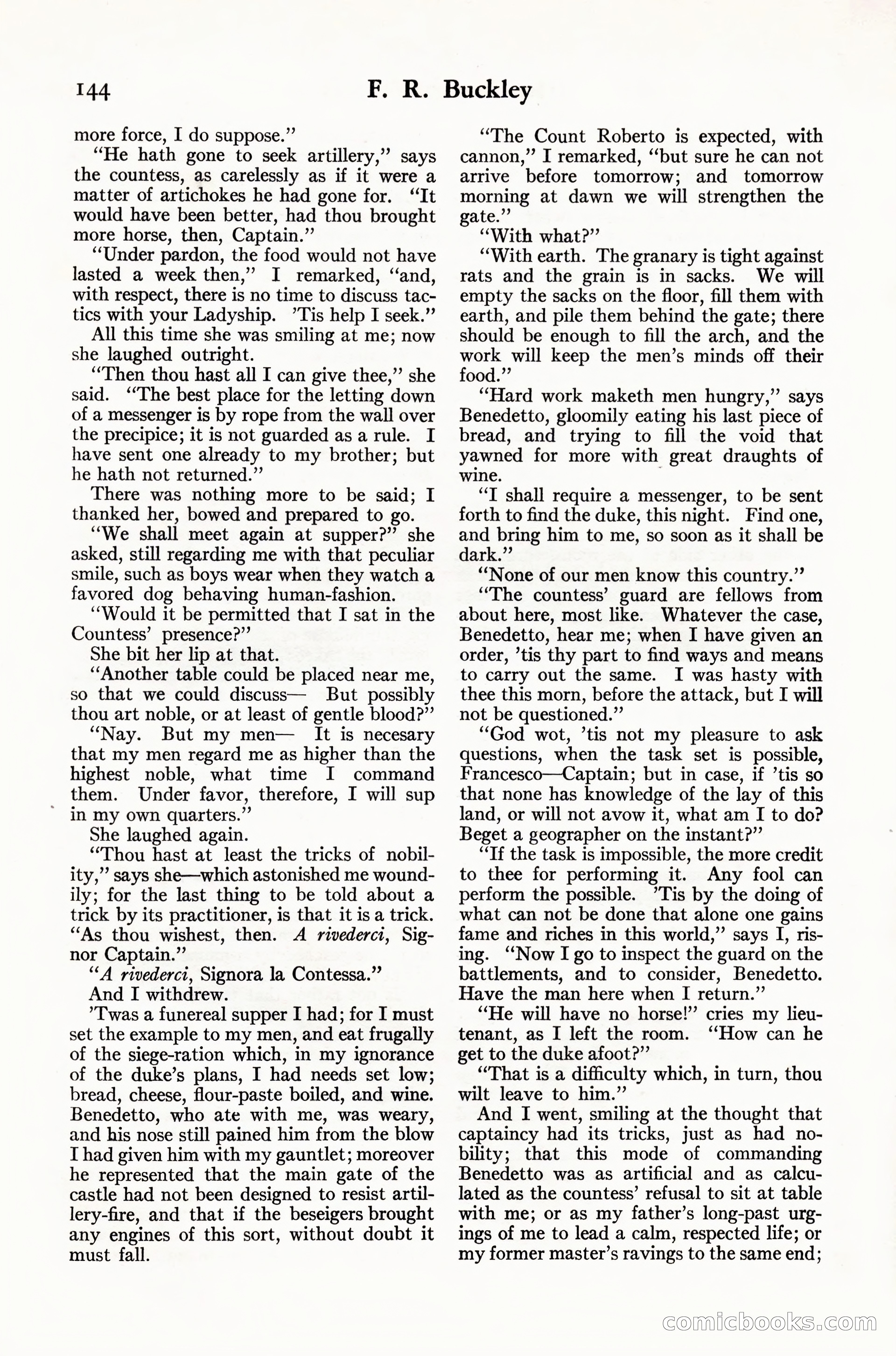
A restored page from Pulp Fiction, 1926. Page through the whole issue in the reader above.
📄 Transcribed text from this page (OCR, searchable)
Machine-transcribed from the original scan — historical spelling and the odd misread are preserved.
144 more force, I do suppose.” “He hath gone to seek artillery,”’ says the countess, as carelessly as if it were a matter of artichokes he had gone for. “It would have been better, had thou brought more horse, then, Captain.” “Under pardon, the food would not have lasted a week then,” I remarked, “and, with respect, there is no time to discuss tac- tics with your Ladyship. ’Tis help I seek.” All this time she was smiling at me; now she laughed outright. ‘Then thou hast all I can give thee,”’ she said. “The best place for the letting down of a messenger is by rope from the wall over the precipice; it is not guarded asarule. I have sent one already to my brother; but he hath not returned.” There was nothing more to be said; I thanked her, bowed and prepared to go. “We shall meet again at supper?” she asked, still regarding me with that peculiar smile, such as boys wear when they watch a favored dog behaving human-fashion. ‘Would it be permitted that I sat in the Countess’ presence?” She bit her lip at that. ‘“‘Another table could be placed near me, so that we could discuss— But possibly thou art noble, or at least of gentle blood?” “Nay. But my men— It is necesary that my men regard me as higher than the highest noble, what time I command them. Under favor, therefore, I will sup in my own quarters.” She laughed again. “Thou hast at least the tricks of nobil- ity,’’ says she—which astonished me wound- ily; for the last thing to be told about a trick by its practitioner, is that it is a trick. ‘“‘As thou wishest, then. A rivederci, Sig- nor Captain.” “fA rivederci, Signora la Contessa.” And I withdrew. Twas a funereal supper I had; for I must set the example to my men, and eat frugally of the siege-ration which, in my ignorance of the duke’s plans, I had needs set low; bread, cheese, flour-paste boiled, and wine. Benedetto, who ate with me, was weary, and his nose still pained him from the blow Thad given him with my gauntlet; moreover he represented that the main gate of the castle had not been designed to resist artil- lery-fire, and that if the beseigers brought any engines of this sort, without doubt it must fall. F. R. Buckley “The Count Roberto is expected, with cannon,” I remarked, ‘“‘but sure he can not arrive before tomorrow; and tomorrow morning at dawn we will strengthen the gate.”’ “With what?” “With earth. The granary is tight against rats and the grain is in sacks. We will empty the sacks on the floor, fill them with earth, and pile them behind the gate; there should be enough to fill the arch, and the work will keep the men’s minds off their food.” “Hard work maketh men hungry,” says Benedetto, gloomily eating his last piece of bread, and trying to fill the void that yawned for more with great draughts of wine. . “T shall require a messenger, to be sent forth to find the duke, this night. Find one, and bring him to me, so soon as it shall be dark.” “None of our men know this country.” ‘The countess’ guard are fellows from about here, most like. Whatever the case, Benedetto, hear me; when I have given an order, ’tis thy part to find ways and means to carry out the same. I was hasty with thee this morn, before the attack, but I will not be questioned.” “God wot, ’tis not my pleasure to ask questions, when the task set is possible, Francesco—Captain; but in case, if ’tis so that none has knowledge of the lay of this land, or will not avow it, what am I to do? Beget a geographer on the instant?” ‘If the task is impossible, the more credit to thee for performing it. Any fool can perform the possible. ’Tis by the doing of what can not be done that alone one gains fame and riches in this world,” says I, ris- ing. ‘‘Now I go to inspect the guard on the battlements, and to consider, Benedetto. Have the man here when I return.” “He will have no horse!” cries my lieu- tenant, as I left the room. ‘How can he get to the duke afoot?” “That is a difficulty which, in turn, thou wilt leave to him.” And I went, smiling at the thought that captaincy had its tricks, just as had no- bility; that this mode of commanding Benedetto was as artificial and as calcu- lated as the countess’ refusal to sit at table with me; or as my father’s long-past urg- ings of me to lead a calm, respected life; or my former master’s ravings to the same end; COMICOOokKS C©