
Pulp Fiction, 1926 · page 119 of 232
Adventure Magazine Cover — page 119: what you’re looking at
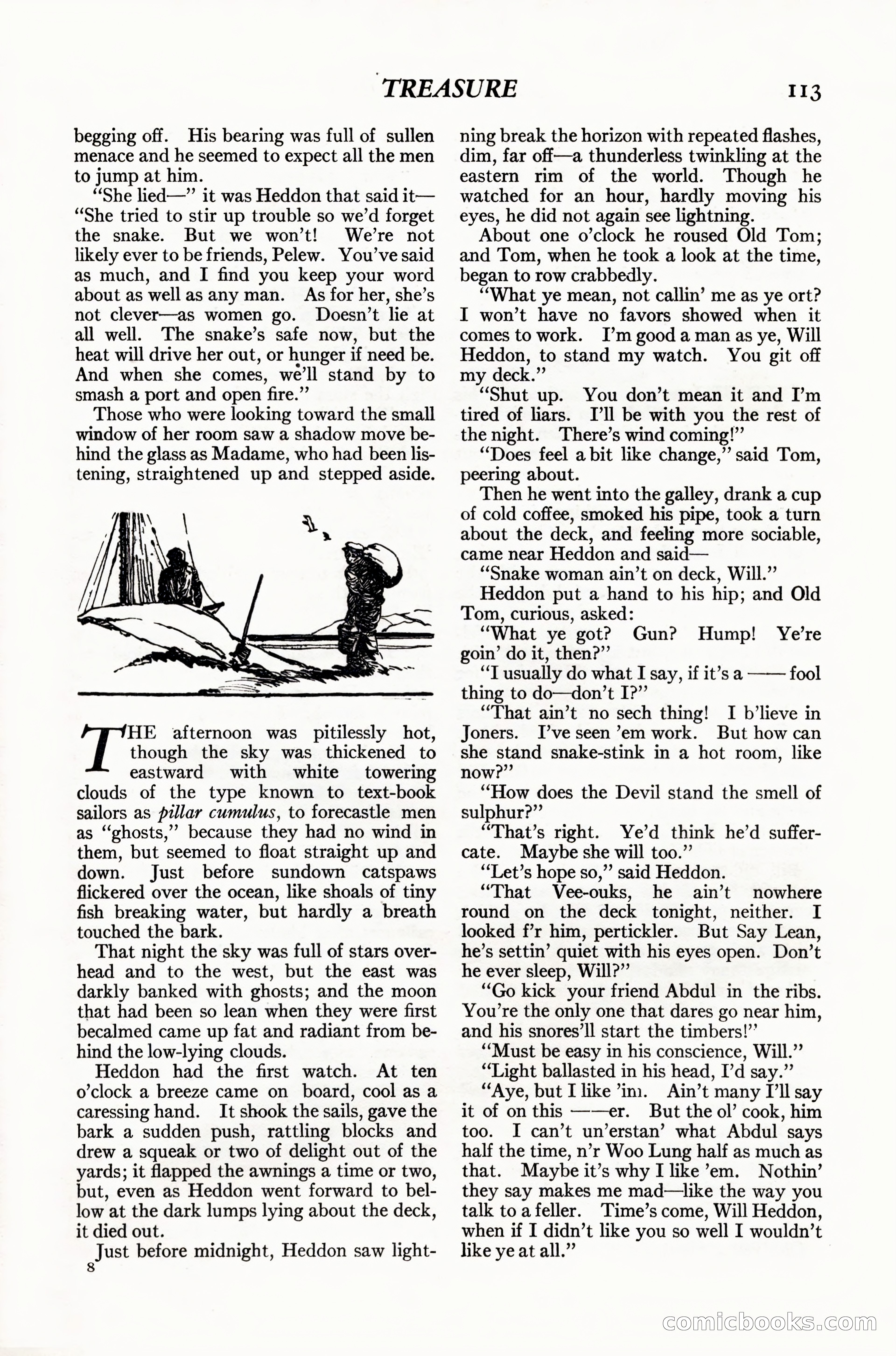
A restored page from Pulp Fiction, 1926. Page through the whole issue in the reader above.
📄 Transcribed text from this page (OCR, searchable)
Machine-transcribed from the original scan — historical spelling and the odd misread are preserved.
"TREASURE begging off. His bearing was full of sullen menace and he seemed to expect all the men to jump at him. “She lied—” it was Heddon that said it— “She tried to stir up trouble so we’d forget the snake. But we won’t! We’re not likely ever to be friends, Pelew. You’ve said as much, and I find you keep your word about as wellas any man. As for her, she’s not clever—as women go. Doesn’t lie at all well. The snake’s safe now, but the heat will drive her out, or hunger if need be. And when she comes, we'll stand by to smash a port and open fire.” Those who were looking toward the small window of her room saw a shadow move be- hind the glass as Madame, who had been lis- tening, straightened up and stepped aside. i 4 \ a | I | ’ HE afternoon was pitilessly hot, though the sky was thickened to eastward with white towering clouds of the type known to text-book sailors as pillar cumulus, to forecastle men as “ghosts,” because they had no wind in them, but seemed to float straight up and down. Just before sundown catspaws flickered over the ocean, like shoals of tiny fish breaking water, but hardly a breath touched the bark. That night the sky was full of stars over- head and to the west, but the east was darkly banked with ghosts; and the moon that had been so lean when they were first becalmed came up fat and radiant from be- hind the low-lying clouds. Heddon had the first watch. At ten o’clock a breeze came on board, cool as a caressing hand. It shook the sails, gave the bark a sudden push, rattling blocks and drew a squeak or two of delight out of the yards; it flapped the awnings a time or two, but, even as Heddon went forward to bel- low at the dark lumps lying about the deck, it died out. Just before midnight, Heddon saw light- 8 113 ning break the horizon with repeated flashes, dim, far off—a thunderless twinkling at the eastern rim of the world. Though he watched for an hour, hardly moving his eyes, he did not again see lightning. About one o’clock he roused Old Tom; and Tom, when he took a look at the time, began to row crabbedly. ‘‘What ye mean, not callin’ me as ye ort? I won’t have no favors showed when it comes to work. I’m good a man as ye, Will Heddon, to stand my watch. You git off my deck.” “Shut up. You don’t mean it and I’m tired of liars. Ill be with you the rest of the night. There’s wind coming!” “Does feel a bit like change,” peering about. Then he went into the galley, drank a cup of cold coffee, smoked his pipe, took a turn about the deck, and feeling more sociable, came near Heddon and said— “Snake woman ain’t on deck, Will.” Heddon put a hand to his hip; and Old Tom, curious, asked: said Tom, “What ye got? Gun? Hump! Ye’re goin’ do it, then?” “T usually do what I say, if it’s a fool thing to do—don’t I?” “That ain’t no sech thing! I b’lieve in Joners. IT’veseen’em work. But how can she stand snake-stink in a hot room, like now?” “How does the Devil stand the smell of sulphur?” “That’s right. Ye’d think he’d suffer- cate. Maybe she will too.” “‘Let’s hope so,” said Heddon. “That Vee-ouks, he ain’t nowhere round on the deck tonight, neither. I looked f’r him, pertickler. But Say Lean, he’s settin’ quiet with his eyes open. Don’t he ever sleep, Will?” “Go kick your friend Abdul in the ribs. You’re the only one that dares go near him, and his snores’ll start the timbers!”’ ““Must be easy in his conscience, Will.” “Light ballasted in his head, I’d say.” “Aye, but I like ’im. Ain’t many I'll say it of on this ——er. But the ol’ cook, him too. I can’t un’erstan’ what Abdul says half the time, n’r Woo Lung half as much as that. Maybe it’s why I like ’em. Nothin’ they say makes me mad—like the way you talk to afeller. Time’s come, Will Heddon, when if I didn’t like you so well I wouldn’t hike yeat all.” DOOK (C©