
Pulp Fiction, 1926 · page 116 of 232
Adventure Magazine Cover — page 116: what you’re looking at
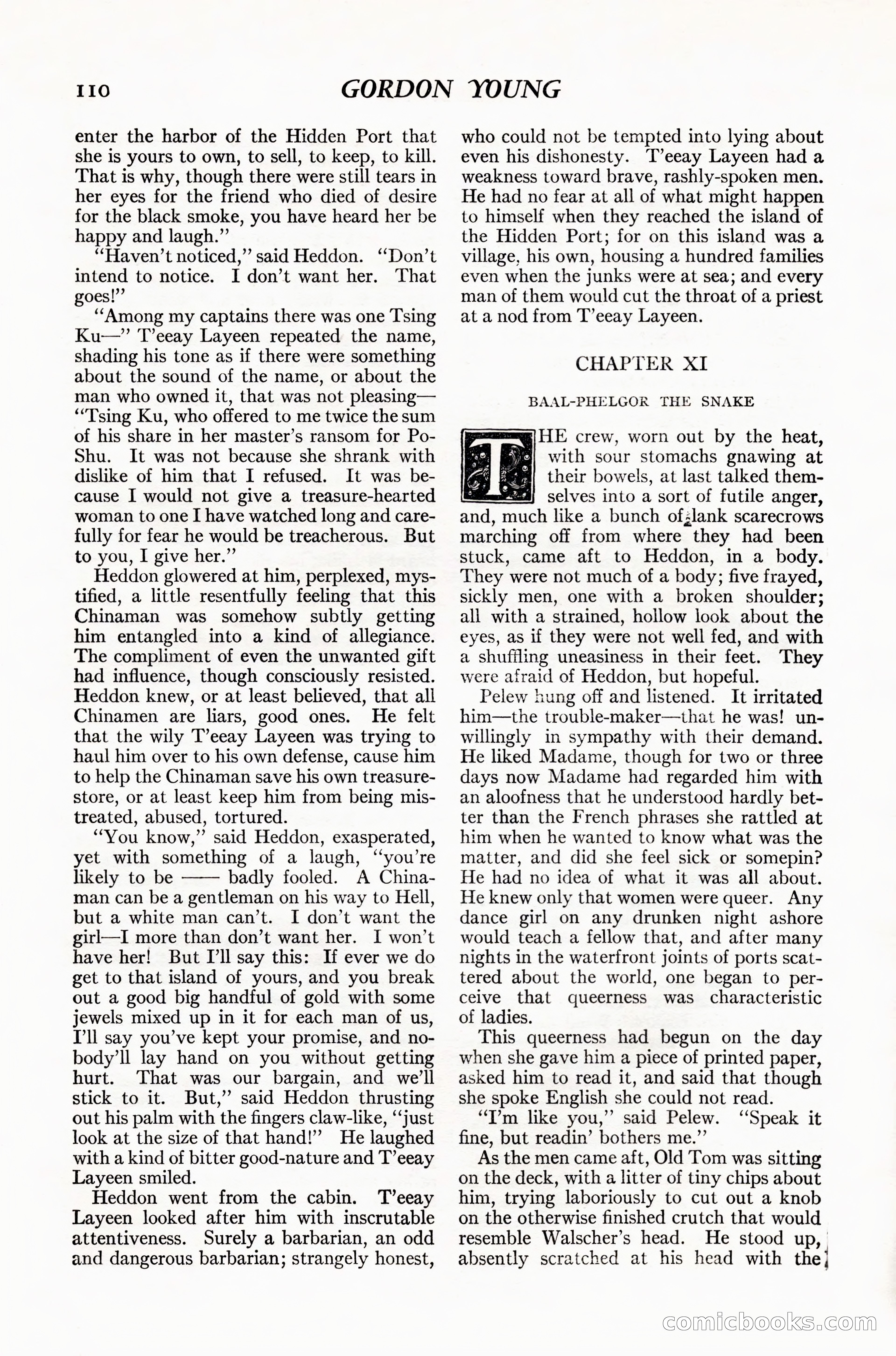
A restored page from Pulp Fiction, 1926. Page through the whole issue in the reader above.
📄 Transcribed text from this page (OCR, searchable)
Machine-transcribed from the original scan — historical spelling and the odd misread are preserved.
IIo enter the harbor of the Hidden Port that she is yours to own, to sell, to keep, to kill. That is why, though there were still tears in her eyes for the friend who died of desire for the black smoke, you have heard her be happy and laugh.”’ ““Haven’t noticed,” said Heddon. ‘Don’t intend to notice. I don’t want her. That goes!’’ ‘‘Among my captains there was one Tsing Ku—” T’eeay Layeen repeated the name, shading his tone as if there were something about the sound of the name, or about the man who owned it, that was not pleasing— “Tsing Ku, who offered to me twice the sum of his share in her master’s ransom for Po- Shu. It was not because she shrank with dislike of him that I refused. It was be- cause I would not give a treasure-hearted woman to one I have watched long and care- fully for fear he would be treacherous. But to you, I give her.”’ Heddon glowered at him, perplexed, mys- tified, a little resentfully feeling that this Chinaman was somehow subtly getting him entangled into a kind of allegiance. The compliment of even the unwanted gift had influence, though consciously resisted. Heddon knew, or at least believed, that all Chinamen are liars, good ones. He felt that the wily T’eeay Layeen was trying to haul him over to his own defense, cause him to help the Chinaman save his own treasure- store, or at least keep him from being mis- treated, abused, tortured. “You know,” said Heddon, exasperated, yet with something of a laugh, “‘you’re likely to be —— badly fooled. A China- man can be a gentleman on his way to Hell, but a white man can’t. I don’t want the girl—I more than don’t want her. I won’t have her! But I'll say this: If ever we do get to that island of yours, and you break out a good big handful of gold with some jewels mixed up in it for each man of us, I'll say you’ve kept your promise, and no- body’ll lay hand on you without getting hurt. That was our bargain, and we'll stick to it. But,” said Heddon thrusting out his palm with the fingers claw-like, “‘just look at the size of that hand!” He laughed with a kind of bitter good-nature and T’eeay Layeen smiled. Heddon went from the cabin. T’eeay Layeen looked after him with inscrutable attentiveness. Surely a barbarian, an odd and dangerous barbarian; strangely honest, GORDON YOUNG who could not be tempted into lying about even his dishonesty. T’eeay Layeen had a weakness toward brave, rashly-spoken men. He had no fear at all of what might happen to himself when they reached the island of the Hidden Port; for on this island was a village, his own, housing a hundred families even when the junks were at sea; and every man of them would cut the throat of a priest at a nod from T’eeay Layeen. CHAPTER XI BAAL-PHELGOR THE SNAKE HE crew, worn out by the heat, | with sour stomachs gnawing at their bowels, at last talked them- selves into a sort of futile anger, and, much like a bunch of;zlank scarecrows marching off from where they had been stuck, came aft to Heddon, in a body. They were not much of a body; five frayed, sickly men, one with a broken shoulder; all with a strained, hollow look about the eyes, as if they were not well fed, and with a shuffling uneasiness in their feet. They were afraid of Heddon, but hopeful. Pelew hung off and listened. It irritated him—the trouble-maker—that he was! un- willingly in sympathy with their demand. He liked Madame, though for two or three days now Madame had regarded him with an aloofness that he understood hardly bet- ter than the French phrases she rattled at him when he wanted to know what was the matter, and did she feel sick or somepin? He had no idea of what it was all about. He knew only that women were queer. Any dance girl on any drunken night ashore would teach a fellow that, and after many nights in the waterfront joints of ports scat- tered about the world, one began to per- celve that queerness was characteristic of ladies. This queerness had begun on the day when she gave him a piece of printed paper, asked him to read it, and said that though she spoke English she could not read. “Y’m like you,” said Pelew. ‘Speak it fine, but readin’ bothers me.”’ As the men came aft, Old Tom was sitting on the deck, with a litter of tiny chips about him, trying laboriously to cut out a knob on the otherwise finished crutch that would resemble Walscher’s head. He stood up, absently scratched at his head with the COmiclbooks ' ‘ (C©