
Pulp Fiction, 1926 · page 98 of 212
Adventure Magazine Cover — page 98: what you’re looking at
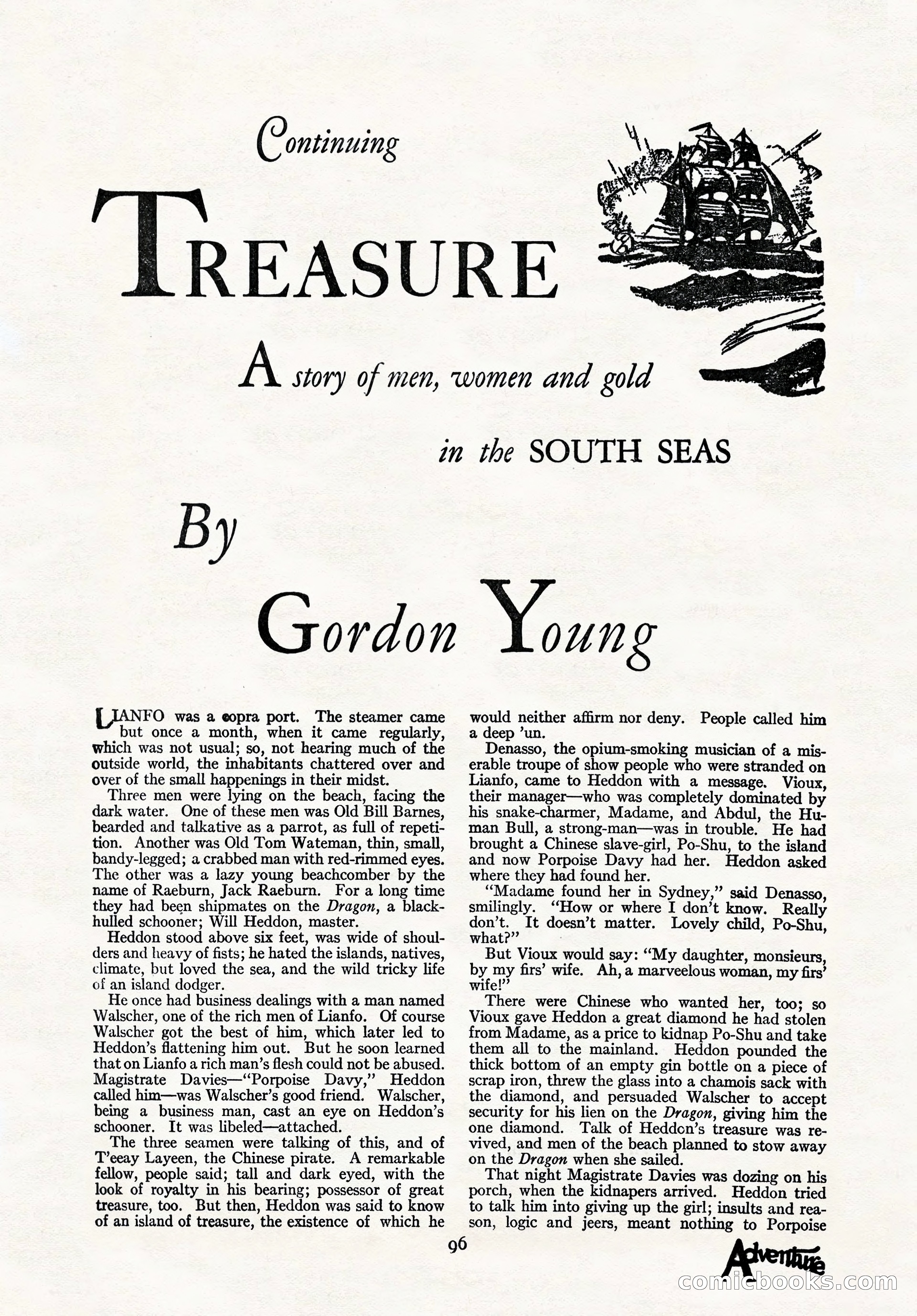
A restored page from Pulp Fiction, 1926. Page through the whole issue in the reader above.
📄 Transcribed text from this page (OCR, searchable)
Machine-transcribed from the original scan — historical spelling and the odd misread are preserved.
(2 ontinuing “TREASURE A story of men, women and gold in the SOUTH SEAS By Gordon Young O was a eopra port. The steamer came but once a month, when it came regularly, which was not usual; so, not hearing much of the outside world, the inhabitants chattered over and over of the small happenings in their midst. Three men were lying on the beach, facing the dark water. One of these men was Old Bill Barnes, bearded and talkative as a parrot, as full of repeti- tion. Another was Old Tom Wateman, thin, small, bandy-legged; a crabbed man with red-rimmed eyes. The other was a lazy young beachcomber by the name of Raeburn, Jack Raeburn. For a long time they had been shipmates on the Dragon, a black- hulled schooner; Will Heddon, master. Heddon stood above six feet, was wide of shoul- ders and heavy of fists; he hated the islands, natives, climate, but loved the sea, and the wild tricky life of an island dodger. He once had business dealings with a man named Walscher, one of the rich men of Lianfo. Of course Walscher got the best of him, which later led to Heddon’s flattening him out. But he soon learned that on Lianfo a rich man’s flesh could not be abused. Magistrate Davies—‘‘Porpoise Davy,’’ Heddon called him—was Walscher’s good friend. Walscher, being a business man, cast an eye on Heddon’s schooner. It was libeled—attached. The three seamen were talking of this, and of T’eeay Layeen, the Chinese pirate. A remarkable fellow, people said; tall and dark eyed, with the look of royalty in his bearing; possessor of great treasure, too. But then, Heddon was said to know of an island of treasure, the existence of which he 96 would neither affirm nor deny. People called him a deep ’un. Denasso, the opium-smoking musician of a mis- erable troupe of show people who were stranded on Lianfo, came to Heddon with a message. Vioux, their manager—who was completely dominated by his snake-charmer, Madame, and Abdul, the Hu- man Bull, a strong-man—was in trouble. He had brought a Chinese slave-girl, Po-Shu, to the island and now Porpoise Davy had her. Heddon asked where they had found her. “Madame found her in Sydney,” said Denasso, smilingly. “How or where I don’t know. Really don’t. It doesn’t matter. Lovely child, Po-Shu, what?” 3 But Vioux would say: ‘My daughter, monsieurs, BY. ny firs’ wife. Ah, a marveelous woman, my firs’ wife!” There were Chinese who wanted her, too; so Vioux gave Heddon a great diamond he had stolen from Madame, as a price to kidnap Po-Shu and take them all to the mainland. Heddon pounded the thick bottom of an empty gin bottle on a piece of scrap iron, threw the glass into a chamois sack with the diamond, and persuaded Walscher to accept security for his lien on the Dragon, giving him the one diamond. Talk of Heddon’s treasure was re- vived, and men of the beach planned to stow away on the Dragon when she sailed. That night Magistrate Davies was dozing on his porch, when the kidnapers arrived. Heddon tried to talk him into giving up the girl; insults and rea- son, logic and jeers, meant nothing to Porpoise Pernt, C@