
Pulp Fiction, 1926 · page 92 of 212
Adventure Magazine Cover — page 92: what you’re looking at
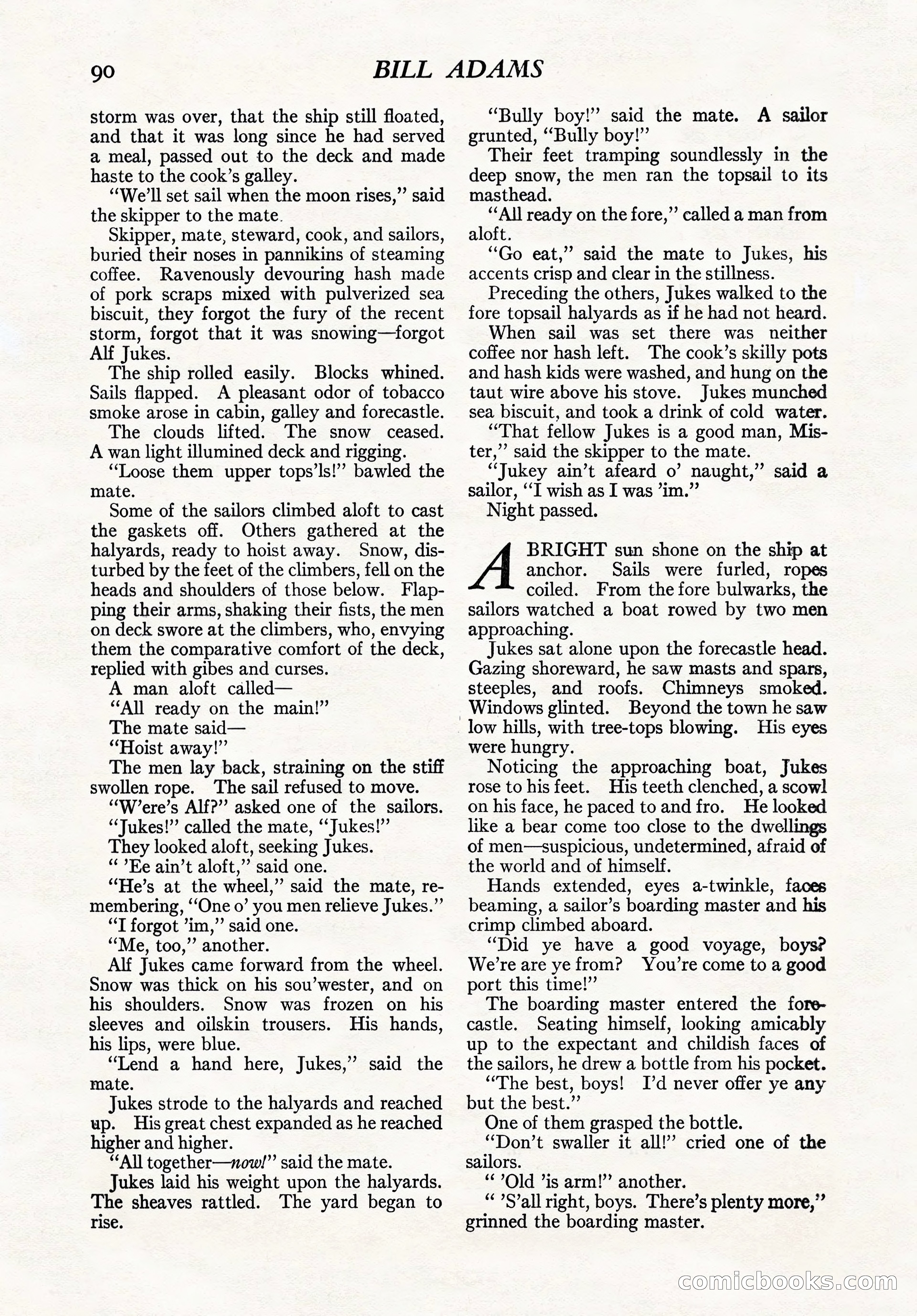
A restored page from Pulp Fiction, 1926. Page through the whole issue in the reader above.
📄 Transcribed text from this page (OCR, searchable)
Machine-transcribed from the original scan — historical spelling and the odd misread are preserved.
gO storm was over, that the ship still floated, and that it was long since he had served a meal, passed out to the deck and made haste to the cook’s galley. ‘‘We’ll set sail when the moon rises,” said the skipper to the mate. Skipper, mate, steward, cook, and sailors, buried their noses in pannikins of steaming coffee. Ravenously devouring hash made of pork scraps mixed with pulverized sea biscuit, they forgot the fury of the recent storm, forgot that it was snowing—forgot Alf Jukes. The ship rolled easily. Blocks whined. Sails flapped. A pleasant odor of tobacco smoke arose in cabin, galley and forecastle. The clouds lifted. The snow ceased. A wan light illumined deck and rigging. “Loose them upper tops’ls!’’ bawled the mate. Some of the sailors climbed aloft to cast the gaskets off. Others gathered at the halyards, ready to hoist away. Snow, dis- turbed by the feet of the climbers, fell on the heads and shoulders of those below. Flap- ping their arms, shaking their fists, the men on deck swore at the climbers, who, envying them the comparative comfort of the deck, replied with gibes and curses. A man aloft called— “All ready on the main!” The mate said— “Hoist away!”’ The men lay back, straining on the stiff swollen rope. The sail refused to move. “‘W’ere’s Alf?” asked one of the sailors. “‘Jukes!”’ called the mate, “Jukes!” They looked aloft, seeking Jukes. “Fe ain’t aloft,” said one. ‘“‘He’s at the wheel,” said the mate, re- membering, “‘One 0’ you men relieve Jukes.”’ “T forgot ’im,” said one. “Me, too,” another. Alf Jukes came forward from the wheel. Snow was thick on his sou’wester, and on his shoulders. Snow was frozen on his sleeves and oilskin trousers. His hands, his lips, were blue. “Lend a hand here, Jukes,” said the mate. Jukes strode to the halyards and reached up. His great chest expanded as he reached higher and higher. “All together—now!”’ said the mate. Jukes laid his weight upon the halyards. The sheaves rattled. The yard began to rise. BILL ADAMS “Bully boy!” said the mate. A sailor grunted, “Bully boy!” Their feet tramping soundlessly in the deep snow, the men ran the topsail to its masthead. ‘‘All ready on the fore,” called a man from aloft. “Go eat,” said the mate to Jukes, his accents crisp and clear in the stillness. Preceding the others, Jukes walked to the fore topsail halyards as if he had not heard. When sail was set there was neither coffee nor hash left. The cook’s skilly pots and hash kids were washed, and hung on the taut wire above his stove. Jukes munched sea biscuit, and took a drink of cold water. “That fellow Jukes is a good man, Mis- ter,’’ said the skipper to the mate. “Jukey ain’t afeard o’ naught,” said a sailor, “‘I wish as I was ’im.”’ Night passed. BRIGHT sun shone on the ship at A anchor. Sails were furled, ropes coiled. From the fore bulwarks, the sailors watched a boat rowed by two men approaching. Jukes sat alone upon the forecastle head. Gazing shoreward, he saw masts and spars, steeples, and roofs. Chimneys smoked. Windows glinted. Beyond the town he saw low hills, with tree-tops blowing. His eyes were hungry. Noticing the approaching boat, Jukes rose to his feet. His teeth clenched, a scowl on his face, he paced to and fro. He looked like a bear come too close to the dwellings of men—suspicious, undetermined, afraid of the world and of himself. Hands extended, eyes a-twinkle, faces beaming, a sailor’s boarding master and his crimp climbed aboard. “Did ye have a good voyage, boys? We’re are ye from? You’re come to a good port this time!”’ The boarding master entered the fore- castle. Seating himself, looking amicably up to the expectant and childish faces of the sailors, he drew a bottle from his pocket. “The best, boys! Id never offer ye any but the best.” One of them grasped the bottle. “Don’t swaller it all!” cried one of the sailors. ‘Old ’is arm!”’ another. “« ?S’all right, boys. There’s plenty more,” grinned the boarding master. Co DOOLK (©