
Pulp Fiction, 1926 · page 90 of 212
Adventure Magazine Cover — page 90: what you’re looking at
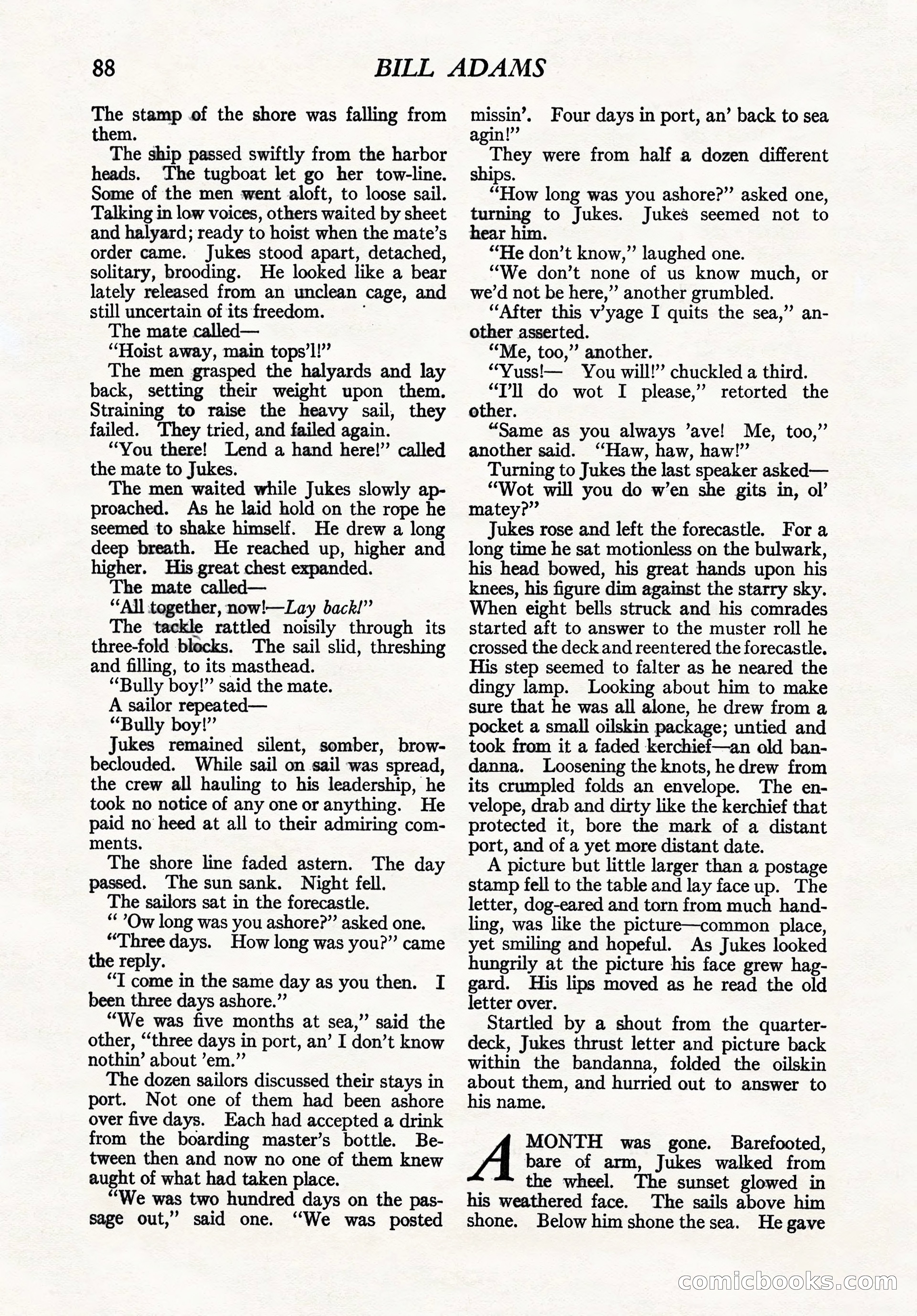
A restored page from Pulp Fiction, 1926. Page through the whole issue in the reader above.
📄 Transcribed text from this page (OCR, searchable)
Machine-transcribed from the original scan — historical spelling and the odd misread are preserved.
88 The stamp of the shore was falling from them. The ship passed swiftly from the harbor heads. The tugboat let go her tow-line. Some of the men went aloft, to loose sail. Talking in low voices, others waited by sheet and halyard; ready to hoist when the mate’s order came. Jukes stood apart, detached, solitary, brooding. He looked like a bear lately released from an unclean cage, and still uncertain of its freedom. The mate called— “Hoist away, main tops’!!”’ The men grasped the halyards and lay back, setting their weight upon them. Straining to raise the heavy sail, they failed. ‘They tried, and failed again. “You there! Lend a hand here!” called the mate to Jukes. The men waited while Jukes slowly ap- proached. As he laid hold on the rope he seemed to shake himself. He drew a long deep breath. He reached up, higher and higher. His great chest expanded. The mate called— “All together, now!—Lay backl”’ The tackle rattled noisily through its three-fold blocks. The sail slid, threshing and filling, to its masthead. “Bully boy!” said the mate. A sailor repeated— Jukes remained silent, somber, brow- beclouded. While sail on sail was spread, the crew all hauling to his leadership, he took no notice of any one or anything. He paid no heed at all to their admiring com- ments. The shore line faded astern. The day passed. The sun sank. Night fell. The sailors sat in the forecastle. “ Ow long was you ashore?” asked one. “Three days. How long was you?” came the reply. “I come in the same day as you then. I been three days ashore.”’ “‘We was five months at sea,” said the other, “three days in port, an’ I don’t know nothin’ about ’em.”’ The dozen sailors discussed their stays in port. Not one of them had been ashore over five days. Each had accepted a drink from the boarding master’s bottle. Be- tween then and now no one of them knew aught of what had taken place. “‘We was two hundred days on the pas- sage out,” said one. “We was posted BILL ADAMS missin’, Four days in port, an’ back to sea agin!’ They were from half a dozen different ships. “How long was you ashore?” asked one, turning to Jukes. Jukes seemed not to hear him. “He don’t know,” laughed one. “We don’t none of us know much, or we'd not be here,”’ another grumbled. “After this v’yage I quits the sea,” an- other asserted. “Me, too,”’ another. “VYuss!— You will!” chuckled a third. “T’ll do wot I please,” retorted the other. “Same as you always ’ave! Me, too,” another said. “Haw, haw, haw!” Turning to Jukes the last speaker asked— “Wot will you do w’en she gits in, ol’ matey?” Jukes rose and left the forecastle. For a long time he sat motionless on the bulwark, his head bowed, his great hands upon his knees, his figure dim against the starry sky. When eight bells struck and his comrades started aft to answer to the muster roll he crossed the deck and reentered the forecastle. His step seemed to falter as he neared the dingy lamp. Looking about him to make sure that he was all alone, he drew from a pocket a small oilskin package; untied and took from it a faded kerchief—an old ban- danna. Loosening the knots, he drew from its crumpled folds an envelope. The en- velope, drab and dirty like the kerchief that protected it, bore the mark of a distant port, and of a yet more distant date. A picture but little larger than a postage stamp fell to the table and lay face up. The letter, dog-eared and torn from much hand- ling, was like the picture—common place, yet smiling and hopeful. As Jukes looked hungrily at the picture his face grew hag- gard. His lips moved as he read the old letter over. Startled by a shout from the quarter- deck, Jukes thrust letter and picture back within the bandanna, folded the oilskin about them, and hurried out to answer to his name. A bare of arm, Jukes walked from the wheel. The sunset glowed in his weathered face. The sails above him shone. Below him shone the sea. He gave MONTH was gone. Barefooted, CoOnmiclbooks (C@ S|