
Pulp Fiction, 1926 · page 27 of 212
Adventure Magazine Cover — page 27: what you’re looking at
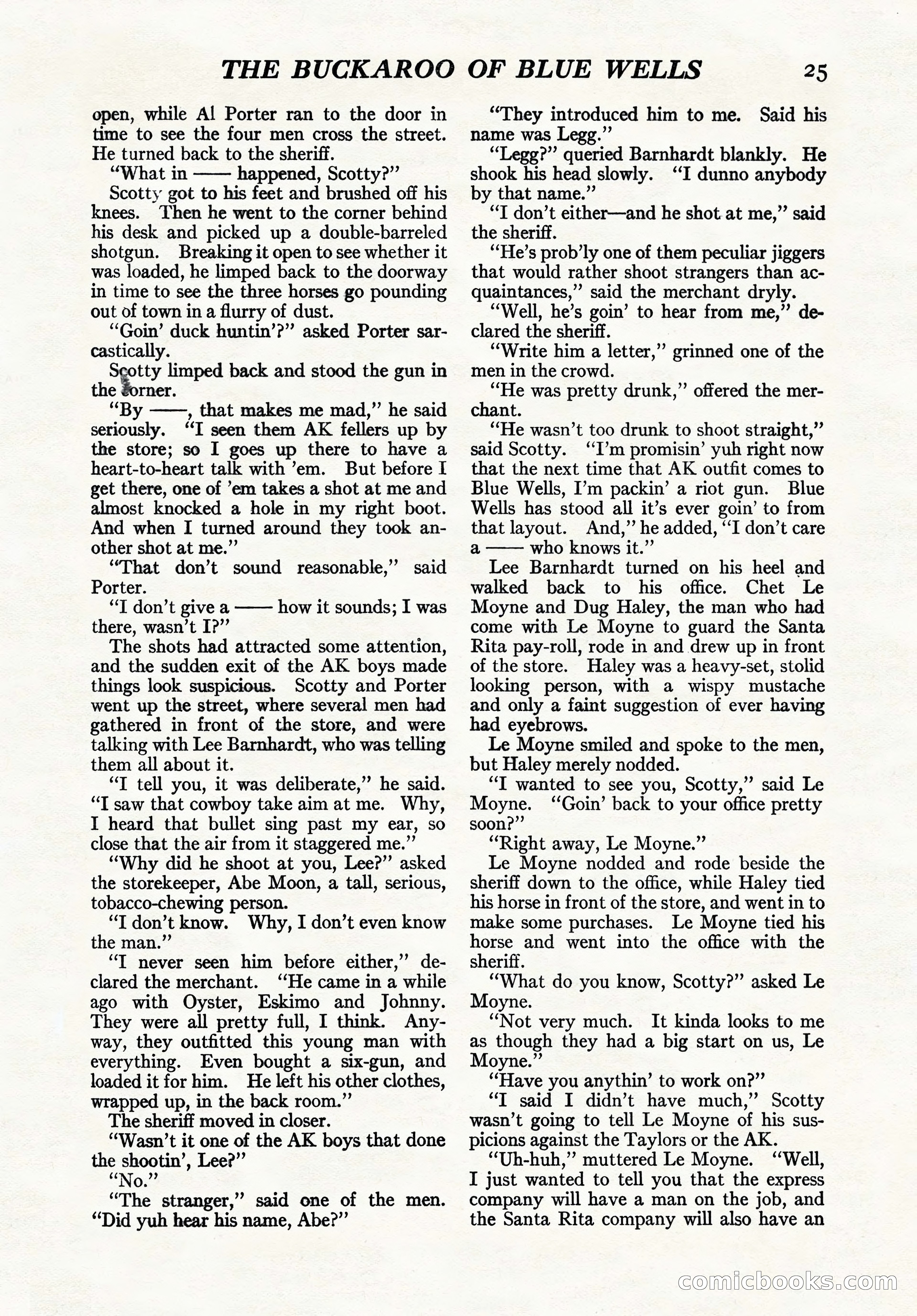
A restored page from Pulp Fiction, 1926. Page through the whole issue in the reader above.
📄 Transcribed text from this page (OCR, searchable)
Machine-transcribed from the original scan — historical spelling and the odd misread are preserved.
THE BUCKAROO OF BLUE WELLS open, while Al Porter ran to the door in time to see the four men cross the street. He turned back to the sheriff. “What in happened, Scotty?” Scotty got to his feet and brushed off his knees. Then he went to the corner behind his desk and picked up a double-barreled shotgun. Breaking it open to see whether it was loaded, he limped back to the doorway in time to see the three horses go pounding out of town in a flurry of dust. ‘Goin’ duck huntin’?” asked Porter sar- castically. Spotty limped back and stood the gun in the rner. “By ——, that makes me mad,” he said seriously. “TI seen them AK fellers up by the store; so I goes up there to have a heart-to-heart talk with ’em. But before I get there, one of ’em takes a shot at me and almost knocked a hole in my right boot. And when I turned around they took an- other shot at me.” “That don’t sound reasonable,” said Porter. “T don’t give a —— how it sounds; I was there, wasn’t I?” The shots had attracted some attention, and the sudden exit of the AK boys made things look suspicious. Scotty and Porter went up the street, where several men had gathered in front of the store, and were talking with Lee Barnhardt, who was telling them all about it. “T tell you, it was deliberate,” he said. “T saw that cowboy take aim at me. Why, I heard that bullet sing past my ear, so close that the air from it staggered me.” “Why did he shoot at you, Lee?’”’ asked the storekeeper, Abe Moon, a tall, serious, tobacco-chewing person. “T don’t know. Why, I don’t even know the man.” “T never seen him before either,’ de- clared the merchant. ‘He came in a while ago with Oyster, Eskimo and Johnny. They were all pretty full, I think. Any- way, they outfitted this young man with everything. Even bought a six-gun, and loaded it for him. He left his other clothes, wrapped up, in the back room.” The sheriff moved in closer. ‘“‘Wasn’t it one of the AK boys that done the shootin’, Lee?”’ “No.” “The stranger,” said one of the men. “Did yuh hear his name, Abe?” 25 “‘They introduced him to me. Said his name was Legg.”’ “Legg?” queried Barnhardt blankly. He shook his head slowly. “I dunno anybody by that name.” “T don’t either—and he shot. at me,” said the sheriff. “‘He’s prob’ly one of them peculiar jiggers that would rather shoot strangers than ac- quaintances,” said the merchant dryly. “Well, he’s goin’ to hear from me,” de- clared the sheriff. ‘“‘Write him a letter,”’ grinned one of the men in the crowd. “He was pretty drunk,” offered the mer- chant. “He wasn’t too drunk to shoot straight,” said Scotty. ‘I’m promisin’ yuh right now that the next time that AK outfit comes to Blue Wells, I’m packin’ a riot gun. Blue Wells has stood all it’s ever goin’ to from that layout. And,’ he added, “I don’t care a —— who knows it.” Lee Barnhardt turned on his heel and walked back to his office. Chet Le Moyne and Dug Haley, the man who had come with Le Moyne to guard the Santa Rita pay-roll, rode in and drew up in front of the store. Haley was a heavy-set, stolid looking person, with a wispy mustache and only a faint suggestion of ever having had eyebrows. Le Moyne smiled and spoke to the men, but Haley merely nodded. “I wanted to see you, Scotty,” said Le Moyne. ‘Goin’ back to your office pretty soonP”’ “Right away, Le Moyne.” Le Moyne nodded and rode beside the sheriff down to the office, while Haley tied his horse in front of the store, and went in to make some purchases. Le Moyne tied his horse and went into the office with the sheriff. “What do you know, Scotty?” asked Le Moyne. “Not very much. It kinda looks to me as though they had a big start on us, Le Moyne.” “Have you anythin’ to work on?” “T said I didn’t have much,” Scotty wasn’t going to tell Le Moyne of his sus- picions against the Taylors or the AK. “Uh-huh,” muttered Le Moyne. “Well, I just wanted to tell you that the express company will have a man on the job, and the Santa Rita company will also have an COMIC OoOOe S (C@