
Pulp Fiction, 1926 · page 177 of 212
Adventure Magazine Cover — page 177: what you’re looking at
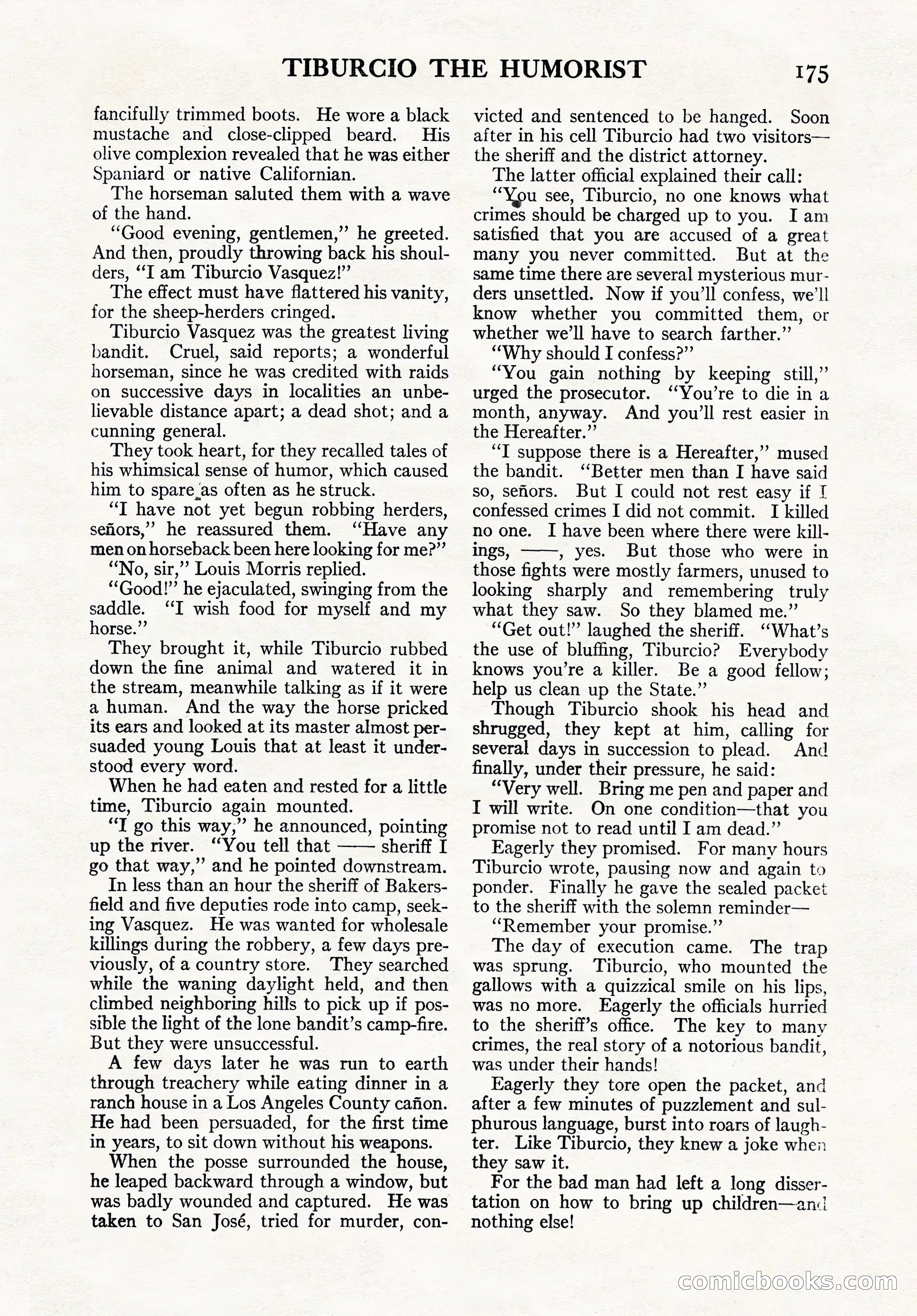
A restored page from Pulp Fiction, 1926. Page through the whole issue in the reader above.
📄 Transcribed text from this page (OCR, searchable)
Machine-transcribed from the original scan — historical spelling and the odd misread are preserved.
TIBURCIO THE HUMORIST fancifully trimmed boots. He wore a black mustache and close-clipped beard. His olive complexion revealed that he was either Spaniard or native Californian. The horseman saluted them with a wave of the hand. “Good evening, gentlemen,” he greeted. And then, proudly throwing back his shoul- ders, “I am Tiburcio Vasquez!”’ The effect must have flattered his vanity, for the sheep-herders cringed. Tiburcio Vasquez was the greatest living bandit. Cruel, said reports; a wonderful horseman, since he was credited with raids on successive days in localities an unbe- lievable distance apart; a dead shot; and a cunning general. They took heart, for they recalled tales of his whimsical sense of humor, which caused him to spare_as often as he struck. “T have not yet begun robbing herders, sefiors,’ he reassured them. ‘Have any men on horseback been here looking for me?” “No, sir,” Louis Morris replied. “Good!” he ejaculated, swinging from the saddle. ‘I wish food for myself and my horse.” They brought it, while Tiburcio rubbed down the fine animal and watered it in the stream, meanwhile talking as if it were a human. And the way the horse pricked its ears and looked at its master almost per- suaded young Louis that at least it under- stood every word. When he had eaten and rested for a little time, Tiburcio again mounted. “T go this way,” he announced, pointing up the river. “You tell that sheriff I go that way,” and he pointed downstream. In less than an hour the sheriff of Bakers- field and five deputies rode into camp, seek- ing Vasquez. He was wanted for wholesale killings during the robbery, a few days pre- viously, of a country store. They searched while the waning daylight held, and then climbed neighboring hills to pick up if pos- sible the light of the lone bandit’s camp-fire. But they were unsuccessful. A few days later he was run to earth through treachery while eating dinner in a ranch house in a Los Angeles County cafion. He had been persuaded, for the first time in years, to sit down without his weapons. When the posse surrounded the house, he leaped backward through a window, but was badly wounded and captured. He was taken to San José, tried for murder, con- 175 victed and sentenced to be hanged. Soon after in his cell Tiburcio had two visitors— the sheriff and the district attorney. The latter official explained their call: “You see, Tiburcio, no one knows what crimes should be charged up to you. I am satisfied that you are accused of a great many you never committed. But at the same time there are several mysterious mur- ders unsettled. Now if you’ll confess, we’ll know whether you committed them, or whether we'll have to search farther.” “Why should I confess?” “You gain nothing by keeping still,” urged the prosecutor. ‘“You’re to die in a month, anyway. And you’ll rest easier in the Hereafter.”’ “TI suppose there is a Hereafter,’’ mused the bandit. ‘Better men than I have said so, sefors. But I could not rest easy if J confessed crimes I did not commit. I killed no one. I have been where there were kill- ings, ——, yes. But those who were in those fights were mostly farmers, unused to looking sharply and remembering truly what they saw. So they blamed me.”’ “Get out!” laughed the sheriff. ‘‘What’s the use of bluffing, Tiburcio? Everybody knows you're a killer. Be a good fellow; help us clean up the State.” Though Tiburcio shook his head and shrugged, they kept at him, calling for several days in succession to plead. And finally, under their pressure, he said: “Very well. Bring me pen and paper and I will write. On one condition—that you promise not to read until I am dead.”’ Eagerly they promised. For many hours Tiburcio wrote, pausing now and again to ponder. Finally he gave the sealed packet to the sheriff with the solemn reminder— ‘“‘Remember your promise.” The day of execution came. The trap was sprung. Tiburcio, who mounted the gallows with a quizzical smile on his lips, was no more. Eagerly the officials hurried to the sheriff’s office. The key to many crimes, the real story of a notorious bandit, was under their hands! Eagerly they tore open the packet, and after a few minutes of puzzlement and sul- phurous language, burst into roars of laugh- ter. Like Tiburcio, they knew a joke when they saw it. For the bad man had left a long disser- tation on how to bring up children—an:! nothing else! DOOLK (C@